

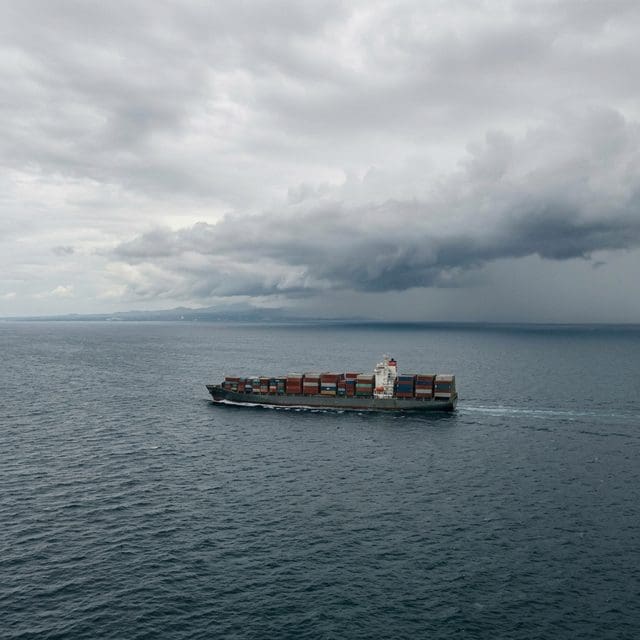
The available reporting offers no confirmed tariff, port or shipping change, while Tropical Storm Cempaka remains far east of the Philippines and Washington signals both strikes and talks with Iran.
The latest scan of trade and supply-chain headlines offers little evidence of a new tariff, trade-deal or port development. That absence matters: without a confirmed policy change or shipping interruption, there is no sound basis to claim that goods are being rerouted, delayed or made more expensive at the border. The clearest logistics-related item is a storm being tracked far offshore from the Philippines—not a reported disruption to cargo movement.
On Nov. 7, the Philippine Atmospheric, Geophysical and Astronomical Services Administration reported that Tropical Storm Cempaka was 2,175 kilometers east of extreme Northern Luzon. The storm had maximum sustained winds of 65 kilometers per hour, gusts up to 80 kilometers per hour and was moving west-northwest at 30 kilometers per hour. PAGASA said it remained outside the Philippine Area of Responsibility.
Those figures describe a weather system’s location and strength; they do not establish that ports, shipping lanes or factories have been affected. The available material reports no port closure, vessel diversion or supply interruption tied to Cempaka. For importers, manufacturers and workers whose livelihoods depend on predictable deliveries, that distinction is essential. A storm may warrant monitoring, but a warning is not evidence that a shipment has stopped.
The broader geopolitical picture is less settled. On Nov. 6, President Donald Trump confirmed new U.S. “minor” strikes on Iranian air-defense systems while saying Washington had made “a lot of progress” in talks with Tehran. U.S. Central Command also offered up to $20 million for information on Iran’s nuclear program. Separately, the supplied baseline says oil prices fell about $8 a barrel on Nov. 4 as traders considered whether the Iran conflict might move toward an end.
That mix of military action, diplomacy and shifting oil-market expectations is relevant to the cost environment for goods that travel long distances. But the reporting provided does not document a resulting change in fuel costs for specific carriers, freight rates, insurance premiums or delivery schedules. Any claim that the latest developments have already altered the price or route of a particular product would go beyond the evidence.
The same evidentiary gap applies to tariffs and manufacturing location. The recent headline scan does not identify a new tariff order, a trade agreement, a port backlog or a factory relocation. Nor does it provide data on import volumes or shipment costs. The prior coverage of a court ruling on broad tariffs and changing shipping rates is a separate story; it does not establish what has happened in the latest 48-hour window.
For now, the practical supply-chain picture is one of watchfulness rather than a confirmed break in the flow of goods. Cempaka is being tracked, but remains outside the Philippines’ monitoring area, and no related shipping impact is reported. Washington’s Iran policy continues to combine pressure with diplomatic language, while oil-market signals have moved in response to hopes of de-escalation. None of those facts, by themselves, shows that a product’s path from origin to shelf has changed.
A useful trade report needs to follow that path: where an item is made, how it moves, what policy applies at the border and whether workers or customers bear a measurable cost. In the material available today, those details are missing. Until a port, carrier, government agency or company reports a specific change, the most accurate account is that no new disruption to trade has been confirmed.

Sean Bradley serves as the Senior Correspondent for Trade, Supply Chains, and Global Labor at Just Right News, where he brings a principled, clear-eyed perspective to the complex systems that power the modern world. With a focus on the economic forces that impact the American household, Bradley has distinguished himself as a leading voice in explaining how global shifts in manufacturing and logistics translate to the kitchen table.
Growing up in Long Beach, California, Bradley’s interest in the movement of goods was forged against the backdrop of one of the nation’s most vital maritime gateways. Raised in a community where the towering cranes of the port were a constant fixture on the horizon, he developed an early appreciation for the blue-collar industries that form the backbone of the American economy. This upbringing instilled in him a profound respect for the dockworkers, truckers, and laborers who keep the country moving, a sentiment that remains a cornerstone of his reporting today. For Bradley, trade is not merely a series of abstract figures on a spreadsheet; it is a human endeavor that sustains families and defines the strength of a nation.
Now based in Seattle, Washington, Bradley occupies a strategic vantage point in another of the country’s most significant trade hubs. His location allows him to witness firsthand the intersection of traditional industry and the evolving technological landscape of global logistics. From the Pacific Northwest, he monitors the flow of goods across the ocean, providing Just Right News readers with timely insights into how international tensions, regulatory hurdles, and labor disputes affect the availability and cost of essential goods.
His signature feature series, “The Journey of Things,” has become a staple for readers seeking to understand the intricate path products take from raw materials to the retail shelf. Through this series, Bradley pulls back the curtain on the global marketplace, often highlighting the risks of over-reliance on foreign adversaries and the importance of domestic manufacturing resilience. His reporting consistently emphasizes the conservative values of national sovereignty, free-market competition, and the protection of the American worker from unfair global practices.
As a journalist of Irish heritage, Bradley maintains a deep-seated respect for the dignity of the individual worker and the importance of community stability. He approaches his beat with a commitment to transparency, often questioning the status quo of globalist policies that prioritize corporate efficiency over local prosperity. Whether he is reporting from a warehouse floor or analyzing a new international trade agreement, his goal remains the same: to provide the American public with the truth about where their products come from and what it costs to get them there.
Throughout his tenure at Just Right News, Bradley has remained a steadfast advocate for economic common sense. His work serves as a vital resource for those who believe that a strong nation is built on secure borders, robust trade, and a respected workforce. By combining his local roots in Long Beach with his professional experience in Seattle, Bradley continues to offer a unique and necessary perspective on the forces that shape the American way of life.