

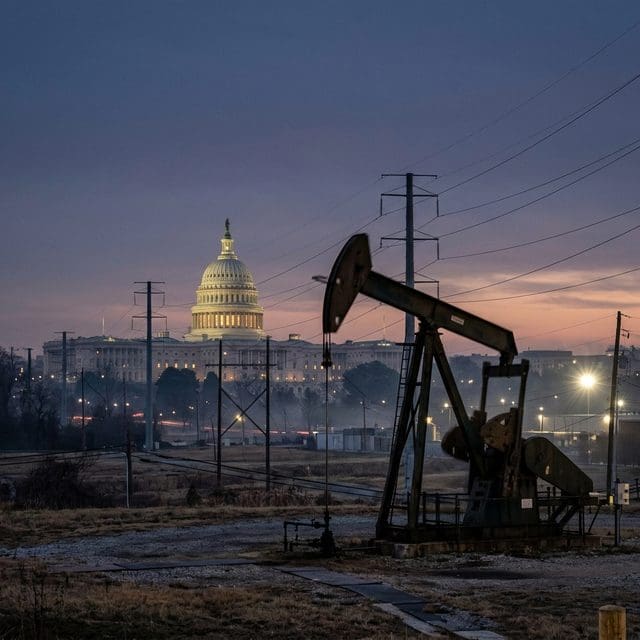
Democratic control of Congress could intensify oversight of the Trump administration’s emissions agenda, while Suncor’s results show the cash still generated by oil production.
Democrats’ wins in the U.S. midterm elections are set to make energy policy a more contested issue in Washington, with potential consequences for emissions rules, oil-and-gas development and compliance costs. Reuters reported November 4 that Democrats won control of both the House and Senate, opening the way for tougher oversight of President Donald Trump’s rollbacks and possible use of the Congressional Review Act against rules facilitating sales of gas-powered trucks and SUVs.
The election does not itself change regulations or guarantee that Congress will reverse the administration’s actions. It does raise the likelihood of investigations and legislative fights. Euronews reported that Democrats may examine drilling approvals, fossil-fuel subsidies, methane policy, agency staffing and environmental enforcement, as well as the dismantling of climate measures. The reporting identifies areas of possible scrutiny, not specific findings of misconduct or a completed legislative plan.
For energy companies, the immediate effect may be uncertainty more than a change in production or costs. Oversight could expose how decisions were made, while attempts to undo rules may create planning risk for businesses weighing long-lived investments. The reporting describes possible avenues, not enacted policy; any congressional action would face procedural and political constraints. The exact impact would depend on which rules lawmakers target and whether proposed action survives the legislative process.
The competing economic stakes are concrete. Looser emissions requirements can reduce compliance costs for some businesses and preserve consumer choice in conventional vehicles and fuels. Tighter standards can encourage cleaner technology and reduce emissions, but may add costs or require changes to products and infrastructure. Affordability and reliability depend on the details, including the pace of change, available alternatives and whether the grid can serve new demand. A policy shift may affect investment calculations well before it changes the amount of fuel consumed or emissions released.
Oil producer Suncor Energy offered a snapshot of the industry’s current earning power. It reported third-quarter net earnings of $3.814 billion, adjusted funds from operations of $6.705 billion and free funds flow of $5.196 billion on November 3. Those measures are not interchangeable: earnings reflect accounting results, while funds-flow measures describe cash generated under the company’s reporting definitions. Together, the figures show substantial cash generation in the quarter, but do not establish future earnings or how much can be sustained as prices and operating conditions change.
Suncor also agreed to sell offshore interests in Terra Nova, White Rose and West White Rose for $1.2 billion, plus a contingent payment of up to $350 million. Closing is expected in early 2027, subject to approvals and other conditions. The available information does not say how Suncor will use the proceeds or how the sale will affect overall output, so the deal alone cannot be read as a broad retreat from oil production. The contingent portion also means the maximum stated value is not necessarily the amount ultimately received.
Total Energy Services announced a normal-course issuer bid that began October 21 and runs through October 20, 2027, according to the company’s website. Such an authorization permits a company to repurchase shares within specified terms; the announcement does not establish how many shares will be bought. A separate report anticipated quarterly results on November 11, but the supplied material does not establish the results or provide a verified basis for an earnings forecast. The buyback authorization alone says little about future spending or demand for energy services.
SolarEdge Technologies appeared in reports of unusually high share trading after better-than-expected quarterly earnings. The supplied material does not include the underlying financial results or enough detail to assess the company’s performance, the reason for the trading activity or the solar equipment outlook. No materially new, source-supported development for Shell was identified, so the available reporting does not support a broader comparison of the two companies or a conclusion about renewables-market conditions.
The available evidence points to a tougher political environment for the administration’s energy agenda and an oil sector still generating substantial cash. It does not settle the larger questions of prices, grid reliability or emissions. Those outcomes will depend on policy decisions and market conditions that remain unresolved.

Mark Davis serves as the Senior Correspondent for Energy, Climate, and Resource Economics at Just Right News. In an era where the conversation around the environment is often dominated by alarmism and top-down mandates, Mark provides a vital, market-oriented perspective on the complex forces shaping our world. As the lead voice behind the acclaimed feature series “Power and the Planet,” he explores the intersection of environmental policy, global energy markets, and the fundamental economic principles that sustain modern civilization.
Mark’s pragmatic approach to resource management was forged in the high desert of his hometown, Albuquerque, New Mexico. Growing up in a region defined by both its breathtaking natural beauty and its rugged, resource-dependent landscape, he developed an early appreciation for the delicate balance between conservation and utilization. New Mexico’s unique position as a hub for both traditional energy production and cutting-edge scientific research provided Mark with a front-row seat to the evolution of the American energy sector. This upbringing instilled in him a deep-seated belief that true environmental stewardship is inseparable from economic prosperity and technological innovation.
Now based in Boulder, Colorado, Mark operates from the heart of the nation’s climate research community. While Boulder is often seen as a bastion of environmental idealism, Mark utilizes his post to provide a necessary counterweight, grounded in the realities of resource economics. He understands that energy policy does not exist in a vacuum; it has tangible consequences for the American taxpayer, the stability of the national power grid, and the strength of the domestic manufacturing sector. By reporting from the front lines of the climate debate, he is able to challenge prevailing narratives with hard data and a commitment to the principles of the free market.
Throughout his tenure at Just Right News, Mark has distinguished himself by focusing on the “Resource Economics” aspect of his beat. He frequently highlights the hidden costs of rapid energy transitions and advocates for an “all-of-the-above” energy strategy that prioritizes American energy independence. His work often shines a light on the geopolitical implications of resource scarcity, arguing that a secure nation must first be an energy-secure nation. Whether he is analyzing the impact of federal land-use regulations or investigating the supply chains required for new technologies, Mark remains focused on how policy decisions affect the lives and livelihoods of everyday citizens.
In “Power and the Planet,” Mark continues to bridge the gap between complex scientific concepts and the economic realities facing the country. He rejects the false choice between a healthy environment and a thriving economy, instead seeking out solutions that leverage American ingenuity and private-sector competition. For Mark, reporting on the climate is not about following the latest trends, but about ensuring that the conversation remains tethered to the foundational values of liberty, property rights, and fiscal responsibility. His contributions ensure that Just Right News readers receive a comprehensive, clear-eyed view of the challenges and opportunities defining the future of our planet.