

President Trump has called for Mary Peltola to be barred from Alaska’s Senate race after a report alleged that a Democratic operative helped recruit a candidate named Daniel J. Sullivan, who shares the incumbent senator’s first and last name. Peltola’s campaign and the Democratic Senatorial Campaign Committee deny involvement, while Daniel J. Sullivan says he is genuinely running. The Alaska Supreme Court ruled that he may remain on the ballot after state officials tried to exclude him. The Justice Department has sued to prevent certification if Sen. Dan Sullivan loses because of voter confusion, but no ruling on that lawsuit is described. The ballot lists four candidates and lets voters rank their choices.
TLDR: The Alaska Senate contest includes two candidates with the same first and last name, prompting accusations, denials, and a federal lawsuit. The state’s highest court has allowed both candidates to remain on the ballot, while certification could face legal review under the Justice Department’s request.
President Donald Trump said Mary Peltola should not be allowed to run in next week’s Alaska Senate election, after a report alleged that people aligned with her campaign helped recruit a candidate named Daniel J. Sullivan. The candidate shares the first and last name of Republican Sen. Dan Sullivan, Peltola’s main opponent. Trump called the matter election fraud, but the reported allegation has not been established as a legal finding against Peltola or her campaign.
The stated rationale for scrutiny is the possibility that voters could confuse the two candidates with the same first and last name. Attorney General Todd Blanche described the Justice Department lawsuit as an effort to put guardrails in place. That is a practical concern in a close race, but it does not by itself resolve who recruited Daniel J. Sullivan or whether any conduct violated election law.
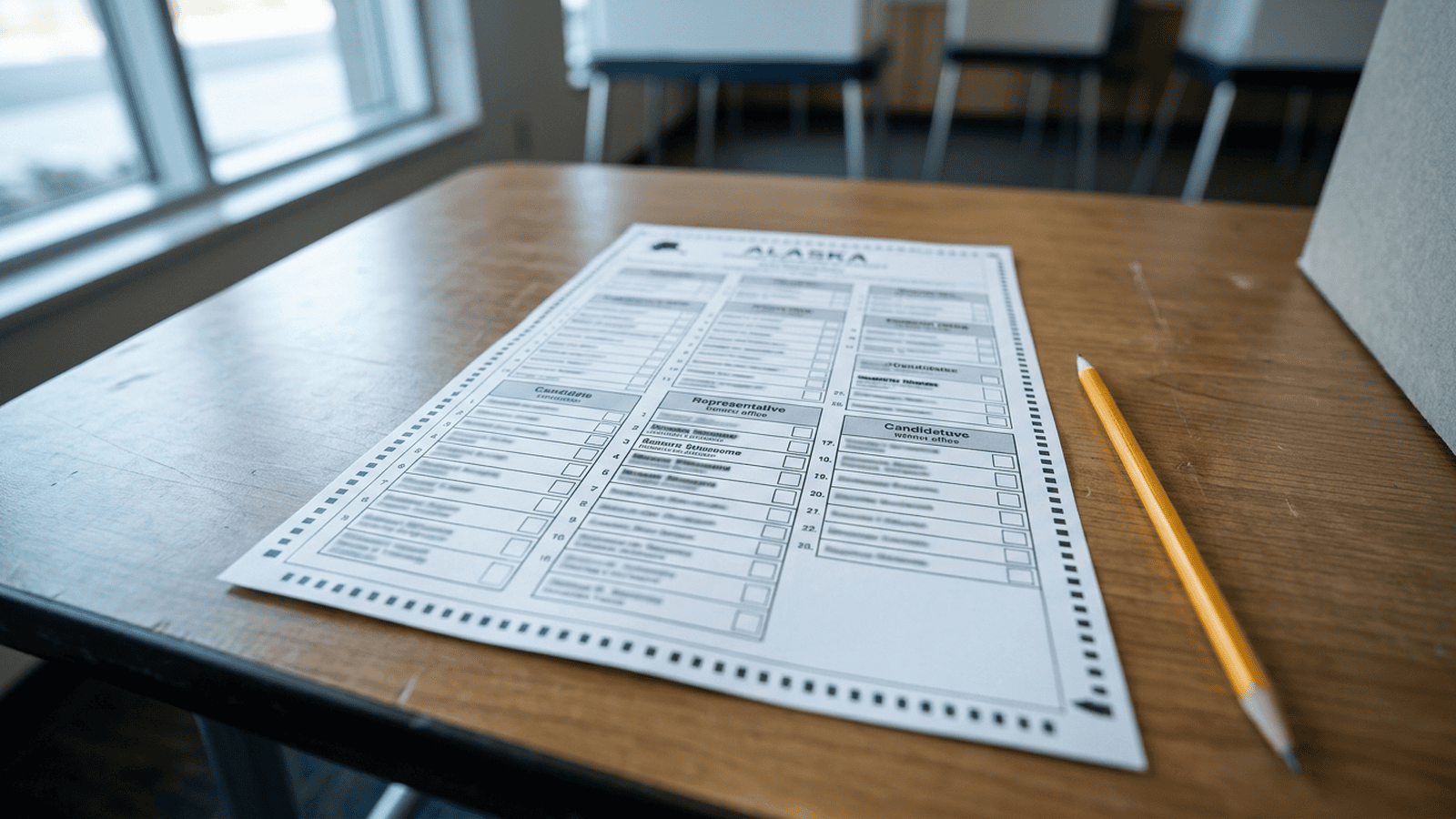
Alaskans are choosing among four candidates who advanced through a nonpartisan primary earlier this year. The ballot allows voters to rank candidates rather than select only one. It identifies Sen. Dan Sullivan as a Republican and incumbent, while Daniel J. Sullivan Jr. has no party affiliation listed. The different middle initial and suffix provide a distinction, though the shared first and last names have become the focus of the dispute.
The New York Times reported Wednesday that a Democratic operative who worked with Peltola’s campaign and national Democrats helped encourage Daniel J. Sullivan to enter the race. The newspaper cited text messages and interviews and said the effort appeared to be part of a wider push to draw more candidates into the contest. The report is evidence described by the newspaper, not a court ruling that Peltola directed or approved the recruitment.
Peltola’s campaign and the Democratic Senatorial Campaign Committee have denied involvement in getting Daniel J. Sullivan on the ballot. A campaign spokesperson said the campaign had no involvement with either Sullivan campaign. A DSCC spokesperson likewise said the organization was not involved with Dan J. Sullivan. The denials stand alongside the Times’ reporting and Trump’s accusations, leaving key questions about the alleged recruitment unresolved in the material available so far.
Daniel J. Sullivan has rejected claims that he is a sham candidate and said he is genuinely interested in running for the Senate. Sen. Dan Sullivan has described the challenger as a sham candidate trying to trick voters. Those opposing accounts matter because the candidate’s intent is central to the dispute over whether his candidacy is legitimate or designed to affect the incumbent’s vote.
State officials initially tried to keep Daniel J. Sullivan off the ballot. They found that he was trying to confuse voters and argued that his candidacy was not made in good faith. The Alaska Supreme Court rejected that decision and ruled that he could appear on the ballot. That ruling is a significant legal limit on efforts to remove him from the contest, even as questions about political involvement continue.
The Justice Department filed a lawsuit last week seeking to prevent certification of the election if Sen. Dan Sullivan loses because of voter confusion involving the two Sullivans. The filing does not establish that confusion changed the result, and the excerpt provides no court decision on the lawsuit. Trump said he had directed the department to bring it. The case places certification under possible legal review if the specified outcome occurs.
The practical effects are clear in some respects and unspecified in others. Voters will face a ranked ballot listing four candidates, including two whose names share the same first and last name; the incumbent is marked as a Republican and sitting senator, while Daniel J. Sullivan Jr. has no party affiliation listed. The Justice Department’s suit could delay certification if Sen. Dan Sullivan loses because of voter confusion. The excerpt identifies no new fees, voter forms, compliance requirements, or specific court deadline, so those details remain unknown.
The dispute also puts a basic tension in view: election officials first sought to limit ballot access, while the state’s highest court ordered that the candidate remain eligible. The Justice Department is now seeking a condition on certification tied to a possible confusion-based result. That approach may add legal review and uncertainty after voting, while leaving the candidate on the ballot. Those are real consequences of the current process, not proof of either side’s claims.
The next steps are the election and any further action in the Justice Department case. The lawsuit’s request concerns certification only if Sen. Dan Sullivan loses due to voter confusion; the excerpt does not say when a court will rule or what evidence it will require. Those proceedings are necessary steps in resolving the legal dispute, and the court’s review—not campaign accusations—will determine what follows.

Mark Davis serves as the Senior Correspondent for Energy, Climate, and Resource Economics at Just Right News. In an era where the conversation around the environment is often dominated by alarmism and top-down mandates, Mark provides a vital, market-oriented perspective on the complex forces shaping our world. As the lead voice behind the acclaimed feature series “Power and the Planet,” he explores the intersection of environmental policy, global energy markets, and the fundamental economic principles that sustain modern civilization.
Mark’s pragmatic approach to resource management was forged in the high desert of his hometown, Albuquerque, New Mexico. Growing up in a region defined by both its breathtaking natural beauty and its rugged, resource-dependent landscape, he developed an early appreciation for the delicate balance between conservation and utilization. New Mexico’s unique position as a hub for both traditional energy production and cutting-edge scientific research provided Mark with a front-row seat to the evolution of the American energy sector. This upbringing instilled in him a deep-seated belief that true environmental stewardship is inseparable from economic prosperity and technological innovation.
Now based in Boulder, Colorado, Mark operates from the heart of the nation’s climate research community. While Boulder is often seen as a bastion of environmental idealism, Mark utilizes his post to provide a necessary counterweight, grounded in the realities of resource economics. He understands that energy policy does not exist in a vacuum; it has tangible consequences for the American taxpayer, the stability of the national power grid, and the strength of the domestic manufacturing sector. By reporting from the front lines of the climate debate, he is able to challenge prevailing narratives with hard data and a commitment to the principles of the free market.
Throughout his tenure at Just Right News, Mark has distinguished himself by focusing on the “Resource Economics” aspect of his beat. He frequently highlights the hidden costs of rapid energy transitions and advocates for an “all-of-the-above” energy strategy that prioritizes American energy independence. His work often shines a light on the geopolitical implications of resource scarcity, arguing that a secure nation must first be an energy-secure nation. Whether he is analyzing the impact of federal land-use regulations or investigating the supply chains required for new technologies, Mark remains focused on how policy decisions affect the lives and livelihoods of everyday citizens.
In “Power and the Planet,” Mark continues to bridge the gap between complex scientific concepts and the economic realities facing the country. He rejects the false choice between a healthy environment and a thriving economy, instead seeking out solutions that leverage American ingenuity and private-sector competition. For Mark, reporting on the climate is not about following the latest trends, but about ensuring that the conversation remains tethered to the foundational values of liberty, property rights, and fiscal responsibility. His contributions ensure that Just Right News readers receive a comprehensive, clear-eyed view of the challenges and opportunities defining the future of our planet.