

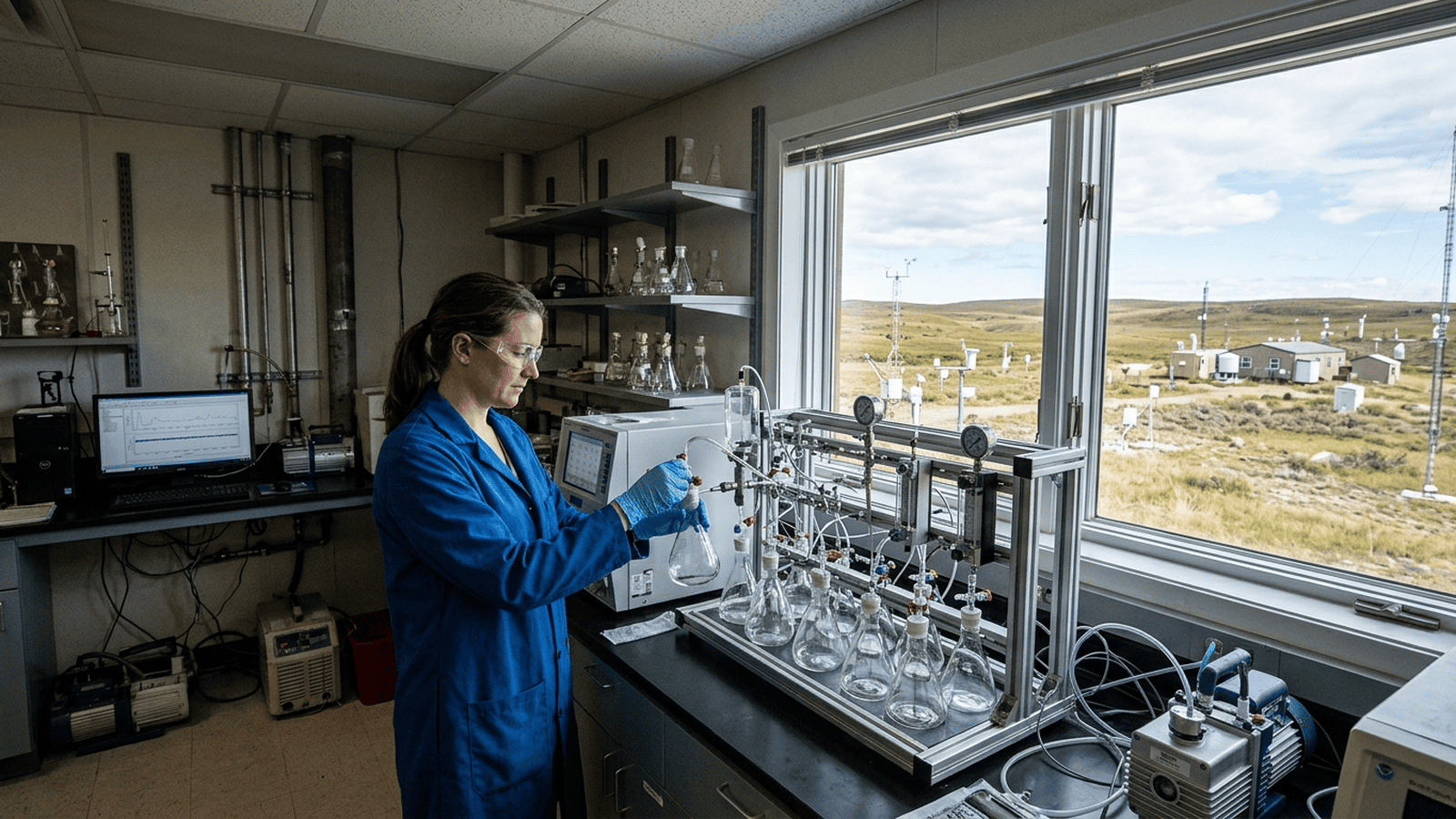
NOAA’s Global Monitoring Laboratory found that atmospheric methane rose by 17 parts per billion in 2021, the largest annual increase in its monitoring record dating to 1983. The measurements show the scale of the rise, but identifying the contributions from wetlands, fossil fuels and other sources requires further research.
TLDR: NOAA scientists found that global atmospheric methane increased by a record 17 parts per billion in 2021. The measurement confirms a rapid rise in a potent greenhouse gas, but it does not pinpoint the cause. Continued monitoring and source studies can help identify where reductions would have the greatest impact.
Atmospheric methane climbed by a record amount in 2021, according to measurements analyzed by scientists at the National Oceanic and Atmospheric Administration. The concentration rose by 17 parts per billion, the largest annual increase since NOAA’s monitoring record began in 1983. The finding adds to evidence that a powerful heat-trapping gas is accumulating rapidly in the atmosphere, even as scientists work to identify the precise mix of sources behind each year’s jump.
NOAA’s Global Monitoring Laboratory tracks greenhouse gases using air samples collected at sites around the world. Researchers combine those observations to estimate global average concentrations, rather than relying on readings from a single location. Long-running, standardized sampling helps distinguish a sustained global trend from local swings caused by weather or nearby emissions. The measurements show methane continued a sharp rise that began in 2007, following a relatively stable period in the early 2000s. The 2021 increase exceeded the previous record, set in 2020, when concentrations grew by about 15.3 parts per billion.
Methane is the second-largest contributor to human-caused warming after carbon dioxide, but it behaves differently in the atmosphere. A methane molecule traps substantially more heat than a carbon dioxide molecule over a period of decades, while remaining in the air for a shorter time. That shorter lifetime means cutting emissions can slow warming relatively quickly. Methane also contributes to the formation of ground-level ozone, which harms human health and crops.
The NOAA measurements establish how much methane accumulated, but they do not by themselves identify every source. Methane comes from natural wetlands as well as human activities, including livestock, landfills, rice cultivation, fossil-fuel production and transport. Microbes generate methane in oxygen-poor environments, while leaks from oil and gas infrastructure can release it directly. Distinguishing these contributions requires additional evidence, including atmospheric chemistry, satellite observations and measurements near emission sources. Satellite and aircraft data can complement surface samples by revealing regional patterns, although translating concentrations into source estimates remains challenging.
Scientists have proposed several explanations for the recent increases. Wetland emissions may rise with changing rainfall and temperatures, and fossil-fuel operations remain a controllable source. The concentration jump in 2020 and 2021 also coincided with changes in atmospheric chemistry: lower emissions of some pollutants may have reduced the abundance of hydroxyl radicals, which naturally remove methane from the air. Hydroxyl radicals act as an atmospheric sink, so changes in their abundance can alter methane’s lifetime as well as emissions. Research published after NOAA’s announcement examined this possibility, but the record increase cannot be assigned to one cause from the monitoring data alone.
NOAA reported that methane averaged about 1,895.7 parts per billion in the global atmosphere in 2021, compared with roughly 1,889 parts per billion in 2020. The gas is present at far lower concentrations than carbon dioxide, yet its warming influence makes its rapid growth important. NOAA also reported that carbon dioxide and nitrous oxide continued to increase, underscoring that the broader greenhouse-gas trend was not limited to methane.
The findings matter for climate policy because methane cuts can deliver near-term benefits, but effective action depends on locating emissions and verifying reductions. Governments and researchers are expanding monitoring through aircraft, satellites and ground-based instruments, while improving methods for separating human and natural sources. NOAA’s continuing measurements will show whether the extraordinary annual increases persist and help test explanations for them. Better source attribution could guide targeted reductions across energy, agriculture and waste, while sustained observation will be essential for judging whether those efforts change the atmospheric trend.

Mark Davis serves as the Senior Correspondent for Energy, Climate, and Resource Economics at Just Right News. In an era where the conversation around the environment is often dominated by alarmism and top-down mandates, Mark provides a vital, market-oriented perspective on the complex forces shaping our world. As the lead voice behind the acclaimed feature series “Power and the Planet,” he explores the intersection of environmental policy, global energy markets, and the fundamental economic principles that sustain modern civilization.
Mark’s pragmatic approach to resource management was forged in the high desert of his hometown, Albuquerque, New Mexico. Growing up in a region defined by both its breathtaking natural beauty and its rugged, resource-dependent landscape, he developed an early appreciation for the delicate balance between conservation and utilization. New Mexico’s unique position as a hub for both traditional energy production and cutting-edge scientific research provided Mark with a front-row seat to the evolution of the American energy sector. This upbringing instilled in him a deep-seated belief that true environmental stewardship is inseparable from economic prosperity and technological innovation.
Now based in Boulder, Colorado, Mark operates from the heart of the nation’s climate research community. While Boulder is often seen as a bastion of environmental idealism, Mark utilizes his post to provide a necessary counterweight, grounded in the realities of resource economics. He understands that energy policy does not exist in a vacuum; it has tangible consequences for the American taxpayer, the stability of the national power grid, and the strength of the domestic manufacturing sector. By reporting from the front lines of the climate debate, he is able to challenge prevailing narratives with hard data and a commitment to the principles of the free market.
Throughout his tenure at Just Right News, Mark has distinguished himself by focusing on the “Resource Economics” aspect of his beat. He frequently highlights the hidden costs of rapid energy transitions and advocates for an “all-of-the-above” energy strategy that prioritizes American energy independence. His work often shines a light on the geopolitical implications of resource scarcity, arguing that a secure nation must first be an energy-secure nation. Whether he is analyzing the impact of federal land-use regulations or investigating the supply chains required for new technologies, Mark remains focused on how policy decisions affect the lives and livelihoods of everyday citizens.
In “Power and the Planet,” Mark continues to bridge the gap between complex scientific concepts and the economic realities facing the country. He rejects the false choice between a healthy environment and a thriving economy, instead seeking out solutions that leverage American ingenuity and private-sector competition. For Mark, reporting on the climate is not about following the latest trends, but about ensuring that the conversation remains tethered to the foundational values of liberty, property rights, and fiscal responsibility. His contributions ensure that Just Right News readers receive a comprehensive, clear-eyed view of the challenges and opportunities defining the future of our planet.