

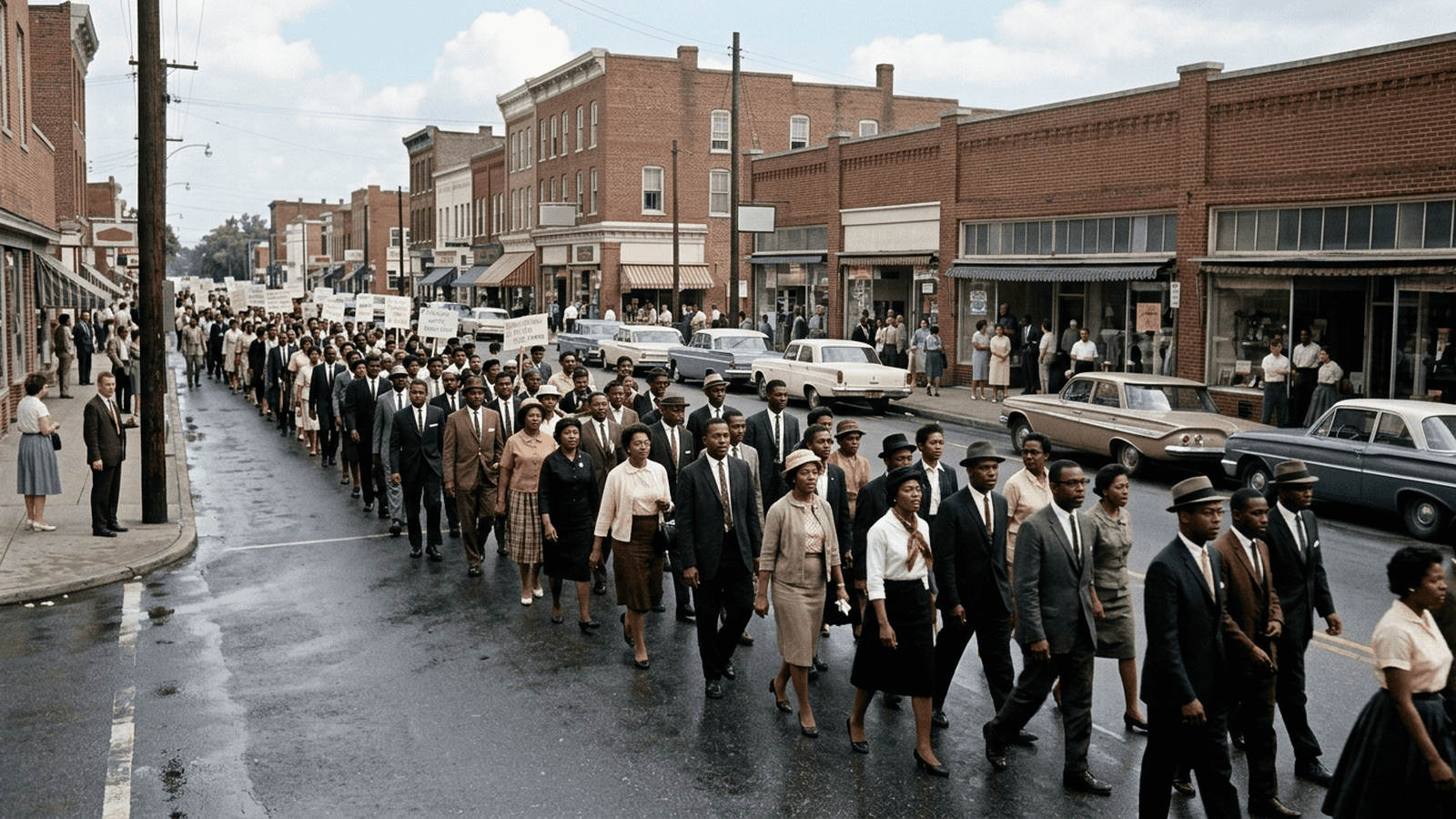
In 1963, Black residents of Cambridge, Maryland, organized against segregation and discrimination, bringing state and federal officials into a tense local struggle. The Treaty of Cambridge offered a negotiated path forward, but a referendum defeat and the need for federal civil rights laws revealed the limits of agreements without enforceable protections in the United States.
TLDR: Cambridge, Maryland, became a civil rights flashpoint in 1963 as Black residents challenged segregation and discrimination. State and federal officials helped negotiate the Treaty of Cambridge, but voters later rejected a fair-housing measure. The struggle exposed the limits of local agreements and highlighted the need for enforceable federal protections.
In the summer of 1963, a small Maryland city became a national test of whether civil rights agreements could end segregation without resolving the inequalities beneath it. In Cambridge, on the Eastern Shore, Black residents challenged segregated public facilities, discrimination in housing and jobs, and the political power that kept those conditions in place. Their campaign drew state and federal officials, National Guard troops, and news coverage to a community far from the Deep South but bound by many of the same barriers. The Eastern Shore setting challenged the assumption that entrenched segregation was confined to states farther south.
The movement had grown over several years. In 1961, local activists, including Gloria Richardson, helped lead demonstrations through the Cambridge Nonviolent Action Committee, an affiliate of the Student Nonviolent Coordinating Committee. Protesters sought equal access to restaurants, theaters, public facilities, and employment. White resistance and arrests followed. By 1963, demonstrations and clashes had intensified, and the city’s disputes had become part of the wider national civil rights crisis. The committee used nonviolent protest, direct action, and local organizing to keep the issue visible when conventional channels brought little progress.
Cambridge’s conflict was not only about separate counters or waiting rooms. Black residents faced exclusion from many neighborhoods and unequal opportunities, while the city’s white-controlled institutions resisted demands for change. Richardson, a forceful local organizer, insisted that negotiations address structural conditions, not simply the reopening of individual businesses. Her leadership gave the movement a prominent voice, though Black residents’ organizing extended well beyond any one figure.
In June 1963, after violence escalated, Maryland Governor J. Millard Tawes sent the National Guard to Cambridge. Guardsmen patrolled streets and helped enforce a state-imposed curfew. The deployment brought order of a kind, but it also underscored how far local authorities had failed to settle the underlying conflict. The presence of troops could suppress street confrontations, but could not itself compel private businesses or landlords to change their practices. Federal officials joined negotiations, and U.S. Attorney General Robert F. Kennedy dispatched assistant attorney general Burke Marshall to help mediate.
On July 11, representatives of the city, civil rights groups, and government reached what became known as the Treaty of Cambridge. The agreement provided for desegregation of public accommodations and called for action on housing and employment discrimination. It temporarily eased tensions and offered a framework for change, but its terms depended on implementation and public support. The deal did not erase distrust, nor did it resolve every dispute over the pace and scope of integration.
The agreement’s limits became clear when opponents sought a referendum on Cambridge’s fair-housing ordinance. In November 1963, voters rejected the measure, demonstrating that a negotiated commitment could be vulnerable to organized opposition. The result also exposed the gap between officials’ promises and enforceable protections. Activists continued pressing for change, while the city remained a focal point for debate over how civil rights could be secured in communities outside the South’s most familiar headlines.
Federal law eventually changed the terrain. The Civil Rights Act of 1964 prohibited discrimination in public accommodations and strengthened federal authority, while the Fair Housing Act of 1968 later addressed discrimination in housing. Those laws did not automatically end local exclusion, but they gave residents and federal authorities tools that the Treaty alone could not provide. Cambridge’s struggle showed both the importance of local organizing and the weakness of voluntary agreements without durable enforcement. Its legacy belongs to a broader civil rights history in which protest, negotiation, public oversight, and federal legislation repeatedly reshaped the boundaries of equality.

Ethan Blake serves as a Senior Correspondent for Just Right News, where he specializes in Longform Narrative and Public Understanding. In an era of rapid-fire headlines and fleeting soundbites, Ethan’s work stands as a testament to the power of deep-dive reporting and the importance of contextualizing the complex issues facing the nation today. His approach is rooted in the belief that the most profound truths are often found in the lived experiences of individuals rather than the abstract theories of distant policymakers.
Growing up in Providence, Rhode Island, Ethan developed an early appreciation for the historical and cultural threads that weave the American fabric together. Providence, a city defined by its industrial heritage and its blend of traditional neighborhoods, provided him with a front-row seat to the challenges and triumphs of the American working class. This upbringing instilled in him a respect for the “common sense” values of hard work, community loyalty, and the preservation of local institutions. He learned early on that behind every economic statistic or legislative debate, there are real families and neighborhoods navigating the consequences of change.
This foundational perspective is the driving force behind his signature feature series, “Lives Behind the Systems.” Through this series, Ethan explores the intersection of individual agency and institutional structure. Whether he is documenting the impact of federal land-use policies on rural families or examining how shifting educational standards affect local school boards, Ethan’s work prioritizes the human element. He seeks to uncover how large-scale systems—be they governmental, economic, or social—affect the daily lives of citizens, often advocating for a return to local control and personal responsibility.
Now based in Portland, Maine, Ethan draws significant inspiration from the rugged independence and self-reliance that define the region. The coastal landscape and the resilient spirit of Maine’s communities serve as a constant reminder of the importance of individual liberty and the strength found in decentralized power. Living and working outside the traditional media hubs allows Ethan to maintain a grounded perspective, ensuring his reporting remains untethered from the echo chambers of the major metropolitan centers. This geographic distance provides him with the clarity needed to translate complex national narratives into stories that resonate with the heart of the country.
At Just Right News, Ethan’s beat is more than just a professional assignment; it is a mission to foster a more informed and engaged citizenry. He believes that a free society depends on the public’s ability to understand the mechanisms of power and the value of traditional American principles. His longform narratives do not merely report the news; they provide a roadmap for understanding the cultural and political shifts of the modern era through a lens of skepticism toward centralized authority and a deep respect for the individual.
Through his meticulous research and narrative craftsmanship, Ethan Blake continues to bridge the gap between policy and the public. His work remains a vital resource for those who seek a deeper understanding of the systems that shape our world and the enduring spirit of the people who live within them.