

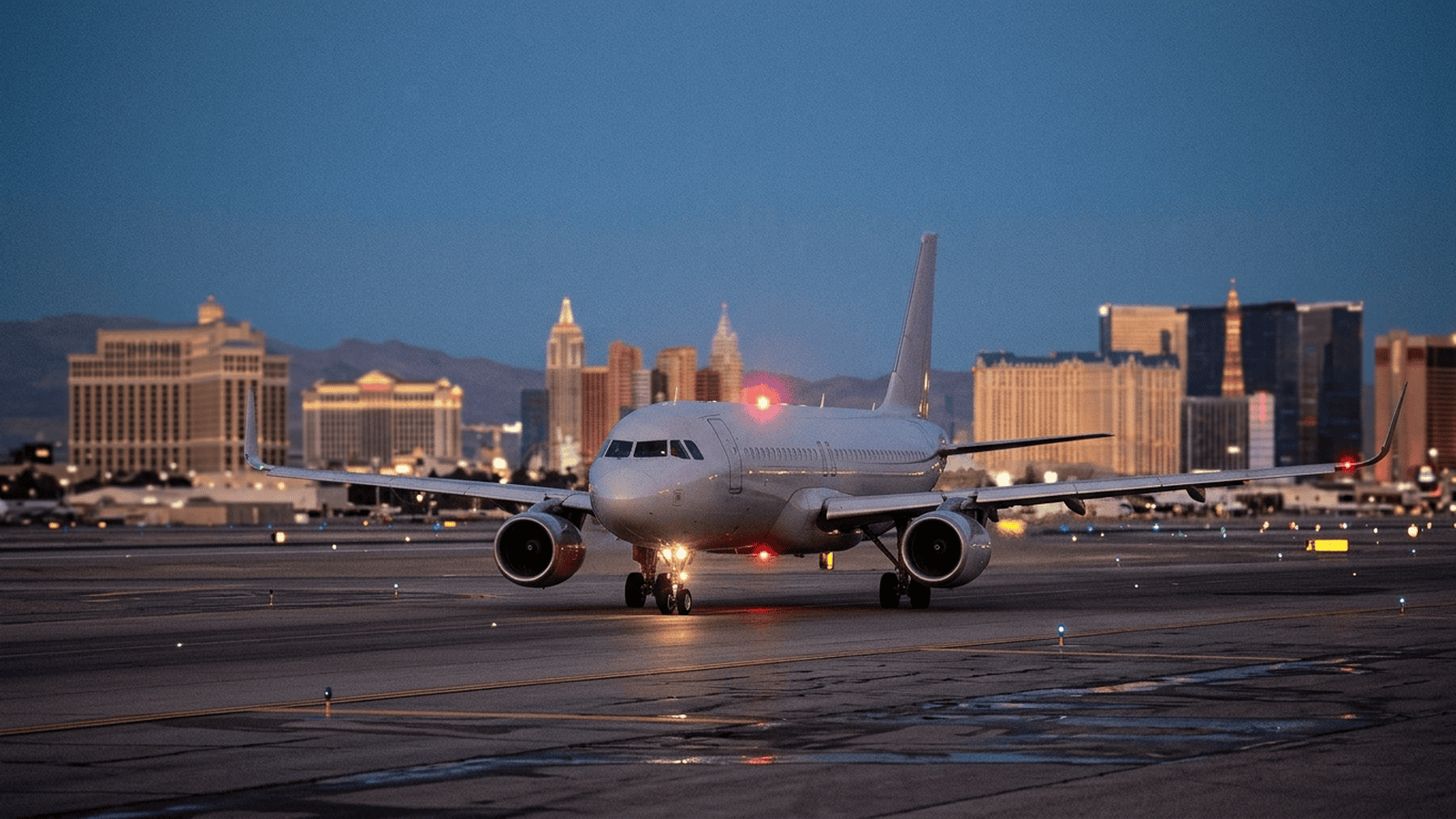
A United flight headed from Las Vegas to Newark returned shortly after takeoff after a flight attendant saw a passenger’s message about hijacking and crashing the plane, according to a police report. The captain was notified after the aircraft passed 10,000 feet, and the pilot informed air traffic control that the plane would return. Passenger Dante Milne was taken into custody and charged with making a threat or offering false information in reference to terrorism. He told officers the message was co-worker banter, denied intending harm, and plans to plead not guilty, his attorney said. The report gives no court date or further compliance deadline, and the case remains unresolved.
TLDR: A United flight returned to Las Vegas after a crew member reported a passenger’s text about hijacking and crashing the plane. The passenger was arrested and charged, but denies intending harm and plans to plead not guilty.
A United flight bound for Newark returned to Las Vegas shortly after takeoff Saturday night after a flight attendant saw a passenger’s text about hijacking the aircraft, according to a police report. The passenger, Dante Milne, 25, was taken into custody after the plane landed. He told officers the message was banter with a co-worker and denied intending to hijack the plane or harm anyone, the report said.
The rationale for the crew’s response was straightforward: a message describing a hijacking and a crash could not safely be treated as a joke while the aircraft was in flight. The report said the captain was notified after the plane passed 10,000 feet, consistent with sterile flight deck procedures. The flight then returned to Las Vegas.
The episode shows how a few words exchanged privately can carry consequences in a shared, high-stakes setting. A passenger may view a message as workplace banter, but crew members who see language about hijacking have to consider the safety of everyone aboard. The diversion disrupted the flight, while the response put the reported threat in the hands of the crew and police.
According to the police report, a flight attendant first noticed two passengers exchanging messages during boarding. Those texts included derogatory remarks about other passengers and attendants, the report said. Later, the attendant saw an incoming message beginning with “I’m gonna hijack” and notified the lead flight attendant.
Police said the complete message stated that the sender would hijack the plane and crash “ur row only,” with an expletive used in place of the word “plane.” The report identified Milne as the sender. After the aircraft passed 10,000 feet, the captain was informed. A recording posted on an air traffic control app captured the pilot telling a controller that a flight attendant had reported the message and that the aircraft would return to Las Vegas.
Milne told officers he had been in Las Vegas for a three-day apprenticeship training program connected to his work as an underwater welder. He said he had consumed beer and shots at an airport bar and planned to sleep during the flight. According to the report, he said he was asleep when he woke and learned the plane was returning to Las Vegas.
He acknowledged exchanging texts with the other passenger, whom he had met at the training program, but initially said he could not recall what the messages contained, the report said. When asked about the hijacking message, Milne described its wording as poorly stated and characterized the exchange as banter between co-workers. He denied intending to hijack or crash the plane or hurt anyone.
Those statements are his account, as recorded by police, and do not resolve the charge. Milne was charged with making a threat or offering false information in reference to an act of terrorism. His attorney, James Gallo, told The Associated Press that he was still evaluating the case and that Milne plans to plead not guilty. The reported charge and planned plea are part of a legal process, not a finding of guilt.
The incident also fits a pattern of aviation responses to threat-related jokes. In 2022, a man was arrested in Chicago after joking about having a bomb while checking a bag. In 2017, a Turkish Airlines flight was diverted after someone renamed a Wi-Fi hotspot “bomb on board.” An Allegiant Air flight made an emergency landing last summer after a passenger told another traveler that his laptop was a bomb. Making that kind of joke can be a felony in most jurisdictions, according to the report.
The industry is likely on heightened alert after authorities said less than a month ago that a co-pilot on a FlyDubai flight attacked the captain with an axe and tried to crash the plane before passengers intervened. That separate event does not establish what Milne intended. It does help explain why flight crews treat reports of threats as matters requiring immediate attention rather than casual interpretation.
The practical impact in this case was a return to Las Vegas, Milne’s arrest, and a criminal charge. The directly affected passengers faced a diverted flight, while the flight crew and police responded to the reported message. The excerpt gives no information about fees, compensation, additional forms, or a court date. It also sets no new rule or deadline; the captain’s notification followed the stated flight procedure, and no further compliance schedule is reported.
The next steps are the legal process and any further review of the reported incident. Milne’s attorney says he plans to plead not guilty, and the case remains unresolved. The return and arrest were concrete consequences of the crew’s response, while the charge will be addressed through the process described in the report.

Tom Blake serves as the Senior Correspondent for Labor, Wages, and Automation at Just Right News, where he brings a grounded, principled perspective to the most pressing economic issues facing the American heartland. As the lead voice behind the acclaimed feature series “The Price of Work,” Tom focuses his reporting on the intersection of traditional industry and the rapidly evolving technological landscape, always prioritizing the dignity of the individual worker and the health of the American family.
Tom’s deep understanding of the labor market is not merely academic; it is rooted in his upbringing in Detroit, Michigan. Growing up in the shadow of the automotive industry, he witnessed firsthand the triumphs and tribulations of the American blue-collar workforce. He saw how the stability of a manufacturing job could build a community and, conversely, how the erosion of those industries could tear the social fabric apart. This background instilled in him a lifelong respect for the trades and a healthy skepticism toward economic policies that prioritize globalist interests over the well-being of local communities.
Now based in Pittsburgh, Pennsylvania, Tom continues to report from the front lines of the shifting economy. Pittsburgh, a city that has reinvented itself while maintaining its gritty, industrious spirit, provides the perfect vantage point for his beat. From the steel mills that remain to the high-tech robotics labs reshaping the city’s future, Tom explores how automation is changing the nature of employment. His reporting often highlights the tension between innovation and tradition, arguing that while progress is inevitable, it must not come at the expense of the American worker’s ability to provide for their family through honest, meaningful labor.
In his role at Just Right News, Tom has become a vital voice for those who feel overlooked by mainstream economic coverage. He rejects the notion that the decline of American manufacturing is an unavoidable casualty of the modern era. Instead, his work often examines how regulatory overreach, rising energy costs, and the unchecked rise of automation impact the take-home pay of everyday citizens. Through “The Price of Work,” Tom delves into the true cost of economic shifts, looking beyond the raw data to tell the stories of the people behind the statistics.
Tom’s reporting is characterized by a commitment to the conservative values of self-reliance, fiscal responsibility, and the preservation of the American dream. He believes that a strong nation is built on a foundation of stable jobs and fair wages, and his work seeks to hold both government and corporate entities accountable to that standard. Whether he is interviewing a shop floor manager about the implementation of new AI technology or analyzing the impact of wage inflation on small businesses, Tom provides a clear-eyed analysis that resonates with readers who value hard work and common sense.
Through his dedicated coverage, Tom Blake remains a steadfast advocate for the American workforce, ensuring that the voices of those in the industrial heartland are heard loud and clear in the national conversation. His perspective is essential for anyone seeking to understand the complex realities of labor and automation in the twenty-first century.