

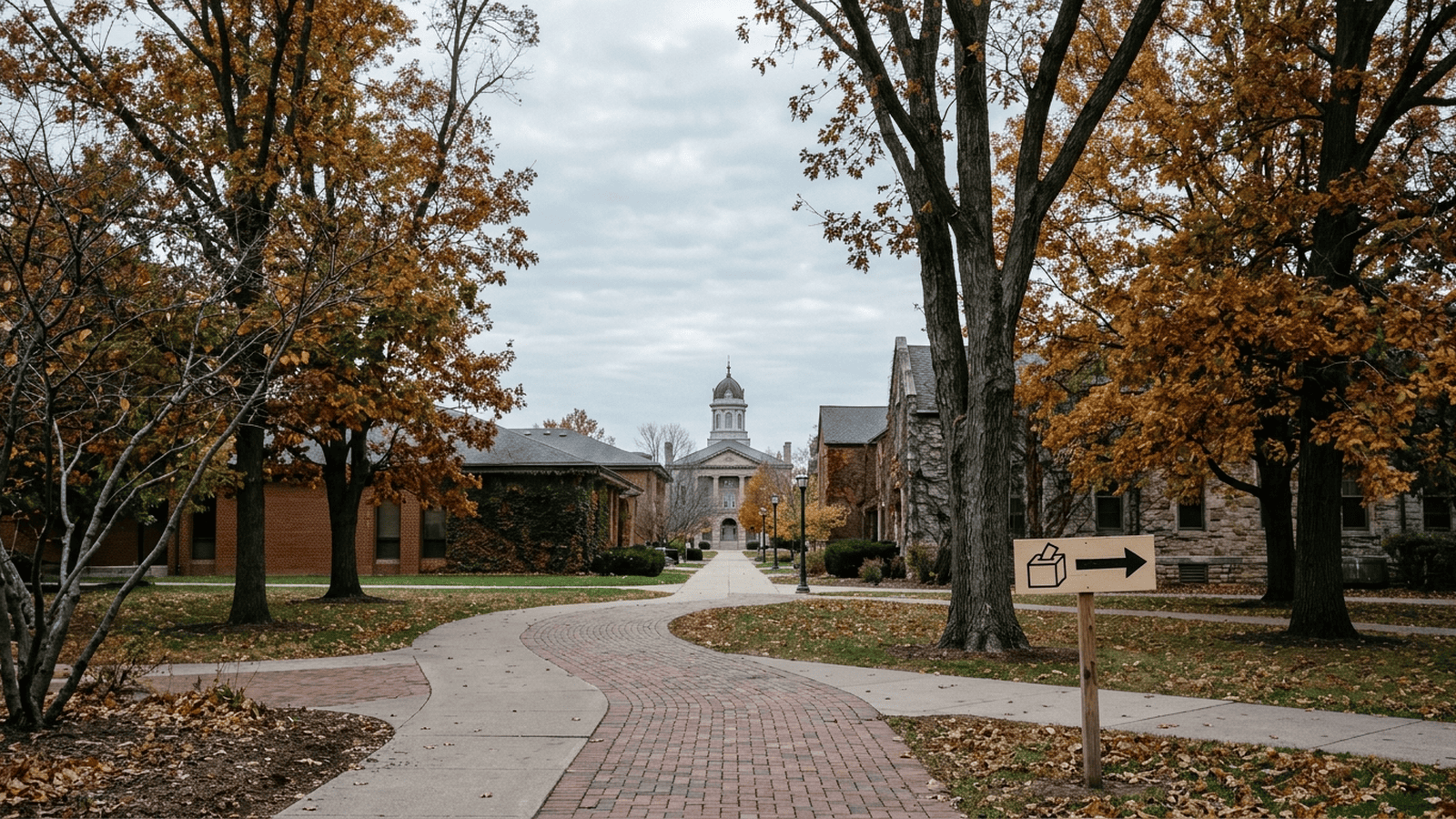
Young voters are encountering changes in polling access, identification rules and registration requirements as the November midterms approach. In Greensboro, more than 100 students walked about 40 minutes to vote after requests for two campus early-voting sites were denied, with officials citing low turnout. Tarrant County reduced polling places from 316 to 224 and removed four campus early-voting locations. The SAVE America Act, which passed the House but is stalled in the Senate, would require proof of citizenship for certain voter registrations and updates. A separate Youth Voting Rights Act proposal would require campus polling sites and expand registration access, but the excerpt gives no implementation timeline.
TLDR: College students face longer trips to some polling places, along with changing identification and registration rules that can make voting harder to plan. Federal proposals remain at different stages, while local election decisions and ballot procedures will shape access before November.
Efforts to protect young voters are growing across college campuses as students, lawmakers and administrators respond to changes in polling access and voting rules. The issue is drawing attention before the November midterm elections, when nearly 50 million people aged 18 to 29 are eligible to vote. A recent survey found that more than 80 percent of eligible voters in that age group in key battleground states probably or definitely plan to vote.
The stated aim of the measures described in the report varies by policy. North Carolina election officials cited low turnout when denying requests for two early-voting sites in Greensboro. The proposed SAVE America Act would require proof of citizenship when people register for the first time or update a registration after changing their name or address. The excerpt does not provide a single official rationale covering all the state and federal changes.
On October 15, the first day of in-person early voting in North Carolina, more than 100 students walked about 40 minutes to the Guilford County Courthouse to vote. The students attended North Carolina A&T State University and the University of North Carolina at Greensboro. Both universities had on-campus early voting in 2024, but a Republican-majority state elections board denied requests for sites at the two schools in January, citing low turnout.
The courthouse location is difficult for some students to reach on foot. Olu Rouse, a cofounder and codirector of Protect Ours North Carolina, said students must cross highways and main streets to get there. First-year students without cars face particular difficulties, he said. Students and community groups are organizing early-voting efforts in response, while the local board’s decision leaves voters with fewer nearby options.
The Greensboro example sits within a broader pattern. An analysis of 35 states that offered in-person early voting in 2020 found that 74 percent of college campuses had no on-campus in-person voting option. More than half of American college students had no voting option on campus. Those figures describe access on campus, not whether students had other voting locations available.
In Texas, Tarrant County’s Commissioners Court reduced the number of polling places from 316 in the previous midterms to 224. The change included the removal of four early-voting sites on college campuses. Janet Mattern, president of the League of Women Voters of Tarrant County, said the combined student, faculty and staff population at the University of Texas at Arlington is about 60,000, with the closest polling location a mile and a half away. Mattern and her team are offering low-cost transportation to polling places.
Identification and registration rules create additional hurdles for some young voters, according to the report. Young people may move frequently and may not have identification accepted by the state where they are registered. New Hampshire joined 10 other states in eliminating student IDs as an accepted form of identification. The report also says young voters face higher risks of provisional ballots being rejected and mail ballots arriving late. It does not give a cost estimate for obtaining other identification or details on how many ballots are affected.
The SAVE America Act, which passed the House earlier in the year, remains stalled in the Senate, according to the excerpt. It would require proof of citizenship when registering to vote for the first time and when updating registration after a name or address change. The report says 12 states have enacted laws similar to the SAVE Act since 2024. It identifies low-income young people and young people of color as groups that could be disproportionately affected, but supplies no estimate of the number of voters or additional paperwork involved.
A separate proposal, the Youth Voting Rights Act of 2026, was reintroduced by Senator Elizabeth Warren last month. It would require on-campus polling stations, expand voter registration at public colleges and universities, and allow preregistration before people turn 18. The excerpt does not state that the bill has passed, provide an implementation timetable, or describe oversight arrangements. It also reports that Washington voters aged 18 to 25 had the highest rate of mail-ballot challenges in the state from 2020 to 2025, according to a recent study.
For voters, the practical effects described include longer trips to polling places, transportation needs, limits on which IDs are accepted, added proof-of-citizenship requirements under the proposed federal bill, and the possibility of provisional ballot rejection or late mail ballots. No new fees, forms, compliance penalties, or specific deadlines are supplied in the excerpt. College students and other young voters are directly affected by polling-site decisions and by rules governing registration, identification and ballot handling.
The next steps are the Senate’s consideration of the SAVE America Act and any further action on the Youth Voting Rights Act. State and county election decisions will also shape where students can vote and what identification they can use. Those developments and the handling of ballots remain necessary points for public oversight; the available account does not establish that experts have resolved the access concerns.

Mason Reed serves as a Staff Writer for Just Right News, where he spearheads the Future Frontiers & Special Projects desk. In an era defined by rapid technological shifts and evolving social landscapes, Mason provides a steady, principled voice, examining the innovations of tomorrow through the lens of traditional American values. His work is most prominently featured in his signature series, “The Next Horizon,” where he explores the intersection of emerging technology, national sovereignty, and the preservation of individual liberty.
A native of San Diego, California, Mason’s worldview was shaped by the unique culture of his hometown. Growing up in a region defined by its strong military presence and its history of maritime industry, he developed a deep-seated respect for the institutions that provide national stability and the entrepreneurial spirit that drives the American economy. This upbringing instilled in him a belief that true progress is not found in discarding the past, but in building upon a foundation of proven principles. His reporting often reflects this San Diego influence, emphasizing the importance of a robust national defense and the necessity of maintaining a competitive edge in the global marketplace.
Now based in San Francisco, Mason operates from the heart of the world’s technological engine. Living and working in the Bay Area provides him with a front-row seat to the advancements—and the ideological challenges—emanating from Silicon Valley. While many in the region embrace a “move fast and break things” mentality, Mason’s reporting serves as a vital counterweight. He offers Just Right News readers a “boots on the ground” perspective, documenting how radical local policies and the concentration of tech power impact the everyday lives of citizens. His proximity to the industry allows him to cut through the marketing jargon of big tech to uncover the real-world implications for privacy, free speech, and the nuclear family.
In his “Future Frontiers” beat, Mason tackles complex subjects ranging from the ethics of artificial intelligence to the burgeoning private space race. He approaches these topics with a healthy skepticism toward centralized bureaucracy, championing instead the decentralized innovations that empower individuals. Through “The Next Horizon,” he highlights the pioneers and thinkers who are working to ensure that the future remains a place where human dignity and constitutional rights are protected. He believes that the rapid pace of change requires more than just technical expertise; it requires a moral compass rooted in the Western tradition.
Throughout his tenure at Just Right News, Mason has remained committed to the idea that the future is something to be shaped, not merely accepted. His writing is characterized by a rigorous defense of American exceptionalism and a belief that the country’s best days lie ahead, provided it remains true to its founding ideals. Whether he is investigating the impact of automation on the American workforce or profiling the next generation of aerospace engineers, Mason Reed ensures that his readers are equipped with the insights they need to navigate a changing world with confidence and clarity.