

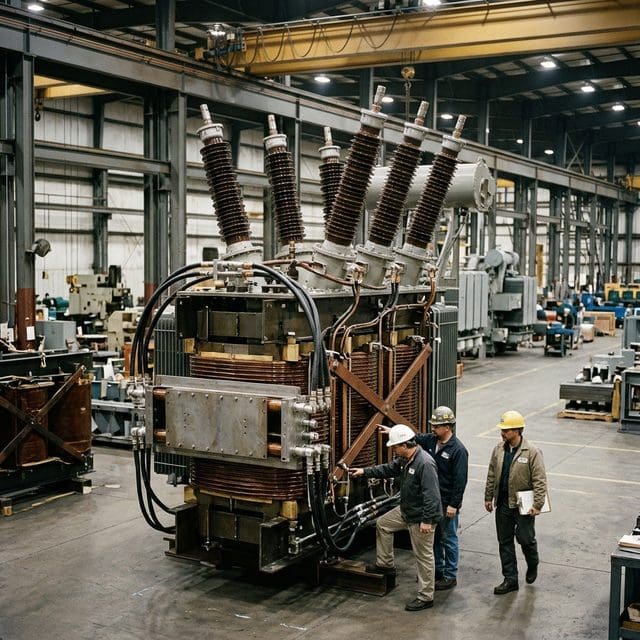
GE Vernova’s $9 billion Trench acquisition would add high-voltage equipment capacity as grid investment accelerates and Persian Gulf supply risks keep energy markets volatile.
GE Vernova’s planned $9 billion acquisition of Trench Group is a bet that high-voltage grid equipment will remain in demand as power systems expand. The purchase would give the U.S. company a larger role in equipment used to move electricity over long distances, including high-voltage direct-current lines.
Trench, owned by Triton Partners, brings about $5 billion in backlog and framework agreements. GE Vernova said the deal will be funded equally with cash and debt. Closing is expected in late 2027, subject to regulatory approvals, so the transaction will not provide an immediate remedy for grid constraints.
A key North American addition is Trench’s recently opened facility in Charlotte, North Carolina. Production there of 765-kilovolt equipment is expected to begin in late 2027. Reuters reported that Trench products are used in the majority of high-voltage direct-current lines built globally. Such equipment can help connect generation to customers, but it cannot by itself resolve permitting delays, build new transmission routes or guarantee lower bills.
GE Vernova’s latest results help explain the deal’s scale. Its third-quarter update reported $12.6 billion in revenue, $29 billion in orders and a $197 billion backlog. The company raised its 2026 guidance to $46.5 billion-$47.5 billion in revenue, a 13.5%-14.5% adjusted EBITDA margin and $16 billion-$17 billion in free cash flow. Those figures indicate strong demand and financial capacity, while the purchase price and debt financing leave execution and integration risks for investors to assess.
The reliability case for grid investment is straightforward: electricity has to reach customers when and where it is needed. The economic test is whether capacity arrives on time and at a cost consumers can bear. GE Vernova has not provided an estimate of savings to customers or quantified an emissions effect. Any climate-policy impact will depend partly on which generation the expanded grid connects and how that power system is operated.
Oil markets, meanwhile, remain exposed to events far from U.S. infrastructure investment. On October 27, prices fell as traders weighed Iran-related diplomacy against renewed Houthi attacks on Saudi Arabia. One market report put Brent at $114.81 a barrel and U.S. West Texas Intermediate at $100.88; another reported Brent at $113.72 and WTI at $99.83, down 1.8% and 1.9%, respectively. The differing snapshots reflect a volatile market, not a settled direction.
Gulf crude exports had fallen for a fourth straight week, while flows through the Strait of Hormuz were about 60% of normal, according to the supplied market report. That leaves prices sensitive to whether diplomacy reduces supply concerns or shipping risks worsen. For consumers, changes in oil prices can feed through to fuel costs, even as utilities and manufacturers invest in infrastructure with a longer time horizon.
In Britain, Chancellor John Healey announced a £100 energy payment for millions, according to the Guardian’s budget coverage. The available report gives no further detail on eligibility or funding. Bill support can ease household pressure in the near term, but it does not increase supply or address the reasons costs are high.
The developments capture two distinct policy challenges: building infrastructure for future reliability and managing today’s energy bills. A large corporate backlog does not guarantee timely construction, just as temporary household assistance does not settle the supply question. Affordability, dependable electricity and emissions outcomes will turn on what gets built, which fuels remain available and how much of the cost lands on consumers.

Mark Davis serves as the Senior Correspondent for Energy, Climate, and Resource Economics at Just Right News. In an era where the conversation around the environment is often dominated by alarmism and top-down mandates, Mark provides a vital, market-oriented perspective on the complex forces shaping our world. As the lead voice behind the acclaimed feature series “Power and the Planet,” he explores the intersection of environmental policy, global energy markets, and the fundamental economic principles that sustain modern civilization.
Mark’s pragmatic approach to resource management was forged in the high desert of his hometown, Albuquerque, New Mexico. Growing up in a region defined by both its breathtaking natural beauty and its rugged, resource-dependent landscape, he developed an early appreciation for the delicate balance between conservation and utilization. New Mexico’s unique position as a hub for both traditional energy production and cutting-edge scientific research provided Mark with a front-row seat to the evolution of the American energy sector. This upbringing instilled in him a deep-seated belief that true environmental stewardship is inseparable from economic prosperity and technological innovation.
Now based in Boulder, Colorado, Mark operates from the heart of the nation’s climate research community. While Boulder is often seen as a bastion of environmental idealism, Mark utilizes his post to provide a necessary counterweight, grounded in the realities of resource economics. He understands that energy policy does not exist in a vacuum; it has tangible consequences for the American taxpayer, the stability of the national power grid, and the strength of the domestic manufacturing sector. By reporting from the front lines of the climate debate, he is able to challenge prevailing narratives with hard data and a commitment to the principles of the free market.
Throughout his tenure at Just Right News, Mark has distinguished himself by focusing on the “Resource Economics” aspect of his beat. He frequently highlights the hidden costs of rapid energy transitions and advocates for an “all-of-the-above” energy strategy that prioritizes American energy independence. His work often shines a light on the geopolitical implications of resource scarcity, arguing that a secure nation must first be an energy-secure nation. Whether he is analyzing the impact of federal land-use regulations or investigating the supply chains required for new technologies, Mark remains focused on how policy decisions affect the lives and livelihoods of everyday citizens.
In “Power and the Planet,” Mark continues to bridge the gap between complex scientific concepts and the economic realities facing the country. He rejects the false choice between a healthy environment and a thriving economy, instead seeking out solutions that leverage American ingenuity and private-sector competition. For Mark, reporting on the climate is not about following the latest trends, but about ensuring that the conversation remains tethered to the foundational values of liberty, property rights, and fiscal responsibility. His contributions ensure that Just Right News readers receive a comprehensive, clear-eyed view of the challenges and opportunities defining the future of our planet.