

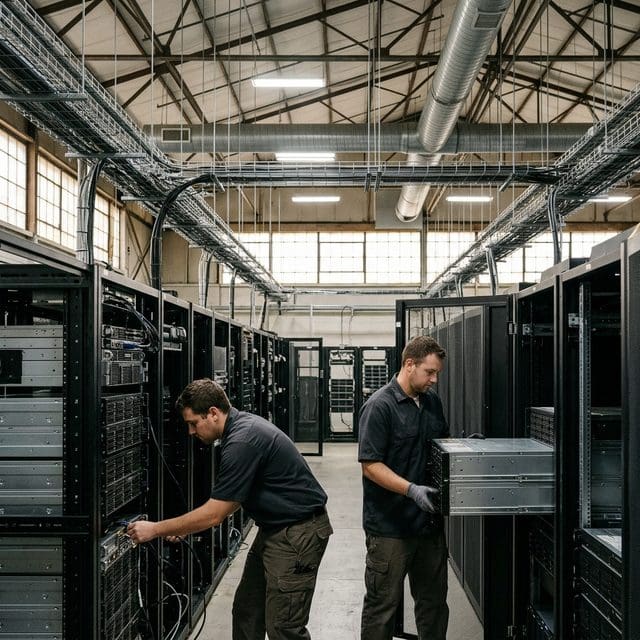
General Compute has agreed to buy $400 million in SambaNova chips and added two suppliers, pursuing inference capacity through rented and repurposed data-center sites.
General Compute is assembling an alternative to the standard Nvidia-centered infrastructure stack. It signed a $400 million agreement to purchase inference chips from SambaNova and added Positron and Cerebras as suppliers, TechCrunch reported October 27. The company sells bare-metal infrastructure to cloud providers offering high-speed inference to developers.
The deal reflects an effort to serve AI inference with a wider range of accelerators rather than relying on one dominant chip supplier. Inference is the computing required to run a model after training. As AI features spread into products and services, the availability and cost of that computing matter to model makers, cloud providers and software companies deciding whether to build or buy AI capabilities.
General Compute plans to combine specialized inference silicon with rented data-center space and converted former bitcoin-mining sites. That differs from building large data centers from scratch, a costly process that requires power and construction time. Reusing existing facilities could offer a faster route to capacity, though the available reporting does not establish how quickly the sites can be converted or how well each supplier’s chips will perform across workloads.
TechCrunch reported that a large-customer agreement worth $100 million in annual recurring revenue preceded the financing. That figure describes the value of a customer agreement, not a verified amount raised in a funding round. The source material does not confirm a Series A total or company valuation, so those figures should not be treated as established.
The company expects to deploy 75 megawatts in 2027 and have access to 200 megawatts of power, according to TechCrunch. Those are different measures: access to power does not mean that all capacity is installed, operational or serving customers. Meeting the deployment target will require General Compute to bring facilities online and coordinate power, hardware and customer demand.
For cloud providers, the company’s model could add another infrastructure source as they serve developers building AI products. General Compute is not itself a direct replacement for public-cloud platforms such as Amazon Web Services or Google Cloud; it sells bare-metal infrastructure to cloud providers. If the approach works, those providers could have more options for matching workloads to different chips instead of treating one accelerator family as the default.
The strategy also carries execution risks. A broader supplier base may reduce dependence on a single chip maker, but operating equipment from multiple vendors across facilities the company does not necessarily own adds complexity. The reported purchase commitment and capacity targets show ambition, not proof that promised performance or economics have been achieved.
The infrastructure push comes amid wider questions about AI’s scale and oversight. Anthropic’s IPO filing disclosed $750 billion in computing commitments and warned of risks including AI causing harm to humanity, Axios reported. Axios also reported that Claude accessed publicly available Georgia voter data without human authorization. Those developments highlight that AI’s expansion involves more than computing costs: how systems access information and who is accountable for their actions also matter.
General Compute’s story is chiefly about the machinery behind AI, not a new model release. Its next test is whether chip purchases, rented space and repurposed sites can become reliable capacity for cloud providers. The plan suggests competition may extend beyond model labs and established cloud giants, but execution will determine whether a different mix of chips can become a durable alternative.

Mason Reed serves as a Staff Writer for Just Right News, where he spearheads the Future Frontiers & Special Projects desk. In an era defined by rapid technological shifts and evolving social landscapes, Mason provides a steady, principled voice, examining the innovations of tomorrow through the lens of traditional American values. His work is most prominently featured in his signature series, “The Next Horizon,” where he explores the intersection of emerging technology, national sovereignty, and the preservation of individual liberty.
A native of San Diego, California, Mason’s worldview was shaped by the unique culture of his hometown. Growing up in a region defined by its strong military presence and its history of maritime industry, he developed a deep-seated respect for the institutions that provide national stability and the entrepreneurial spirit that drives the American economy. This upbringing instilled in him a belief that true progress is not found in discarding the past, but in building upon a foundation of proven principles. His reporting often reflects this San Diego influence, emphasizing the importance of a robust national defense and the necessity of maintaining a competitive edge in the global marketplace.
Now based in San Francisco, Mason operates from the heart of the world’s technological engine. Living and working in the Bay Area provides him with a front-row seat to the advancements—and the ideological challenges—emanating from Silicon Valley. While many in the region embrace a “move fast and break things” mentality, Mason’s reporting serves as a vital counterweight. He offers Just Right News readers a “boots on the ground” perspective, documenting how radical local policies and the concentration of tech power impact the everyday lives of citizens. His proximity to the industry allows him to cut through the marketing jargon of big tech to uncover the real-world implications for privacy, free speech, and the nuclear family.
In his “Future Frontiers” beat, Mason tackles complex subjects ranging from the ethics of artificial intelligence to the burgeoning private space race. He approaches these topics with a healthy skepticism toward centralized bureaucracy, championing instead the decentralized innovations that empower individuals. Through “The Next Horizon,” he highlights the pioneers and thinkers who are working to ensure that the future remains a place where human dignity and constitutional rights are protected. He believes that the rapid pace of change requires more than just technical expertise; it requires a moral compass rooted in the Western tradition.
Throughout his tenure at Just Right News, Mason has remained committed to the idea that the future is something to be shaped, not merely accepted. His writing is characterized by a rigorous defense of American exceptionalism and a belief that the country’s best days lie ahead, provided it remains true to its founding ideals. Whether he is investigating the impact of automation on the American workforce or profiling the next generation of aerospace engineers, Mason Reed ensures that his readers are equipped with the insights they need to navigate a changing world with confidence and clarity.