

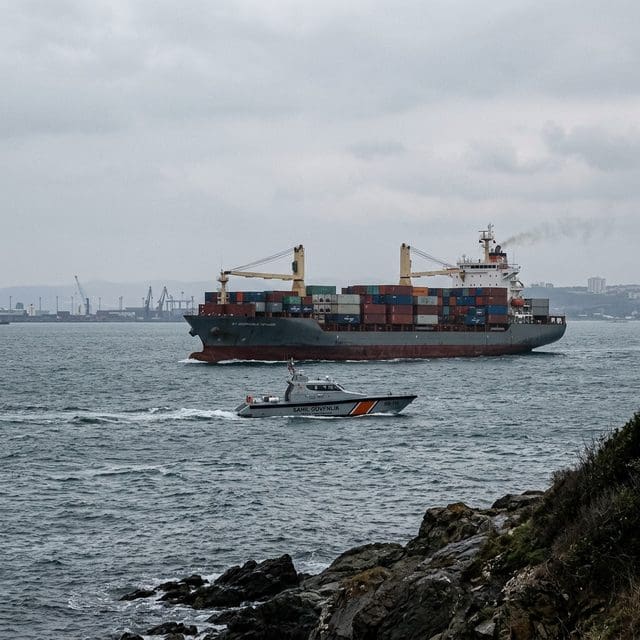
Ankara warned Moscow and Kyiv against further attacks on commercial vessels, raising the stakes for civilian shipping and regional security in the Black Sea.
Turkey has warned Russia and Ukraine against further attacks on commercial vessels in the Black Sea, drawing attention to civilian shipping in a region where the war’s effects reach beyond the battlefield.
Turkish Defense Minister Yaşar Güler issued the warning Wednesday, according to Reuters reporting carried by Al-Monitor and The Straits Times. He said Ankara reserved the right to take legal action over strikes against commercial vessels. The reports do not identify the vessels or specify the incidents, their locations, or whether they caused damage or casualties.
That limits what can be concluded about the immediate threat. The accounts establish a public warning from a senior Turkish official, but do not detail the scale of attacks or say that Turkey has begun legal proceedings. They also do not describe a new Turkish military measure to protect shipping.
The broader stakes are clear even where the particulars are not. The Black Sea is both a military theater and a commercial route. Attacks on civilian vessels could increase risks for operators and complicate trade, though the reports provide no figures for affected ships, disruptions, or economic costs. Any sustained danger would matter to governments and businesses relying on secure maritime access.
Turkey has particular weight in this dispute. It is a NATO member with interests in Black Sea security and relations with both Kyiv and Moscow. Its warning addresses both belligerents without, on the available information, committing Ankara to a specific enforcement action or announcing a change in alliance policy.
That distinction matters for Washington and its allies. A public warning may be intended to deter further attacks, but it is not the same as a decision to escort vessels, expand patrols, or alter NATO’s military posture. The reports describe no formal alliance decision, request for NATO assistance, or Pentagon response. For now, the clearest signal is Ankara’s stated opposition to attacks on commercial shipping and its reservation of legal options.
Whether that signal changes calculations in Moscow or Kyiv remains uncertain. The accounts provide no response from either government and do not say what legal action Turkey might pursue. Without those details, it is difficult to assess the warning’s likely effect or the risk of a wider confrontation.
The episode nonetheless illustrates how the war can impose costs on countries outside the fighting. Even without a confirmed trade interruption, uncertainty around commercial routes can shape decisions by shipping companies and governments. The available reporting does not establish a specific price impact, supply disruption, or change in shipping activity, so those consequences should not be assumed.
For NATO, the challenge is to protect allied interests and support secure maritime access without widening the conflict. The reports do not indicate that the alliance has agreed to new surveillance or maritime measures. Turkey’s statement is a national warning, not evidence of a coordinated NATO response.
Ankara has made its boundary public while leaving the form of any response open. That preserves room for diplomacy, but the warning’s force will depend on what follows: whether Russia and Ukraine avoid further attacks on commercial vessels, and whether Turkey turns its stated legal options into action. Until more is known about the incidents, the scale of the danger remains unclear.

Olivia Kendall serves as the Senior Correspondent for Geopolitics, Defense, and Foreign Policy at Just Right News, where she provides a principled, conservative perspective on the complex forces shaping the global stage. With a career dedicated to deconstructing the intricacies of international relations, Kendall has become a trusted voice for readers who value national sovereignty, a robust military, and a foreign policy that prioritizes American interests above all else.
A native of Washington, D.C., Kendall’s professional journey is deeply rooted in her upbringing within the nation’s capital. Growing up in the epicenter of American political life, she developed an early and profound understanding of how policy is crafted and, more importantly, how it often fails to account for the values of the American heartland. This unique vantage point allowed her to witness firsthand the rise of globalist bureaucracies, fueling her commitment to reporting that champions the constitutional foundations of the United States. Her background as a British White American further informs her worldview, providing her with a keen appreciation for the Western tradition and the enduring importance of the “Special Relationship” in maintaining global stability.
Now based in Arlington, Virginia, Kendall operates from the doorstep of the Pentagon and the heart of the nation’s defense establishment. Her proximity to the decision-makers in the military and intelligence communities allows her to provide boots-on-the-ground reporting that is both timely and deeply informed. For Kendall, Arlington is more than just a base of operations; it is a daily reminder of the sacrifices made by the men and women in uniform. This connection to the defense community drives her rigorous coverage of military readiness and her advocacy for a “peace through strength” approach to diplomacy.
At Just Right News, Kendall is perhaps best known for her acclaimed feature series, “The World’s Shadow on America.” In this ongoing project, she explores the direct correlation between international developments and the daily lives of American citizens. Whether she is analyzing the encroachment of foreign adversaries in domestic supply chains or the impact of international treaties on local economies, Kendall’s work serves as a vital bridge between distant geopolitical shifts and their consequences at home. She rejects the notion that foreign policy is an abstract concern for elites, instead proving that what happens in the corridors of power in Brussels or Beijing has a tangible “shadow” that falls across every American doorstep.
Throughout her tenure, Kendall has remained a steadfast critic of international overreach and a vocal proponent of a clear-eyed, realistic foreign policy. She brings a sharp analytical mind to her beat, often challenging the prevailing narratives of the mainstream media to uncover the underlying truths that affect national security. Her reporting is characterized by a refusal to compromise on the truth and a dedication to the idea that a strong, secure America is the world’s best hope for liberty. As a Senior Correspondent, Olivia Kendall continues to lead the charge in providing the essential context and conservative insight necessary to navigate an increasingly volatile world.