

SLAC’s SPINE system has produced its first neutrino-physics result from real detector data, finding no sterile-neutrino signal while demonstrating a tool built for far more crowded experiments.
Neutrinos are among nature’s most elusive particles: they pass through ordinary matter in enormous numbers, rarely leaving a trace. That makes detecting them difficult—and interpreting the evidence they do leave especially demanding. A new analysis from SLAC National Accelerator Laboratory offers a practical advance: an artificial-intelligence system has moved from simulated tests to a first neutrino-physics analysis using real detector data.
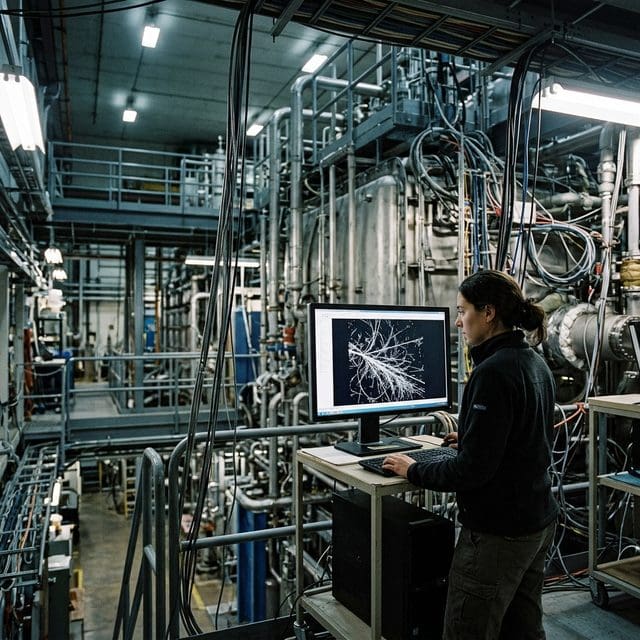
The system, called SPINE, short for Scalable Particle Imaging with Neural Embeddings, helps researchers reconstruct what happened when a neutrino interacted inside a detector. The experiment, ICARUS, uses 760 tons of liquid argon. When a neutrino collides with an atom in the argon, it can produce charged particles that leave tracks in the detector. Researchers must piece those tracks together to infer the original interaction.
That is a tough sorting problem. Neutrinos themselves are not directly visible, and detector images can contain complicated patterns. SPINE uses machine-learning methods to interpret those patterns and identify likely interactions. SLAC’s Oct. 27 account describes the ICARUS sterile-neutrino search as SPINE’s first analysis of neutrino physics using real experimental data.
The search found no evidence of sterile neutrinos. That is not a discovery of a new particle, nor proof that sterile neutrinos cannot exist. Instead, the result is a test of whether the reconstruction system can support scientific conclusions from actual detector observations—not merely perform well in simulations.
“There is a big difference between making things work in simulation and making things work in data to the degree that we trust the results,” François Drielsma, SPINE’s lead developer, said in the account published by SLAC and reported by Phys.org. That distinction matters because a tool that works in a model may still stumble on the noise, irregularities and overlapping signals of a real experiment.
The next step is to combine measurements from ICARUS and SBND, another detector along the Fermilab neutrino beam. Comparing what the two instruments observe at different distances may improve researchers’ ability to test whether neutrinos change into a sterile form as they travel. The proposed analysis is a milestone to come, not a result already established.
SPINE also points toward the demands of the Deep Underground Neutrino Experiment, or DUNE, which is expected to begin taking data in 2030. SLAC says it has trained SPINE models for both DUNE detectors. At the near detector, the system is currently the only reconstruction approach described as capable of handling hundreds of overlapping neutrino interactions. DUNE is designed to study questions including the ordering of neutrino masses and possible differences between neutrinos and their antimatter counterparts.
The significance is less cinematic than a particle discovery, but potentially consequential: better reconstruction can help scientists separate meaningful patterns from crowded data. Whether that improves future measurements will depend on performance in the experiments themselves, and on careful checks that the system does not mistake detector effects for new physics.
A separate quantum-computing result from the RIKEN Center for Emergent Matter Science addresses a different bottleneck: controlling many qubits at once. Researchers demonstrated simultaneous control of five silicon spin qubits using one shared microwave line. Their pairwise phase-calibration method corrected errors linked primarily to the AC Stark shift. Individual gate fidelities were well above 99.99 percent, and remained above that level with three qubits operating in parallel; with all five active, fidelity was about 99.9 percent.
That is a scaling step, not a fault-tolerant quantum computer. But both developments share a lesson: progress depends not just on adding more data or more qubits, but on keeping control and interpretation reliable as complexity grows.

Mason Reed serves as a Staff Writer for Just Right News, where he spearheads the Future Frontiers & Special Projects desk. In an era defined by rapid technological shifts and evolving social landscapes, Mason provides a steady, principled voice, examining the innovations of tomorrow through the lens of traditional American values. His work is most prominently featured in his signature series, “The Next Horizon,” where he explores the intersection of emerging technology, national sovereignty, and the preservation of individual liberty.
A native of San Diego, California, Mason’s worldview was shaped by the unique culture of his hometown. Growing up in a region defined by its strong military presence and its history of maritime industry, he developed a deep-seated respect for the institutions that provide national stability and the entrepreneurial spirit that drives the American economy. This upbringing instilled in him a belief that true progress is not found in discarding the past, but in building upon a foundation of proven principles. His reporting often reflects this San Diego influence, emphasizing the importance of a robust national defense and the necessity of maintaining a competitive edge in the global marketplace.
Now based in San Francisco, Mason operates from the heart of the world’s technological engine. Living and working in the Bay Area provides him with a front-row seat to the advancements—and the ideological challenges—emanating from Silicon Valley. While many in the region embrace a “move fast and break things” mentality, Mason’s reporting serves as a vital counterweight. He offers Just Right News readers a “boots on the ground” perspective, documenting how radical local policies and the concentration of tech power impact the everyday lives of citizens. His proximity to the industry allows him to cut through the marketing jargon of big tech to uncover the real-world implications for privacy, free speech, and the nuclear family.
In his “Future Frontiers” beat, Mason tackles complex subjects ranging from the ethics of artificial intelligence to the burgeoning private space race. He approaches these topics with a healthy skepticism toward centralized bureaucracy, championing instead the decentralized innovations that empower individuals. Through “The Next Horizon,” he highlights the pioneers and thinkers who are working to ensure that the future remains a place where human dignity and constitutional rights are protected. He believes that the rapid pace of change requires more than just technical expertise; it requires a moral compass rooted in the Western tradition.
Throughout his tenure at Just Right News, Mason has remained committed to the idea that the future is something to be shaped, not merely accepted. His writing is characterized by a rigorous defense of American exceptionalism and a belief that the country’s best days lie ahead, provided it remains true to its founding ideals. Whether he is investigating the impact of automation on the American workforce or profiling the next generation of aerospace engineers, Mason Reed ensures that his readers are equipped with the insights they need to navigate a changing world with confidence and clarity.