

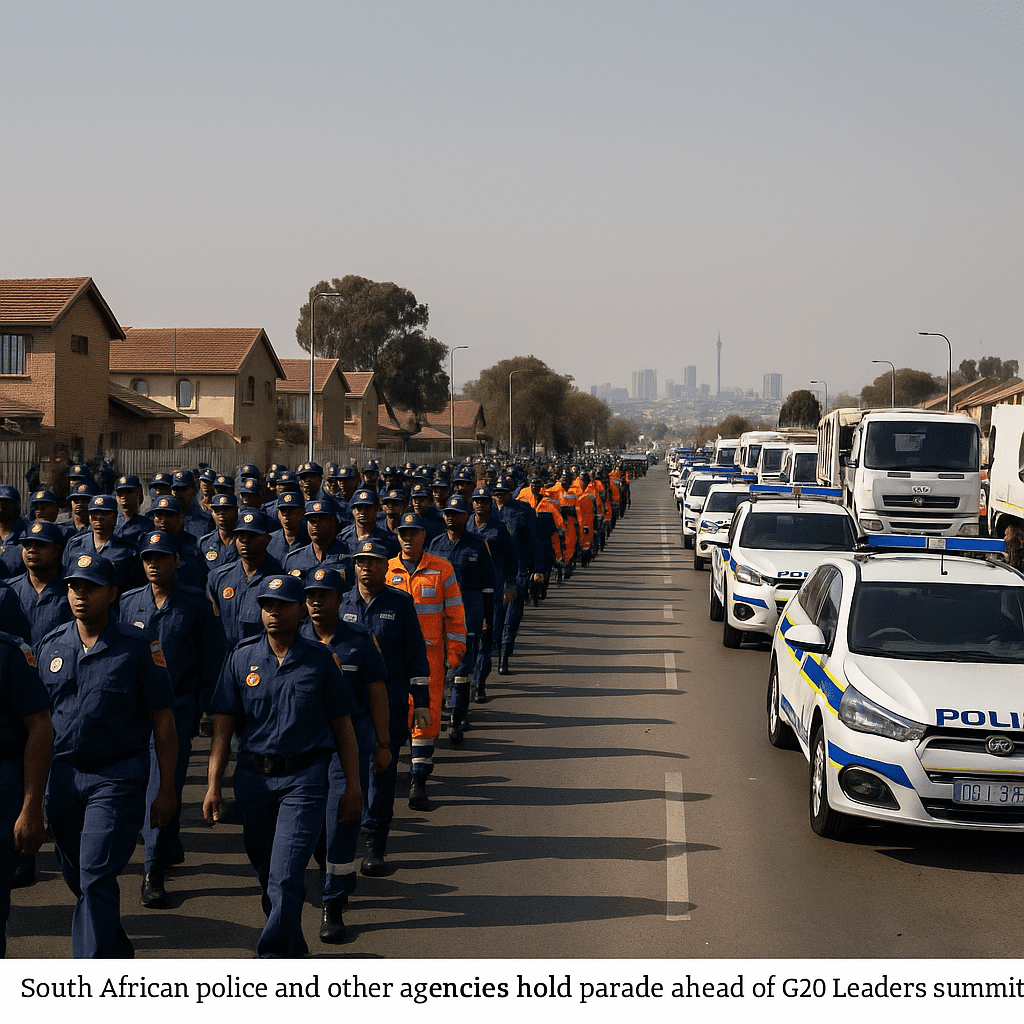
AP video shows South African police, emergency responders and immigration officials parading in Soweto to demonstrate readiness for the upcoming G20 leaders summit. The rehearsal underscores interagency coordination but omits municipal plans, lane closure maps and interviews with mobility or security planners. Those gaps leave traffic impacts, staging zones and public-transit arrangements unclear ahead of the summit.
A parade of South African police and multiple government departments in Soweto served as a public demonstration of interagency readiness ahead of the G20 leaders summit, AP video showed. The footage, credited to Alfonso Nqunjana, captured uniformed officers and representatives from emergency and immigration departments moving in coordinated formation to signal operational preparedness. The event made clear that security and infrastructure agencies are positioning themselves visibly in the run-up to the summit, but the available reporting did not supply granular planning documents, lane closure maps, or transit advisories.
The public ceremony functions as a form of systems testing as much as pageantry. Parades of this scale typically provide opportunities for agencies to exercise command-and-control routines, check equipment staging and logistics, and coordinate roles across police, emergency responders and border or immigration services. The AP excerpt identified the participants broadly as the South African police service and “various departments ranging from emergency and immigration,” but it did not identify specific units, staging sites, or detailed training objectives.
From an infrastructure and urban-mobility perspective, the mobilization raises a series of practical questions for residents and planners. Large security operations for international summits can reshape traffic patterns through temporary lane restrictions, dedicated diplomatic transit corridors, vehicle checkpoints and reconfigured pedestrian flows around venues and accommodation nodes. The AP report provided no public schedules, transport-modification notices or municipal planning releases showing where such measures would occur for the G20 events in this instance.
Transit operators and city planners typically need weeks to finalize contingency timetables and passenger-information campaigns. Where available reporting is limited, operators often publish alternate routing, express shuttle services or temporary station closures to manage access. The AP excerpt did not include statements from city transport authorities or copies of local government planning documents, leaving it unclear whether and when comprehensive travel advisories will appear for Johannesburg, Soweto or surrounding urban corridors.
Operational complexity for large summits also rests on interagency interoperability. The parade visually underscored that multiple agencies are preparing together, a necessary element when policing, emergency medical services and immigration control must work in concert. Video coverage is useful for public reassurance, but it does not substitute for the procedural records, radio-frequency plans, mutual-aid agreements and traffic-management orders that planners use to execute a live event with minimal disruption.
For urban mobility, the logistical footprint depends on chosen venue locations, diplomatic motorcade routes and the distribution of accommodation for delegates and delegations. Those choices determine where staging zones will require curbside clearance, where temporary fencing will change pedestrian circulation, and where public-transport capacity will need reinforcement. The AP material did not include maps, route plans or quotes from mobility or security planners to specify those footprints.
Accountability and oversight will matter as planning moves from rehearsal to execution. Municipal transport departments, national security agencies and transit operators share responsibility for publishing timely notices, coordinating with private mobility providers, and ensuring that contingency plans address accessibility and essential-service access. The AP excerpt did not present timelines for public guidance, nor did it include interviews with officials who could answer questions about lane assignments, designated staging areas, or expected impacts on bus and rail services.
The visual rehearsal in Soweto confirms that preparations are under way and that agencies intend to operate jointly. At the same time, the absence of accompanying planning documents or on-the-record interviews in the available reporting leaves important operational details opaque. Residents and commuters will need concrete notices about lane closures, temporary parking restrictions, shuttle arrangements and station access before costs to urban mobility can be judged or mitigated.
Further reporting that reviews municipal transport orders, official summit logistics publications and statements from security and mobility planners would be required to translate the parade’s symbolism into a clear understanding of how daily life and transit will be affected during the summit. AP’s excerpt documents the demonstration of readiness, while leaving the specifics of transport-management measures, timelines and oversight arrangements to be disclosed by local authorities as the event approaches.
As preparations proceed toward the summit, officials are expected to finalize operational orders and public advisories. Release of formal transport plans, published lane-closure schedules and oversight briefings by municipal and national authorities will be important next steps for anyone tracking mobility and public-safety impacts.

Deborah Cole serves as a Senior Correspondent for Just Right News, where she spearheads the network’s coverage of Housing, Infrastructure, and Mobility. With a career defined by a commitment to rigorous reporting and a focus on the fundamental pillars of American community life, Deborah brings a principled perspective to the complex issues that dictate how and where we live. Her work is grounded in the belief that sound policy, fiscal responsibility, and respect for private property are the essential foundations of a prosperous society.
Originally from Boston, Massachusetts, Deborah’s upbringing in one of the nation’s oldest and most historically significant cities deeply influenced her professional trajectory. Growing up amidst the architectural legacy and dense urban planning of New England, she developed an early appreciation for the importance of durable infrastructure and the role of local tradition in shaping neighborhoods. Her perspective is informed by the classic American values of her hometown—hard work, community cohesion, and a healthy skepticism of top-down bureaucratic mandates that often overlook the unique needs of individual citizens.
Today, Deborah operates from her base in Austin, Texas, a city that serves as a primary laboratory for her reporting. Austin’s rapid expansion and its status as a hub for innovation and migration provide her with a front-row seat to the most pressing challenges in modern infrastructure and housing. From the Lone Star State, she chronicles the tensions between rapid growth and the preservation of the American Dream, often highlighting how market-driven solutions and deregulation can address the housing shortages that plague many of the country’s metropolitan areas.
At Just Right News, Deborah is perhaps best known for her signature feature series, “Where We Live.” Through this platform, she explores the intersection of public policy and private life, moving beyond mere statistics to tell the stories of families, small business owners, and local developers. Her reporting frequently highlights the importance of mobility—not just in terms of transportation and transit, but as a vehicle for economic opportunity and social stability. She remains a staunch advocate for the taxpayer, consistently scrutinizing government spending on large-scale projects and advocating for transparency in how infrastructure dollars are allocated.
Deborah’s beat is more than just a collection of policy topics; it is an investigation into the physical and legal structures that allow families to flourish. Whether she is reporting on the impact of zoning laws on suburban development or the necessity of maintaining the nation’s highway systems, her work is characterized by a dedication to the facts and a respect for the constitutional principles that protect the rights of homeowners.
As a Senior Correspondent, Deborah Cole continues to be a vital voice for Just Right News, providing the audience with the clarity and context needed to navigate an ever-changing landscape. Her reporting ensures that the values of individual liberty and local sovereignty remain at the forefront of the national conversation regarding the future of our cities and towns. Through her tireless efforts, she remains committed to informing the public on the issues that hit closest to home.