

California’s new transit-oriented housing law and a crowded slate of state ballot measures put zoning, development and affordability policy before voters and local governments.
California is entering a consequential test of how housing gets built: a state law now requires more density near certain transit stops, while November ballots across four states are set to put housing policy before voters. The decisions could shape where homes are allowed, how quickly projects move through review and whether new development is tied to public transportation.
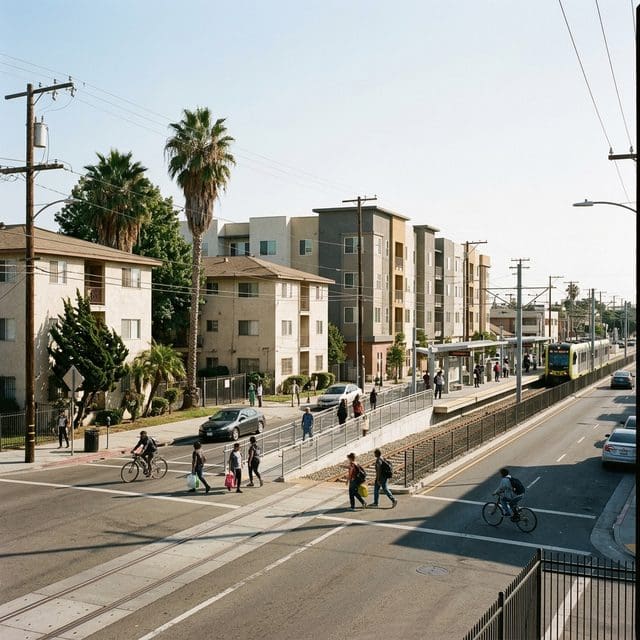
The most immediate change is S.B. 79, California’s transit-oriented housing law, which took effect July 1. It requires higher-density housing near qualifying high-frequency transit stops in eight urban transit counties. The reported minimum standard is 30 dwelling units per acre for eligible projects of at least five units.
The measure links land-use rules to transit access, potentially allowing more homes near existing service rather than leaving local zoning as the sole constraint. But the available reporting does not establish how many projects will be proposed, how many will be built or whether transit capacity will keep pace. Those outcomes will depend on implementation and on whether developers find eligible sites financially workable.
The law also raises a familiar question in California’s housing debate: how far should state requirements reach into local decisions? Statewide rules can open more land to housing in places with transit, while local officials and residents may object to changes in neighborhood scale or question whether infrastructure can support added residents. The cost-of-living stakes are concrete, but density rules alone do not guarantee homes that are affordable to lower-income households.
Voters will have a separate role this fall. Six housing-related ballot measures are scheduled across California, Hawaii, Massachusetts and Rhode Island, the largest number in a single election year in at least two decades, according to Ballotpedia reporting summarized by Ground News on October 17. The available summary does not provide enough detail to compare the measures’ costs, funding mechanisms or likely effects on housing production.
California Proposition 45 is described as a housing-reform measure intended to streamline environmental reviews for housing projects. Supporters of faster review may argue that delays raise costs and postpone construction. Opponents warn that the measure could encourage sprawl. Those competing claims point to a policy trade-off: reducing procedural barriers can make projects easier to advance, but the location and infrastructure consequences still matter to taxpayers and residents.
HousingWire’s October 18 headline likewise framed housing affordability as a question of voters’ influence in state-level battles. The supplied headline and excerpt offer little detail beyond California’s ballot measures and early voting in other states, so they do not support a fuller account of the proposals or their projected effects. No new, substantive HousingWire report on mortgage rates, rents or federal housing policy was available in the supplied material.
That evidence gap matters. Housing affordability is shaped not only by permission to build, but also by financing, construction costs, public infrastructure and the continuing expenses of living near work and transit. The available material supplies no current figures on rents, home prices, mortgage rates or homelessness, and it does not describe a new federal infrastructure decision that would change those costs.
For now, California’s law sets a clear rule near qualifying transit, and the November measures promise a broader public debate over housing policy. Whether either produces homes that households can afford will depend on details absent from the current reporting: implementation, project economics, infrastructure capacity and the choices voters make at the ballot box.

Deborah Cole serves as a Senior Correspondent for Just Right News, where she spearheads the network’s coverage of Housing, Infrastructure, and Mobility. With a career defined by a commitment to rigorous reporting and a focus on the fundamental pillars of American community life, Deborah brings a principled perspective to the complex issues that dictate how and where we live. Her work is grounded in the belief that sound policy, fiscal responsibility, and respect for private property are the essential foundations of a prosperous society.
Originally from Boston, Massachusetts, Deborah’s upbringing in one of the nation’s oldest and most historically significant cities deeply influenced her professional trajectory. Growing up amidst the architectural legacy and dense urban planning of New England, she developed an early appreciation for the importance of durable infrastructure and the role of local tradition in shaping neighborhoods. Her perspective is informed by the classic American values of her hometown—hard work, community cohesion, and a healthy skepticism of top-down bureaucratic mandates that often overlook the unique needs of individual citizens.
Today, Deborah operates from her base in Austin, Texas, a city that serves as a primary laboratory for her reporting. Austin’s rapid expansion and its status as a hub for innovation and migration provide her with a front-row seat to the most pressing challenges in modern infrastructure and housing. From the Lone Star State, she chronicles the tensions between rapid growth and the preservation of the American Dream, often highlighting how market-driven solutions and deregulation can address the housing shortages that plague many of the country’s metropolitan areas.
At Just Right News, Deborah is perhaps best known for her signature feature series, “Where We Live.” Through this platform, she explores the intersection of public policy and private life, moving beyond mere statistics to tell the stories of families, small business owners, and local developers. Her reporting frequently highlights the importance of mobility—not just in terms of transportation and transit, but as a vehicle for economic opportunity and social stability. She remains a staunch advocate for the taxpayer, consistently scrutinizing government spending on large-scale projects and advocating for transparency in how infrastructure dollars are allocated.
Deborah’s beat is more than just a collection of policy topics; it is an investigation into the physical and legal structures that allow families to flourish. Whether she is reporting on the impact of zoning laws on suburban development or the necessity of maintaining the nation’s highway systems, her work is characterized by a dedication to the facts and a respect for the constitutional principles that protect the rights of homeowners.
As a Senior Correspondent, Deborah Cole continues to be a vital voice for Just Right News, providing the audience with the clarity and context needed to navigate an ever-changing landscape. Her reporting ensures that the values of individual liberty and local sovereignty remain at the forefront of the national conversation regarding the future of our cities and towns. Through her tireless efforts, she remains committed to informing the public on the issues that hit closest to home.