

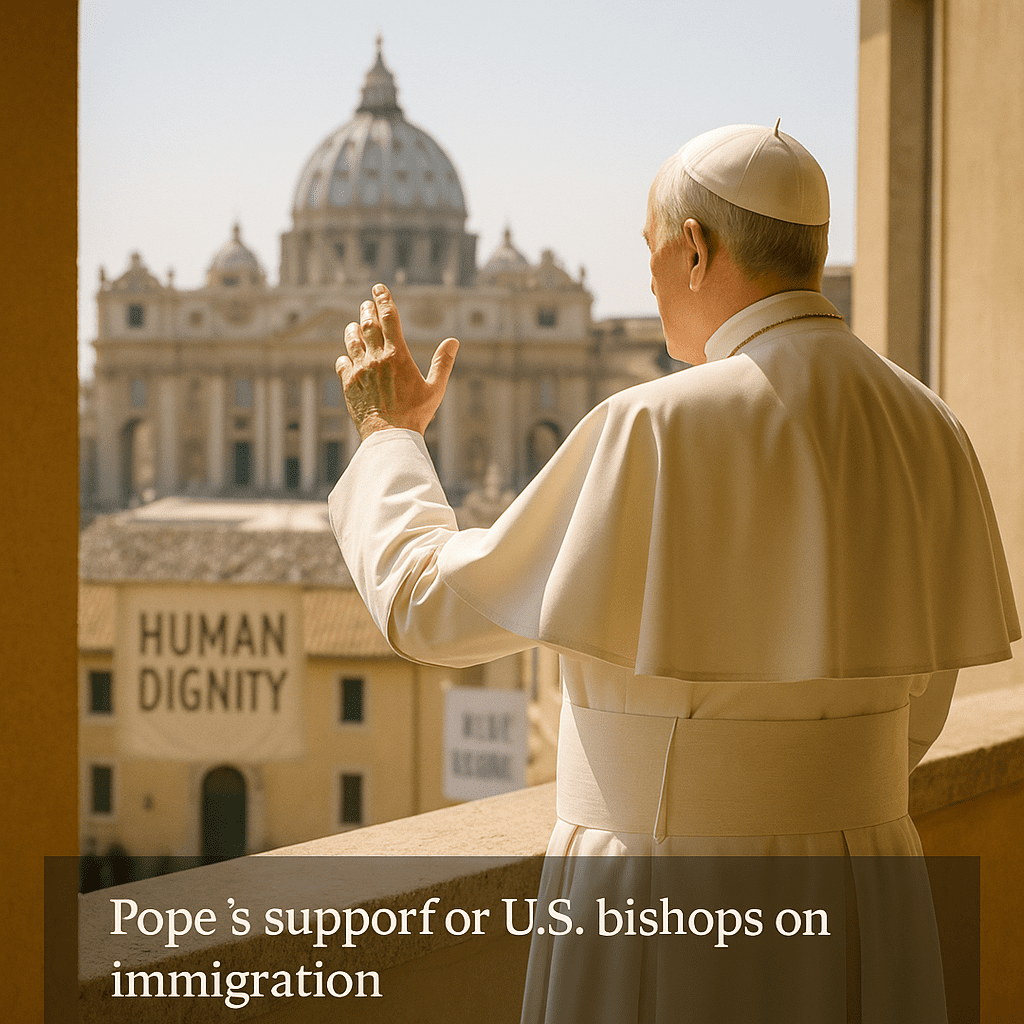
Pope Leo XIV publicly backed a rare U.S. bishops’ statement condemning the Trump administration’s immigration crackdown and urged humane treatment for migrants, saying “we have to look for ways of treating people humanely.” The bishops criticized mass deportations and the “vilification” of migrants and used an Instagram video to amplify their message. The reporting does not include reactions from political leaders, dioceses in swing states or immigrant-rights groups, leaving local responses and concrete policy shifts uncertain. The intervention raises potential pressure on state and local officials to reassess cooperation with federal enforcement, and it sets a scene for closer scrutiny of diocesan actions and political responses ahead of the 2026 midterms.
Pope Leo XIV on Tuesday publicly backed a rare, single-issue statement by the U.S. bishops that criticized the Trump administration’s immigration crackdown and urged Americans to treat migrants humanely. Speaking as he left his villa in Castel Gandolfo, the Chicago-born pope said, “I think we have to look for ways of treating people humanely, treating people with the dignity that they have.” He repeated a practical admonition: “If people are in the United States illegally, there are ways to treat that. There are courts, there’s a system of justice.”
The bishops’ “special message,” adopted at their general assembly last week, criticized mass deportations and the “vilification” of migrants, according to reporting on the statement. The bishops accompanied the text with an Instagram video of individual prelates reading the message, signaling an effort to amplify its reach beyond Catholic institutional channels. The move was notable: it was the first single-issue statement of that kind by the U.S. Conference of Catholic Bishops since 2013.
Leo framed his support as both moral and pragmatic, lamenting that raids have sown “fear and anxiety” and that pastoral care has been denied to migrants in detention. He said U.S. bishops had been “very clear” and added, “I would just invite all people in the United States to listen to them.” The pope, who has urged local bishops previously to take the lead on social-justice matters, signaled institutional backing from the Vatican for the American prelates’ intervention.
Religious leaders weighing in on a fraught federal policy inevitably shift conversations that matter in statehouses and city halls. Local officials write and implement many day-to-day policies that affect immigrant communities — from access to health and social services to cooperation with federal immigration authorities. A public endorsement from the pope and a coordinated bishops’ statement can ratchet up expectations for dioceses to lobby local policymakers, mobilize parish networks and press for alternatives to aggressive deportation tactics.
Reporting on the pope’s remarks and the bishops’ statement did not include responses from elected political leaders, Catholic dioceses in specific swing states, or immigrant-rights groups. Those responses therefore cannot be recounted here. The absence of on-the-record reactions in the material available leaves open critical questions about how governors, mayors and county officials will respond in places where Catholic voters are influential.
Still, local political implications are foreseeable. Where bishops and parishes have active social service programs, clergy endorsements or sustained messaging can increase pressure on local officials to limit collaboration with federal immigration enforcement. City councils and state legislatures may find their debates sharpened by clergy appeals to human dignity. County sheriffs and municipal administrators could face renewed scrutiny over policies governing jail bookings and immigration detainers.
For campaigns and elections, the intervention could shift narratives in precincts with sizeable Catholic populations. The report referenced broader national political context in related coverage, noting courts and election trackers that place the 2026 midterms on the horizon. Religious messaging that frames immigration as a matter of human dignity rather than purely law enforcement may influence voters who are attentive to moral arguments from trusted faith leaders, although the available reporting does not provide polling or reaction data specific to this intervention.
Immigrant-rights organizations historically have welcomed ecclesiastical voices that call for humane treatment and pastoral access, but the excerpt does not include statements from such groups in response to the bishops’ or the pope’s remarks. Likewise, the reporting does not describe actions dioceses plan to take following the conference’s Instagram campaign. A careful local reporting effort will be needed to document how parishes and diocesan offices convert national messaging into local programs, legal support or advocacy.
The pope’s comments also came with routine updates about his schedule: he acknowledged problems in the U.S. migration system but stressed that countries have the right to determine their borders. He is due to travel next week on his first foreign trip as pope, to Turkey and Lebanon, according to the reporting. Those schedules and the bishops’ recent assembly mark a period when Vatican-level views and U.S. episcopal leadership are both highly visible.
Future reporting that traces whether dioceses in battleground states amplify the bishops’ message, whether municipal leaders alter enforcement or pastoral access policies, and whether immigrant-advocacy groups respond publicly will determine the concrete local impact of this intervention. For now, the pope’s endorsement makes clear that what had been framed as a national debate over enforcement has acquired a prominent moral interlocutor from Rome. Local officials, church leaders and advocacy groups face near-term pressure to state positions and outline next steps before the 2026 political cycle escalates.
Dylan Brooks serves as the Senior Correspondent for Statehouses and Local Governance at Just Right News, where he brings a principled, constitutionalist lens to the often-overlooked machinery of state-level politics. As the lead voice behind the acclaimed feature series “Fifty Laboratories of Power,” Dylan has dedicated his career to the idea that the most impactful governance happens closest to home. His reporting consistently champions the Tenth Amendment, exploring how individual states can serve as testing grounds for innovative, conservative policy solutions that prioritize personal liberty and fiscal responsibility.
A native of Des Moines, Iowa, Dylan’s journalistic philosophy was forged in the heart of the American Midwest. Growing up in a community where local school board meetings and town halls were the bedrock of civic life, he developed a deep appreciation for the “retail politics” of the heartland. This upbringing instilled in him a fundamental belief that the American experiment is best preserved when power is decentralized. He carries the values of his Iowa roots into every assignment, maintaining a healthy skepticism of federal overreach and a steadfast commitment to the concerns of everyday citizens over the interests of the administrative state.
Now based in Madison, Wisconsin, Dylan operates from one of the nation’s most pivotal political battlegrounds. His location in a state capital known for its rigorous policy debates allows him to provide Just Right News readers with a front-row seat to the legislative process. From Madison, he tracks the ripple effects of statehouse decisions on local municipalities, ensuring that the connection between high-level policy and community impact is never lost. His work often highlights the success of conservative governors and legislatures in fostering economic growth, protecting parental rights, and securing the integrity of local institutions.
As an African American man in the conservative media landscape, Dylan offers a vital perspective on how limited government and free-market principles empower individuals and families. He frequently reports on how deregulation and school choice initiatives provide new avenues for success in underserved communities, challenging the monolithic narratives often presented by legacy media outlets. Dylan’s work is characterized by a commitment to the facts and a refusal to shy away from the complex realities of modern governance.
Throughout his tenure at Just Right News, Dylan has become a trusted authority for readers who value a rigorous, principled approach to the news. Whether he is dissecting a complex state budget or profiling a local grassroots movement, his goal remains the same: to provide the American public with the information they need to hold their local leaders accountable. By focusing on the “Fifty Laboratories of Power,” Dylan Brooks ensures that the vital work being done in statehouses across the country receives the national attention it deserves, always through a lens that respects the traditions and sovereignty of the American people.