

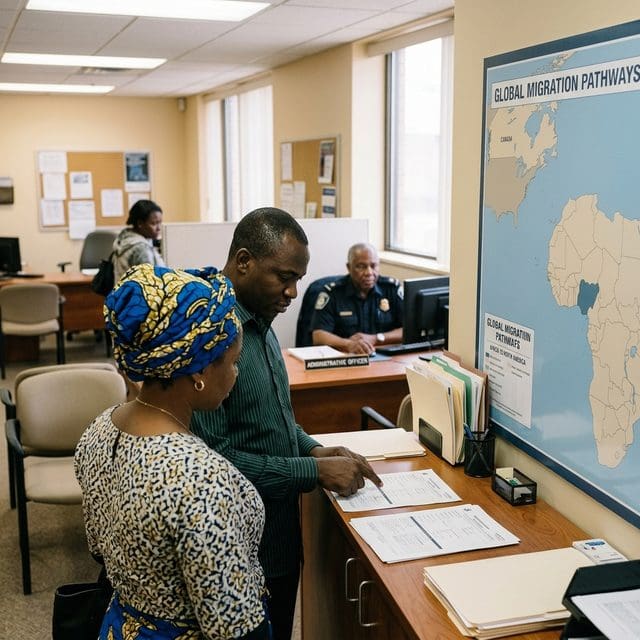
Nigeria reported thousands of refugees registering to return, while Canada tightened checks on employer-backed work permits and held a high-scoring immigration draw.
Nigeria’s plans for refugee returns, Canada’s immigration selection system and an alleged visa-fraud case in Port Harcourt offered distinct snapshots of migration policy and its enforcement on Tuesday.
Nigeria reported that 14,000 Nigerian refugees in Cameroon had registered their intention to return home. An agreement covering 2,000 Nigerians in Niger was also being finalised, according to reporting on the government’s update. The figures describe planned or pending repatriations, not completed journeys. Registration signals intent, but does not by itself establish when people will leave or what support they will receive after returning.
A separate Punch report said Nigeria’s humanitarian affairs minister had described more than 7,000 refugees as voluntarily returned during 2026 from neighbouring countries under tripartite agreements. That account differs in scope from the reported registration figures: one concerns people said to have returned, while the other concerns refugees in Cameroon who registered an intention to do so and an agreement still being finalised in Niger. The available reports do not reconcile the counts.
The distinction matters for tracking displacement. Return totals, registrations and agreements measure different stages of a process, and should not be treated as interchangeable indicators of how many people have safely resettled. The available material provides no further breakdown by location, timing or post-return conditions.
In Canada, Immigration, Refugees and Citizenship Canada issued 752 invitations to candidates in the Provincial Nominee Program through an Express Entry draw on October 13. The minimum Comprehensive Ranking System score was 772. Candidates at the cutoff needed to have submitted an Express Entry profile before 13:57:33 UTC on July 15, 2026, under the draw’s tie-break rule.
The draw illustrates how provincial nomination can shape access to permanent-residence selection, while the high minimum score reflects the threshold for this particular round. It does not, on its own, describe the full composition of Canada’s immigration intake or the number of people who will ultimately become permanent residents. An invitation is a step in the application process, not a final decision.
Canada has also updated guidance for officers assessing employer-specific work-permit applications. When an officer questions whether a job offer is genuine, the guidance calls for a procedural-fairness process that includes seeking information directly from the employer. The review may consider whether the employer is actively operating, has a genuine employment need, can meet the offer’s terms, and complies with recruitment and employment law.
The process places scrutiny on both the offer and the employer behind it. The guidance describes how questions should be examined; the material does not provide figures on refusals, investigations or the frequency of suspected fraudulent offers.
In Port Harcourt, Nigeria’s Economic and Financial Crimes Commission arraigned Modupe Oriyomi Ativie and Eudora and Aegle Management Consulting Limited in a five-count case involving alleged visa fraud, advance-fee fraud and obtaining money by false pretences. The allegations include a transaction involving promises of Canadian employment. Ativie pleaded not guilty, according to the EFCC account summarized by Punch.
The court ordered Ativie to remain in EFCC custody and set October 16 for a ruling on bail. The allegations have not been proven in court. Reports of the case included differing or unverified financial details, so no total is stated here.
Together, the developments show migration policy operating at several points: the practical accounting of refugee return, selection for permanent residence, verification of job offers and prosecution of alleged schemes targeting people seeking opportunities abroad. The available reports do not establish a broader trend, but they underscore why clear distinctions between intention, invitation, application and completed movement matter.

Julie Harris serves as a Staff Writer for Just Right News, where she tackles some of the most pressing and complex issues facing the nation today. As the lead reporter for the Migration, Demographics & Cultural Shifts beat, Julie provides a grounded, principled perspective on how the movement of people and the changing makeup of communities are reshaping the American landscape. Her work is defined by a commitment to exploring the long-term consequences of social change, prioritizing the stability of local institutions and the preservation of national identity.
Her deep understanding of these issues is rooted in her upbringing in Tucson, Arizona. Growing up in a prominent border state, Julie witnessed firsthand the intricate realities of migration and the profound impact it has on local infrastructure, law enforcement, and the social fabric. This early exposure instilled in her a respect for the rule of law and a keen awareness of the challenges that arise when federal policies fail to align with the needs of border communities. Her reporting often reflects this lived experience, bringing a necessary level of nuance to topics that are often treated with abstraction in coastal newsrooms.
Now based in Santa Fe, New Mexico, Julie continues to report from the heart of the American Southwest. Her location provides a unique vantage point to observe the intersection of traditional regional cultures and the modern shifts brought about by both internal and external migration. In Santa Fe, a city defined by its rich history and distinct cultural heritage, she finds a perfect environment to explore how communities strive to maintain their character while navigating the pressures of a rapidly changing world. This perspective allows her to bridge the gap between policy debates in Washington and the reality of life in the high desert.
At Just Right News, Julie’s work is characterized by a dedication to examining the data and the human stories that define the “New Mosaic” of America. Her signature feature series, “The New Mosaic,” has become a cornerstone of her reporting. Through this series, Julie explores the evolving social architecture of the United States, documenting how shifts in population affect everything from local economies to the political landscape. She brings a critical eye to the narrative of demographic inevitability, instead asking how these shifts impact the average citizen’s sense of belonging and the integrity of the American social contract.
Julie’s background and her dedication to conservative principles make her a vital voice in contemporary journalism. She understands that demographics are more than just numbers on a spreadsheet; they represent the future of the American family and the nation’s enduring legacy. Through her diligent reporting and insightful analysis, Julie Harris ensures that her readers are informed about the forces shaping their world, providing a perspective that is as thoughtful as it is necessary for the modern era.