

Reports from Jigawa and Keralam show how fuel access and environmental zoning decisions can directly affect farmers, while key details and official responses remain unresolved.
Two different pressures on agriculture are emerging in reports from Nigeria and India: farmers in Jigawa say fuel shortages are disrupting irrigation, while farmers in Kollam, in India’s Keralam state, are protesting a contested environmental zoning process. Neither report concerns U.S. food or water systems, and the available material does not establish effects on American consumers. But both illustrate how practical access to resources and the way land protections are drawn can shape farming decisions.
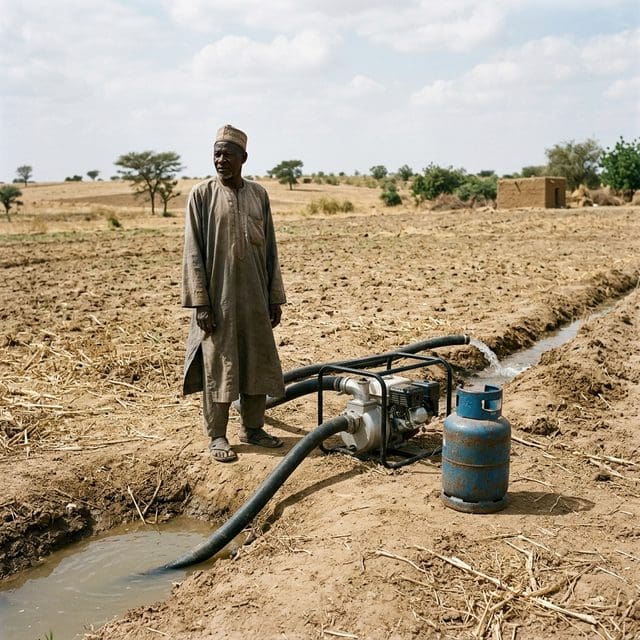
In Jigawa, farmers who switched from petrol to liquefied petroleum gas (LPG) to run irrigation equipment are now facing shortages, high prices and long waits, according to PUNCH’s October 9 report. The outlet reported that farmers said only two stations were consistently supplying Hadejia and nearby areas. Some described waiting much of the day to obtain fuel; one farmer from Auyo said fields had gone without irrigation for days.
The report did not provide independently verified supply data or establish how widespread the disruption is. Its account is based on farmers’ reports, and specific prices could not be confirmed from the available material. That leaves important questions unanswered: how much fuel is reaching farming areas, whether supply interruptions are temporary, and what steps officials can take to restore reliable access.
Those details matter because irrigation depends on more than the presence of water. Farmers need dependable power or fuel to move it when rainfall is insufficient. PUNCH reported farmers describing rainfall this year as inadequate and warning that prolonged LPG scarcity could damage output, particularly for rice, which requires regular watering. That is a concern raised by farmers and the Association of Foodstuff and Agro Producers of Nigeria (AFAN), not a measured forecast of crop losses.
AFAN’s Jigawa chairman, Idris Yau Maiunguwa, said the association would write to government and relevant authorities, PUNCH reported. The association has also helped distribute solar-powered pumping machines through a program with a two-year payback timeline, which it said would continue. The account offers no figures for the program’s scale or the number of farmers it has reached. Solar pumps may reduce exposure to fuel shortages where they are practical, but the report does not show whether they can meet the area’s broader irrigation needs.
In Keralam, the dispute is over a proposed Ecologically Sensitive Area (ESA) notification and the boundaries that determine which communities and land are included. The Hindu reported October 9 that the comment deadline for the Central government’s draft notification had arrived. The State government had submitted a report seeking the exclusion of residential areas, but a revised map had not yet been published.
That gap leaves residents and farmers without a final map to assess, even as decisions about sensitive-area boundaries can affect local land use. Farmers in Kollam have called for a shutdown from 6 a.m. to 6 p.m. on October 27, according to The Hindu. They allege that eight villages were left off an exemption list and object to the State government’s recommendations concerning other villages. The dispute remains tied to a draft process; the available reporting does not establish the final boundaries or the eventual rules for affected communities.
The two cases involve different governments and different challenges, and neither is evidence of a food-safety incident or environmental contamination. Their common thread is implementation: irrigation plans need dependable energy, while conservation rules need clear maps and a process that communities can scrutinize. In both places, the next test will be whether officials provide timely, verifiable information and address the practical concerns raised by farmers.

Eric Nolan serves as the Senior Correspondent for Food, Water, and Environmental Health at Just Right News, where he brings a principled, common-sense perspective to the most fundamental issues facing the American public. With a career dedicated to uncovering the truth behind the policies that govern our natural resources, Eric has become a trusted voice for readers who value traditional stewardship over bureaucratic overreach. His reporting is defined by a commitment to the idea that true environmentalism is rooted in the protection of the American family and the preservation of the nation’s agricultural heritage.
Raised in Fresno, California, Eric’s worldview was shaped in the heart of the San Joaquin Valley. Growing up in one of the world’s most productive agricultural hubs, he witnessed firsthand the vital connection between the land, the water, and the dinner table. In Fresno, he saw the resilience of farmers and the devastating impact that distant, top-down regulations can have on local communities. This upbringing instilled in him a deep respect for the producers who feed the country and a lifelong skepticism toward the alarmist narratives often pushed by mainstream media. For Eric, environmental health is not an abstract political talking point; it is a matter of ensuring that the people who work the land have the freedom and the resources to do so effectively.
Now based in Eugene, Oregon, Eric operates from a unique vantage point in the Pacific Northwest. Living in a region often defined by intense environmental debate, he provides a necessary counter-narrative to the prevailing trends of the area. From his base in Eugene, he monitors the shifting tides of federal and state policies, ensuring that the voices of rural citizens and property owners are not drowned out by urban activism. His reporting often bridges the gap between the rugged realities of the outdoors and the legislative halls where decisions are made, offering a grounded perspective that prioritizes local sovereignty and practical solutions.
As the lead for the acclaimed feature series “Earth on the Table,” Eric explores the intricate journey of the American food supply. He tackles critical issues such as water rights, soil health, and food security through a lens of national stability and individual liberty. He believes that a healthy environment and a thriving economy are not mutually exclusive, but rather two sides of the same coin of national prosperity. His work consistently highlights how innovation and private-sector ingenuity are the most effective tools for ensuring clean water and a safe food supply, rather than the expansion of the administrative state.
At Just Right News, Eric’s reporting serves as a vital resource for those who seek accountability and transparency. Whether he is investigating the impact of federal land management on local economies or examining the safety of the national food infrastructure, his work remains anchored in the values of heritage and hard work. Eric Nolan continues to be a leading voice in environmental journalism, championing the belief that the best way to protect our natural resources is to empower the people who live and work closest to them.