

Two new experiments show how quantum effects can be measured at larger scales and how quantum computers may help model particle collisions.
A quantum force moved a centimeter-scale mechanical assembly in a laboratory experiment, offering a striking demonstration of quantum physics acting on something large enough to see. But the finding is not evidence that the object itself occupied two quantum states at once: the measured motion was classical, the researchers say.
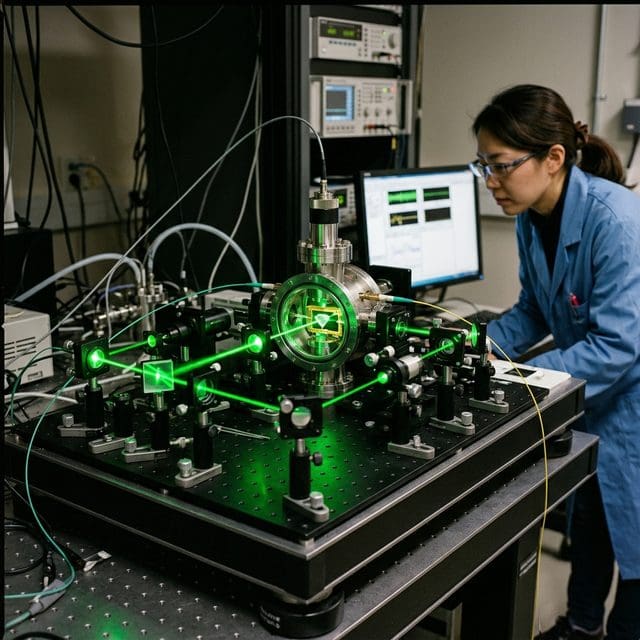
The team at the Okinawa Institute of Science and Technology used electron spins in diamond to produce the force. The diamond contains nitrogen-vacancy centers, defects whose electron spins can be controlled and measured. A laser prepared the spins, and an interferometer detected the mechanical response. The study, published in Science Advances and reported by Phys.org, describes a 100-milligram resonator—far more massive than those in earlier spin-mechanics experiments.
OIST professor Jason Twamley described the result as “a large classical response from a small quantum effect.” In practical terms, the quantum spins supplied a force, and sensitive instruments registered the resulting movement. That distinction matters: the experiment connects a quantum system to a comparatively large mechanical one, but it does not show the larger object behaving in a distinctly quantum way.
That boundary is the reason the result has drawn attention. Physicists want to understand how quantum rules give way to the familiar behavior of everyday objects. OIST describes the platform as a possible testbed for future work on macroscopic superposition and quantum gravity. Those are research goals, not conclusions established by this experiment. The team’s next target is to refine the conditions needed to create a superposition in a regime where gravity may become relevant.
A second report points toward another way quantum research could change physics: using quantum computers to model particle collisions. Researchers from the California Institute of Technology and the University of Washington developed a method to prepare long-range-entangled particle wavepackets with a constant number of circuit layers. Their approach combines measurements made during a computation with classical instructions that adjust later operations—a technique known as mid-circuit measurement and classical feedforward.
In a simulation of one-dimensional Ising field theory, low-energy collisions produced no new particles. At higher energies, the researchers found energy-density features consistent with a light particle converting into a heavier one. They identified the signal by measuring increased skewness, a way to describe how a distribution is asymmetrical. The work appeared in Nature Physics and was reported by Phys.org.
The distinction between a simulation and a discovery in nature is important. The computer produced a result within a simplified theoretical model; it did not observe a new particle in a laboratory collision. Still, the work demonstrates a route for studying the mathematics of particle interactions on quantum hardware. The preparation shortcut could help with calculations that become difficult for conventional computers as systems grow more complex.
Both developments are early steps, not final answers. The spin-mechanics experiment establishes a measurable link between quantum spins and large-scale classical motion, while leaving superposition and quantum-gravity tests for future work. The collision simulation is limited to one dimension, and extending such calculations to more realistic settings will require further advances.
No sufficiently specific, independently reported development in every requested area—quantum, particle, condensed-matter and quantum computing—was established in the available coverage from October 7–8. In particular, the material did not substantiate a new University of Illinois Urbana-Champaign result tied to either of these two experiments. The clearest thread this week is narrower but consequential: researchers are building ways to make quantum effects measurable and quantum theories more tractable, while being careful about what the experiments have—and have not—shown.

Ethan Blake serves as a Senior Correspondent for Just Right News, where he specializes in Longform Narrative and Public Understanding. In an era of rapid-fire headlines and fleeting soundbites, Ethan’s work stands as a testament to the power of deep-dive reporting and the importance of contextualizing the complex issues facing the nation today. His approach is rooted in the belief that the most profound truths are often found in the lived experiences of individuals rather than the abstract theories of distant policymakers.
Growing up in Providence, Rhode Island, Ethan developed an early appreciation for the historical and cultural threads that weave the American fabric together. Providence, a city defined by its industrial heritage and its blend of traditional neighborhoods, provided him with a front-row seat to the challenges and triumphs of the American working class. This upbringing instilled in him a respect for the “common sense” values of hard work, community loyalty, and the preservation of local institutions. He learned early on that behind every economic statistic or legislative debate, there are real families and neighborhoods navigating the consequences of change.
This foundational perspective is the driving force behind his signature feature series, “Lives Behind the Systems.” Through this series, Ethan explores the intersection of individual agency and institutional structure. Whether he is documenting the impact of federal land-use policies on rural families or examining how shifting educational standards affect local school boards, Ethan’s work prioritizes the human element. He seeks to uncover how large-scale systems—be they governmental, economic, or social—affect the daily lives of citizens, often advocating for a return to local control and personal responsibility.
Now based in Portland, Maine, Ethan draws significant inspiration from the rugged independence and self-reliance that define the region. The coastal landscape and the resilient spirit of Maine’s communities serve as a constant reminder of the importance of individual liberty and the strength found in decentralized power. Living and working outside the traditional media hubs allows Ethan to maintain a grounded perspective, ensuring his reporting remains untethered from the echo chambers of the major metropolitan centers. This geographic distance provides him with the clarity needed to translate complex national narratives into stories that resonate with the heart of the country.
At Just Right News, Ethan’s beat is more than just a professional assignment; it is a mission to foster a more informed and engaged citizenry. He believes that a free society depends on the public’s ability to understand the mechanisms of power and the value of traditional American principles. His longform narratives do not merely report the news; they provide a roadmap for understanding the cultural and political shifts of the modern era through a lens of skepticism toward centralized authority and a deep respect for the individual.
Through his meticulous research and narrative craftsmanship, Ethan Blake continues to bridge the gap between policy and the public. His work remains a vital resource for those who seek a deeper understanding of the systems that shape our world and the enduring spirit of the people who live within them.