

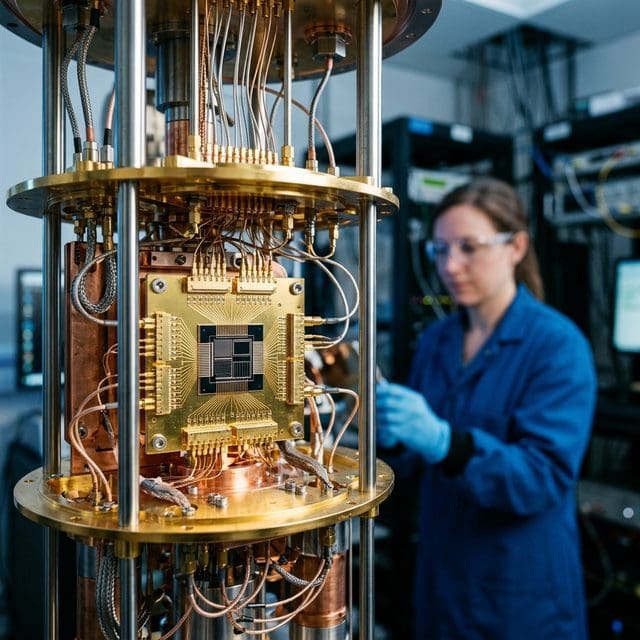
A study of 22 superconducting qubits links performance differences to fabrication geometry and surface chemistry, offering practical clues for making quantum hardware more consistent.
Quantum computers depend on devices so small that minute differences in how they are made can affect how well they work. A study highlighted Monday by The Quantum Insider links three such differences—oxide thickness, etched sidewall angle and trench depth—to performance variation of up to twofold among 22 superconducting transmon qubits.
The finding is not a new computing record, or evidence that a commercial machine has suddenly become twice as powerful. It is a manufacturing result, and that may matter for a technology whose progress depends on building many delicate components that behave predictably.
Transmon qubits are a widely used type of superconducting quantum bit. Like other qubits, they encode information in quantum states but are sensitive to their surroundings. The study, led by the Superconducting Quantum Materials and Systems center at Fermilab, examined how fabrication features and surface chemistry corresponded with performance differences. The analysis points to physical details that builders can measure and potentially control.
A useful quantum computer needs more than a handful of impressive components. Qubits must be made consistently and operate reliably enough to work together. Identifying variables associated with performance gives researchers concrete manufacturing questions to test. The study does not show that changing any single feature will deliver a specific improvement, but it narrows the search for sources of variation.
The Quantum Insider’s October 5 coverage also described University of Oldenburg research using two differently colored femtosecond laser pulses, aimed from converging directions, to create controllable three-dimensional light fields. In potassium atoms, the fields gave researchers access to previously unavailable electronic quantum states and allowed them to observe those states evolving over time. The team sees potential applications in studying chiral molecules, which have left- and right-handed structures.
The laser research and qubit study address different challenges: controlling and observing atoms, and making quantum-computing hardware more reproducible. Neither report announces a new particle discovery or a breakthrough in practical quantum advantage. Together, they show how progress can come from better experimental control as well as bigger machines.
Other quantum headlines this week concerned company and infrastructure plans, rather than comparable laboratory findings. SEALSQ Corp, a semiconductor and cybersecurity company traded on Nasdaq, and its parent WISeKey signed a memorandum with Switzerland’s Canton of Jura to establish a post-quantum semiconductor and cybersecurity center. The planned investment is CHF 40 million to CHF 60 million over six years, with about 150 qualified jobs expected within five years. SEALSQ has also disclosed more than $65 million deployed from a planned $200 million quantum initiative, with another $100 million earmarked through 2027. These are corporate plans, not evidence of a new quantum-computing capability.
German company planqc, honored at the Made in Europe Award 2026, says it is building a 100-qubit neutral-atom system for DLR and a 1,000-qubit system for LRZ, both expected in 2027. Hardware for the LRZ machine arrived in September, and application work is underway with Airbus, ESA, BMW and Fraunhofer. The systems remain under development.
Contrivian also launched a government division offering connectivity for federal and defense customers with post-quantum-ready encryption. The term describes preparation for future cryptographic threats; it does not mean quantum computers are already breaking today’s encryption.
For the qubit researchers, the next step is to test whether fabrication controls can reduce performance variation across larger batches. This week’s reports offer a grounded kind of excitement: progress may depend not only on grand claims, but on shaping light and manufacturing matter with greater precision.

Mason Reed serves as a Staff Writer for Just Right News, where he spearheads the Future Frontiers & Special Projects desk. In an era defined by rapid technological shifts and evolving social landscapes, Mason provides a steady, principled voice, examining the innovations of tomorrow through the lens of traditional American values. His work is most prominently featured in his signature series, “The Next Horizon,” where he explores the intersection of emerging technology, national sovereignty, and the preservation of individual liberty.
A native of San Diego, California, Mason’s worldview was shaped by the unique culture of his hometown. Growing up in a region defined by its strong military presence and its history of maritime industry, he developed a deep-seated respect for the institutions that provide national stability and the entrepreneurial spirit that drives the American economy. This upbringing instilled in him a belief that true progress is not found in discarding the past, but in building upon a foundation of proven principles. His reporting often reflects this San Diego influence, emphasizing the importance of a robust national defense and the necessity of maintaining a competitive edge in the global marketplace.
Now based in San Francisco, Mason operates from the heart of the world’s technological engine. Living and working in the Bay Area provides him with a front-row seat to the advancements—and the ideological challenges—emanating from Silicon Valley. While many in the region embrace a “move fast and break things” mentality, Mason’s reporting serves as a vital counterweight. He offers Just Right News readers a “boots on the ground” perspective, documenting how radical local policies and the concentration of tech power impact the everyday lives of citizens. His proximity to the industry allows him to cut through the marketing jargon of big tech to uncover the real-world implications for privacy, free speech, and the nuclear family.
In his “Future Frontiers” beat, Mason tackles complex subjects ranging from the ethics of artificial intelligence to the burgeoning private space race. He approaches these topics with a healthy skepticism toward centralized bureaucracy, championing instead the decentralized innovations that empower individuals. Through “The Next Horizon,” he highlights the pioneers and thinkers who are working to ensure that the future remains a place where human dignity and constitutional rights are protected. He believes that the rapid pace of change requires more than just technical expertise; it requires a moral compass rooted in the Western tradition.
Throughout his tenure at Just Right News, Mason has remained committed to the idea that the future is something to be shaped, not merely accepted. His writing is characterized by a rigorous defense of American exceptionalism and a belief that the country’s best days lie ahead, provided it remains true to its founding ideals. Whether he is investigating the impact of automation on the American workforce or profiling the next generation of aerospace engineers, Mason Reed ensures that his readers are equipped with the insights they need to navigate a changing world with confidence and clarity.