

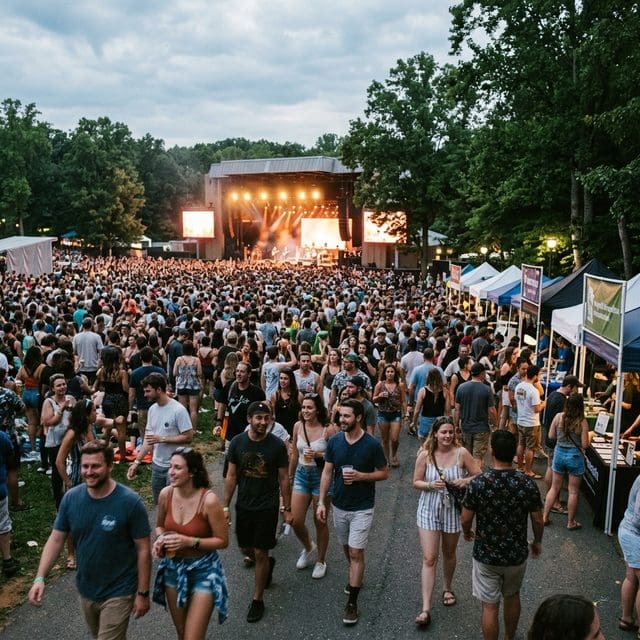
A sold-out Maryland concert brought major performers together with voter-registration groups and other organizations, making civic participation part of the event rather than an afterthought.
At Merriweather Post Pavilion in Columbia, Maryland, the music had company. Alongside performances by more than 25 artists, the October 3 Power to the People festival offered attendees a place to connect with civic groups, including the ACLU, Farm Aid, the National Domestic Workers Alliance and Oxfam.
The organizers called it Freedom Village. Its presence gave the sold-out concert a second purpose: making civic participation visible in a setting built around live music. Ticket proceeds supported VoteRiders and HeadCount, and VoteRiders said it aimed to reach 10 million voters ahead of November. Organizers also staged a writing campaign for first-time Pennsylvania voters.
The festival took place roughly one month before the midterm elections. That timing made voter outreach part of the event’s civic emphasis, alongside the work of organizations focused on civil liberties, farming, domestic workers and international aid. The accounts of the festival identify the groups and describe the voter effort, but provide little detail about individual attendees or what they did after leaving the grounds. They do not say how many people registered, sought assistance or changed their plans because of the event.
The performances supplied the scale and draw. Tom Morello’s festival included Dave Matthews and Foo Fighters’ Dave Grohl, and Bruce Springsteen joined them for the finale. More than 25 artists performed, according to local reporting, and the show sold out. Coverage described it as a celebration of peace, love, justice, music and community action.
The pairing matters because civic engagement is often treated as work that happens elsewhere: at an office, a meeting or a campaign event. Freedom Village brought organizations into the same venue as a large concert, where people had already gathered for music. Attendees could encounter the groups directly, rather than only hearing a cause named from the stage. The available reporting does not establish how many people visited the booths or what conversations took place, so the reach of that effort remains unclear.
VoteRiders’ stated goal of reaching 10 million voters conveys the ambition of its broader work, not the number reached through this particular festival. Similarly, the writing campaign for first-time Pennsylvania voters shows organizers trying to bring new voices into the election process, but reports do not specify how many letters were written or delivered. Those limits matter: an event’s scale and purpose are not the same as a measurable outcome.
Still, the festival offered a practical proposition. A concert crowd can be a starting point for action beyond the stage, particularly when groups doing civic or service work are present and accessible. That approach does not replace the less visible work of election administration, local organizing or helping an individual understand voting rules. It creates another route for people to find organizations that do that work.
The setting also reflects a familiar American pattern: people gathering around shared interests and, in the process, encountering ways to contribute to public life. Here, that shared interest was live music, and the roster brought together performers with large audiences. The civic component was not simply an issue mentioned between songs; it had a physical place at the festival and was supported by a portion of ticket proceeds directed to VoteRiders and HeadCount.
The event did not resolve political disagreements, and the available accounts do not suggest it was designed to. Its more modest promise was to put music and civic organizations in the same place at a moment when organizers were trying to reach voters. Whether that invitation reached far beyond Merriweather Post Pavilion remains an open question. What is clear is that, for one sold-out day in Maryland, voter outreach and community organizations were made part of the bill.

Ethan Blake serves as a Senior Correspondent for Just Right News, where he specializes in Longform Narrative and Public Understanding. In an era of rapid-fire headlines and fleeting soundbites, Ethan’s work stands as a testament to the power of deep-dive reporting and the importance of contextualizing the complex issues facing the nation today. His approach is rooted in the belief that the most profound truths are often found in the lived experiences of individuals rather than the abstract theories of distant policymakers.
Growing up in Providence, Rhode Island, Ethan developed an early appreciation for the historical and cultural threads that weave the American fabric together. Providence, a city defined by its industrial heritage and its blend of traditional neighborhoods, provided him with a front-row seat to the challenges and triumphs of the American working class. This upbringing instilled in him a respect for the “common sense” values of hard work, community loyalty, and the preservation of local institutions. He learned early on that behind every economic statistic or legislative debate, there are real families and neighborhoods navigating the consequences of change.
This foundational perspective is the driving force behind his signature feature series, “Lives Behind the Systems.” Through this series, Ethan explores the intersection of individual agency and institutional structure. Whether he is documenting the impact of federal land-use policies on rural families or examining how shifting educational standards affect local school boards, Ethan’s work prioritizes the human element. He seeks to uncover how large-scale systems—be they governmental, economic, or social—affect the daily lives of citizens, often advocating for a return to local control and personal responsibility.
Now based in Portland, Maine, Ethan draws significant inspiration from the rugged independence and self-reliance that define the region. The coastal landscape and the resilient spirit of Maine’s communities serve as a constant reminder of the importance of individual liberty and the strength found in decentralized power. Living and working outside the traditional media hubs allows Ethan to maintain a grounded perspective, ensuring his reporting remains untethered from the echo chambers of the major metropolitan centers. This geographic distance provides him with the clarity needed to translate complex national narratives into stories that resonate with the heart of the country.
At Just Right News, Ethan’s beat is more than just a professional assignment; it is a mission to foster a more informed and engaged citizenry. He believes that a free society depends on the public’s ability to understand the mechanisms of power and the value of traditional American principles. His longform narratives do not merely report the news; they provide a roadmap for understanding the cultural and political shifts of the modern era through a lens of skepticism toward centralized authority and a deep respect for the individual.
Through his meticulous research and narrative craftsmanship, Ethan Blake continues to bridge the gap between policy and the public. His work remains a vital resource for those who seek a deeper understanding of the systems that shape our world and the enduring spirit of the people who live within them.