

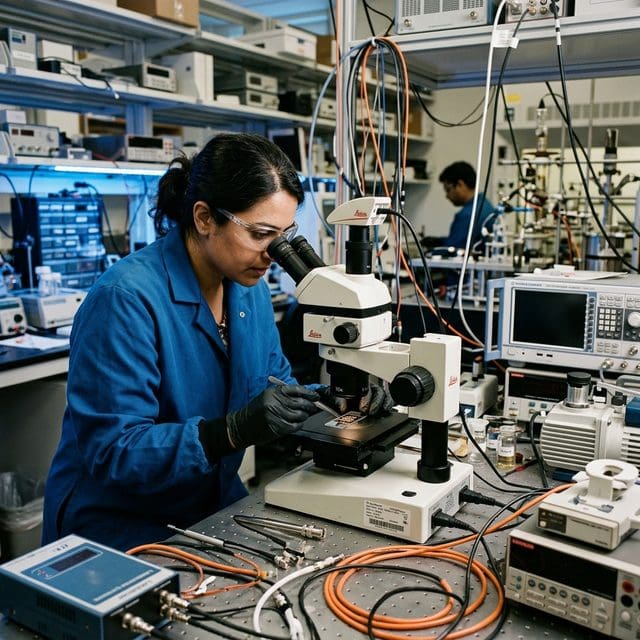
A terahertz cavity raised the critical temperature of a thin superconducting material by up to 5.4%, suggesting a new way to shape quantum matter.
A carefully engineered kind of “empty space” appears to have made a superconductor stronger. Researchers report that placing a thin flake of niobium diselenide inside a terahertz cavity raised its critical temperature—the point below which it superconducts—by as much as 5.4 percent. The material also carried more current and withstood a stronger magnetic field near the transition.
The finding is notable not because it delivers a ready-made device, but because it suggests a new way to influence quantum materials: changing their electromagnetic surroundings rather than directly driving the material with an external energy source. The study was published in Nature on August 19, 2026. October 3 coverage revisited the result; it was not a discovery first made that day.
The experiment used a six-layer flake of NbSe₂, a material that becomes superconducting at low temperatures. Superconductors conduct electricity without resistance, a property with potential uses in powerful magnets and sensitive instruments. Their usefulness is often limited by the temperatures and conditions needed to sustain that state.
Researchers placed the flake in a terahertz “dark cavity,” built around a split-ring resonator designed to shape quantum fluctuations of the electromagnetic field. Even a vacuum—the lowest-energy state of a field—is not simply featureless nothingness; quantum fluctuations can affect matter.
The researchers compared cavity-exposed and unexposed regions of the same flake, making it less likely that differences between samples explain the result. The enhancement was also resonant: it peaked when the cavity’s energy matched low-energy fluctuations associated with superconductivity, rather than appearing equally at any setting.
The proposed explanation is that the material’s fluctuating superconducting state interacts with cavity modes, potentially through virtual photons. That interaction may lower the energy of the superconducting state and make it more stable. This remains a proposed mechanism, not a settled explanation. The experiment provides evidence that a material’s electromagnetic environment can matter—and that its effects may be tuned.
The work brought together researchers at the University of Science and Technology of China (USTC), Shanghai Jiao Tong University and MIT. USTC led the experiment, including work by Changgan Zeng and Guanghui Cheng. Qingdong Jiang’s team at Shanghai Jiao Tong University contributed theoretical modeling and interpretation. Frank Wilczek held appointments at both the university’s Li Zhengdao Institute and MIT.
A separate recent result addresses another challenge in quantum technology: making operations faster. University of Pennsylvania researchers reported a room-temperature diamond system that generated a four-qubit Greenberger–Horne–Zeilinger, or GHZ, state in 14.8 microseconds. It used a nitrogen-vacancy center’s electron spin and three nearby carbon-13 nuclear spins. The parallel operation was about ten times faster than the sequential comparison, and improved measured fidelity from 0.69(3) to 0.92(4).
Published online in Nature Nanotechnology on September 14, the work is a four-qubit laboratory demonstration—not evidence that a scalable quantum computer is close. The cavity result has limits, too: a measured increase in one material under controlled conditions does not show that engineers can raise critical temperatures across superconductors generally.
The next tests will need to reproduce the effect, establish how it depends on cavity design and material, and determine whether the proposed mechanism applies more broadly. If the control proves robust, it could give researchers a new tool for designing quantum materials. For now, the central insight is that what surrounds a material may help determine how it behaves.

Ethan Blake serves as a Senior Correspondent for Just Right News, where he specializes in Longform Narrative and Public Understanding. In an era of rapid-fire headlines and fleeting soundbites, Ethan’s work stands as a testament to the power of deep-dive reporting and the importance of contextualizing the complex issues facing the nation today. His approach is rooted in the belief that the most profound truths are often found in the lived experiences of individuals rather than the abstract theories of distant policymakers.
Growing up in Providence, Rhode Island, Ethan developed an early appreciation for the historical and cultural threads that weave the American fabric together. Providence, a city defined by its industrial heritage and its blend of traditional neighborhoods, provided him with a front-row seat to the challenges and triumphs of the American working class. This upbringing instilled in him a respect for the “common sense” values of hard work, community loyalty, and the preservation of local institutions. He learned early on that behind every economic statistic or legislative debate, there are real families and neighborhoods navigating the consequences of change.
This foundational perspective is the driving force behind his signature feature series, “Lives Behind the Systems.” Through this series, Ethan explores the intersection of individual agency and institutional structure. Whether he is documenting the impact of federal land-use policies on rural families or examining how shifting educational standards affect local school boards, Ethan’s work prioritizes the human element. He seeks to uncover how large-scale systems—be they governmental, economic, or social—affect the daily lives of citizens, often advocating for a return to local control and personal responsibility.
Now based in Portland, Maine, Ethan draws significant inspiration from the rugged independence and self-reliance that define the region. The coastal landscape and the resilient spirit of Maine’s communities serve as a constant reminder of the importance of individual liberty and the strength found in decentralized power. Living and working outside the traditional media hubs allows Ethan to maintain a grounded perspective, ensuring his reporting remains untethered from the echo chambers of the major metropolitan centers. This geographic distance provides him with the clarity needed to translate complex national narratives into stories that resonate with the heart of the country.
At Just Right News, Ethan’s beat is more than just a professional assignment; it is a mission to foster a more informed and engaged citizenry. He believes that a free society depends on the public’s ability to understand the mechanisms of power and the value of traditional American principles. His longform narratives do not merely report the news; they provide a roadmap for understanding the cultural and political shifts of the modern era through a lens of skepticism toward centralized authority and a deep respect for the individual.
Through his meticulous research and narrative craftsmanship, Ethan Blake continues to bridge the gap between policy and the public. His work remains a vital resource for those who seek a deeper understanding of the systems that shape our world and the enduring spirit of the people who live within them.