

The White House pursues a multi-billion dollar Lukoil deal to resolve the Ukraine conflict while confronting Iranian-linked terror plots and Middle Eastern volatility.
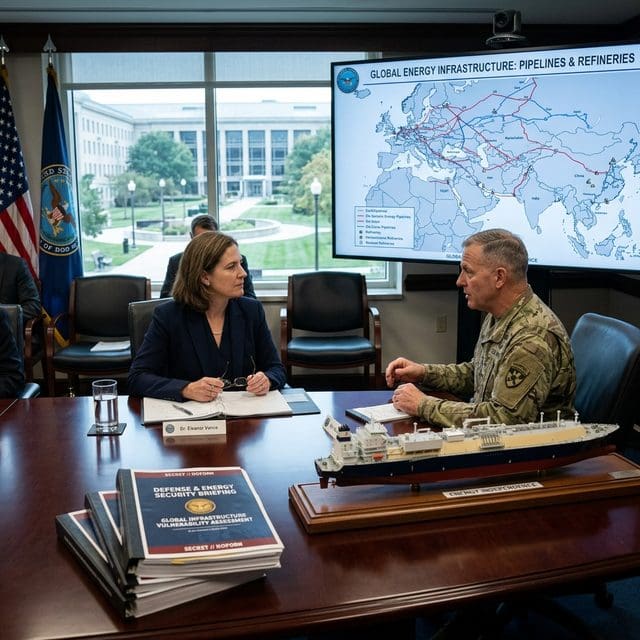
The Trump administration is executing a realist foreign policy that treats global energy markets as a primary lever for peace while maintaining a high-pressure campaign against Iranian regional aggression. Reports emerged on October 3 that negotiations to end the war in Ukraine have expanded into a potential multi-billion-dollar transaction involving Lukoil’s global oil fields, refineries, and gas stations. This proposal, reportedly discussed between Vladimir Putin and U.S. representatives Steve Witkoff and Jared Kushner, suggests that the administration is willing to utilize sanctions relief and private investment to secure a settlement in Eastern Europe. The deal reportedly involves investor Todd Boehly and Middle Eastern groups, highlighting a shift toward transactional diplomacy that prioritizes American economic interests and regional stability over traditional ideological alignment.
While these high-level talks proceed, the situation on the ground in Ukraine remains volatile. Russia has recently intensified its campaign, launching targeted retaliatory strikes on Kyiv and other urban centers, specifically targeting civilian infrastructure. These strikes have severely damaged the Northern Bridge and other crossings over the Dnipro River, disrupting the capital’s transport network. Moscow has justified this escalation as a response to Ukrainian attacks on Russian soil, even as the Kremlin faces domestic challenges, including reports of a quarantined plague outbreak that the regime has been accused of covering up.
In the Middle East, the administration’s focus on Iran remains unwavering. A taxpayer-funded advertisement aired on October 1 featured President Trump and Defense Secretary Pete Hegseth promoting the ongoing seven-month war against Iran, signaling to the American public that the conflict is central to national security. This hardline stance is mirrored by security developments in the United Kingdom, where British authorities recently thwarted Iranian-linked terror plots. Iranian nationals Rahman Salehi and Salam Ahmadyan appeared in court accused of planning a homemade bomb attack against the Manchester Jewish Museum and Heaton Park synagogue. Furthermore, a 25-year-old dual British-Iranian national was arrested in connection with a suspected plot at RAF Fairford, a base critical to U.S. and NATO operations. These incidents underscore the reach of Tehran’s proxy networks and the necessity of the administration’s containment strategy.
Defense Secretary Hegseth is simultaneously overseeing a radical restructuring of the Pentagon to ensure the military is prepared for these multi-theater challenges. On September 30, Hegseth announced a 20 percent reduction in the number of generals and admirals, a move designed to eliminate bureaucratic layers that hinder rapid decision-making. This structural overhaul is accompanied by a cultural shift, including the creation of a Pentagon Office of Religious Affairs reporting directly to the Secretary. These reforms aim to restore a focus on core mission readiness and traditional values within the armed forces.
Energy security continues to serve as the backbone of the administration’s domestic and foreign policy. The $54 billion South Korean investment in an Alaskan natural gas pipeline, announced by President Trump, represents a significant win for American energy independence and heartland jobs. This is particularly critical as global markets remain fragile; G7 nations recently agreed to release 100 million barrels of oil to mitigate supply shocks. The urgency of these measures was highlighted by recent Houthi ballistic missile attacks aimed at Khamis Mushait in Saudi Arabia and reports of a fire at an Aramco facility. By securing domestic production and negotiating global energy deals, the administration seeks to insulate the American economy from the persistent instability of the Middle East and the shifting alliances of the European continent.

Olivia Kendall serves as the Senior Correspondent for Geopolitics, Defense, and Foreign Policy at Just Right News, where she provides a principled, conservative perspective on the complex forces shaping the global stage. With a career dedicated to deconstructing the intricacies of international relations, Kendall has become a trusted voice for readers who value national sovereignty, a robust military, and a foreign policy that prioritizes American interests above all else.
A native of Washington, D.C., Kendall’s professional journey is deeply rooted in her upbringing within the nation’s capital. Growing up in the epicenter of American political life, she developed an early and profound understanding of how policy is crafted and, more importantly, how it often fails to account for the values of the American heartland. This unique vantage point allowed her to witness firsthand the rise of globalist bureaucracies, fueling her commitment to reporting that champions the constitutional foundations of the United States. Her background as a British White American further informs her worldview, providing her with a keen appreciation for the Western tradition and the enduring importance of the “Special Relationship” in maintaining global stability.
Now based in Arlington, Virginia, Kendall operates from the doorstep of the Pentagon and the heart of the nation’s defense establishment. Her proximity to the decision-makers in the military and intelligence communities allows her to provide boots-on-the-ground reporting that is both timely and deeply informed. For Kendall, Arlington is more than just a base of operations; it is a daily reminder of the sacrifices made by the men and women in uniform. This connection to the defense community drives her rigorous coverage of military readiness and her advocacy for a “peace through strength” approach to diplomacy.
At Just Right News, Kendall is perhaps best known for her acclaimed feature series, “The World’s Shadow on America.” In this ongoing project, she explores the direct correlation between international developments and the daily lives of American citizens. Whether she is analyzing the encroachment of foreign adversaries in domestic supply chains or the impact of international treaties on local economies, Kendall’s work serves as a vital bridge between distant geopolitical shifts and their consequences at home. She rejects the notion that foreign policy is an abstract concern for elites, instead proving that what happens in the corridors of power in Brussels or Beijing has a tangible “shadow” that falls across every American doorstep.
Throughout her tenure, Kendall has remained a steadfast critic of international overreach and a vocal proponent of a clear-eyed, realistic foreign policy. She brings a sharp analytical mind to her beat, often challenging the prevailing narratives of the mainstream media to uncover the underlying truths that affect national security. Her reporting is characterized by a refusal to compromise on the truth and a dedication to the idea that a strong, secure America is the world’s best hope for liberty. As a Senior Correspondent, Olivia Kendall continues to lead the charge in providing the essential context and conservative insight necessary to navigate an increasingly volatile world.