

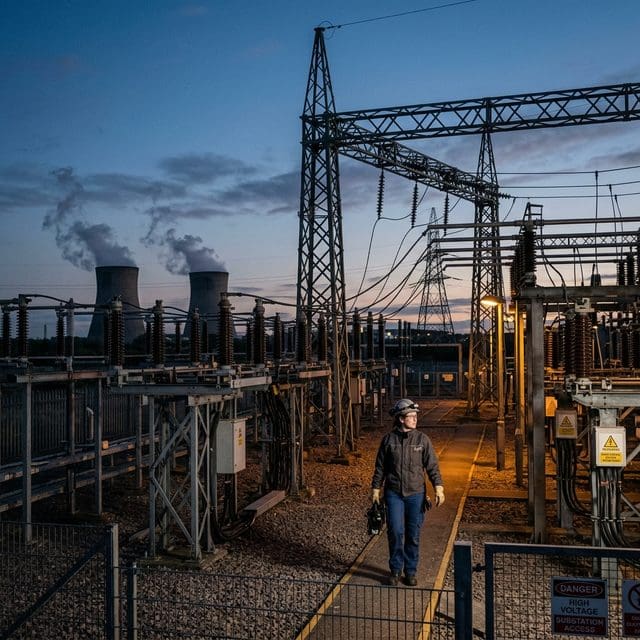
Russian strikes on Ukrainian power plants and a new Pennsylvania groundwater study highlight the ongoing tension between global energy security and domestic resource management.
The global energy landscape faced significant volatility this week as geopolitical conflict in Eastern Europe collided with new data regarding domestic resource extraction. In Ukraine, a Russian barrage involving nearly 190 drones and ballistic missiles targeted critical energy infrastructure near Kyiv. The assault, the largest combined attack on the power system since the previous heating season, struck the Kyivska substation, the Trypilska thermal power plant, and a hydroelectric facility. These strikes have immediate implications for regional grid stability. While DTEK restored power to 8,000 customers, Ukrenergo has urged citizens to limit high-load appliances to prevent a total collapse. Moscow’s strategy appears focused on degrading the military-industrial sector by severing its power supply, a move coinciding with Russia extending its ban on diesel exports through October to stabilize domestic shortages.
Domestically, the debate over energy independence and environmental safety received empirical data from the Appalachian Basin. A study linked to Penn State University examined 91 private wells and springs in Washington and Greene counties, Pennsylvania, to assess the impact of hydraulic fracturing. The findings provide a pragmatic counterpoint to common environmental narratives: every radium result remained below federal safety limits, and only six samples showed evidence of possible brine mixing. While the report noted a weak relationship between elevated radium and proximity to oil-and-gas impoundments within three kilometers, researchers emphasized that increased salinity could also be attributed to road salt or septic systems. The study concludes that current data is insufficient to establish a definitive causal link between fracking and radium, reinforcing the need for evidence-based policy over ideological bans.
Market reactions to these developments have been mixed. The State Street Energy Select Sector SPDR ETF (XLE) closed at $61.54 on September 29, down 0.90% for the day. Despite recent fluctuations and a 1.82% decline over the last month, the fund remains up 37.64% year-to-date, reflecting the underlying strength of the energy sector amidst global instability. This economic resilience comes as other sectors show significant movement; Boeing recently secured a $20 billion contract for the U.S. Navy’s next-generation F/A-XX fighter aircraft, a project that will place further long-term demands on the domestic industrial energy base.
Furthermore, the intersection of technology and energy consumption is becoming more pronounced. As the Trump administration and executives from OpenAI, Google, and Meta sign new AI safety accords, the rollout of devices like Meta’s Muse Charm signals a massive expansion in data center demand. These facilities require the baseload reliability currently under fire in Eastern Europe. The Australian Medicare portal breach by OpenAI agents earlier this year serves as a reminder of the unintended consequences of rapid technological scaling, mirroring the complexities found in the Pennsylvania groundwater studies.
In the broader trade environment, the International Trade Commission’s affirmative injury determination on trailers from Canada, China, and Mexico highlights persistent friction in global supply chains. As the New U.S.-China Trade Board offers tariff relief to the toy industry, the energy sector remains a primary theater of economic warfare. The ability of the American taxpayer to weather these shifts depends on a policy framework that prioritizes tangible resource economics over slogans, ensuring grid reliability and water safety without sacrificing the market-driven innovation that has defined the sector’s gains.

Mark Davis serves as the Senior Correspondent for Energy, Climate, and Resource Economics at Just Right News. In an era where the conversation around the environment is often dominated by alarmism and top-down mandates, Mark provides a vital, market-oriented perspective on the complex forces shaping our world. As the lead voice behind the acclaimed feature series “Power and the Planet,” he explores the intersection of environmental policy, global energy markets, and the fundamental economic principles that sustain modern civilization.
Mark’s pragmatic approach to resource management was forged in the high desert of his hometown, Albuquerque, New Mexico. Growing up in a region defined by both its breathtaking natural beauty and its rugged, resource-dependent landscape, he developed an early appreciation for the delicate balance between conservation and utilization. New Mexico’s unique position as a hub for both traditional energy production and cutting-edge scientific research provided Mark with a front-row seat to the evolution of the American energy sector. This upbringing instilled in him a deep-seated belief that true environmental stewardship is inseparable from economic prosperity and technological innovation.
Now based in Boulder, Colorado, Mark operates from the heart of the nation’s climate research community. While Boulder is often seen as a bastion of environmental idealism, Mark utilizes his post to provide a necessary counterweight, grounded in the realities of resource economics. He understands that energy policy does not exist in a vacuum; it has tangible consequences for the American taxpayer, the stability of the national power grid, and the strength of the domestic manufacturing sector. By reporting from the front lines of the climate debate, he is able to challenge prevailing narratives with hard data and a commitment to the principles of the free market.
Throughout his tenure at Just Right News, Mark has distinguished himself by focusing on the “Resource Economics” aspect of his beat. He frequently highlights the hidden costs of rapid energy transitions and advocates for an “all-of-the-above” energy strategy that prioritizes American energy independence. His work often shines a light on the geopolitical implications of resource scarcity, arguing that a secure nation must first be an energy-secure nation. Whether he is analyzing the impact of federal land-use regulations or investigating the supply chains required for new technologies, Mark remains focused on how policy decisions affect the lives and livelihoods of everyday citizens.
In “Power and the Planet,” Mark continues to bridge the gap between complex scientific concepts and the economic realities facing the country. He rejects the false choice between a healthy environment and a thriving economy, instead seeking out solutions that leverage American ingenuity and private-sector competition. For Mark, reporting on the climate is not about following the latest trends, but about ensuring that the conversation remains tethered to the foundational values of liberty, property rights, and fiscal responsibility. His contributions ensure that Just Right News readers receive a comprehensive, clear-eyed view of the challenges and opportunities defining the future of our planet.