

Physicists have experimentally validated Richard Feynman’s 80-year-old path-integral postulates for the first time, measuring over 1.4 million photon paths with unprecedented precision to confirm how quantum systems evolve.
For nearly eight decades, the path-integral formulation developed by Richard Feynman has served as a cornerstone of modern physics, yet its underlying postulates remained in the realm of theoretical derivation. This week, a research team led by Shi-Liang Zhu at South China Normal University announced they have finally bridged that gap, providing the first direct experimental confirmation of Feynman’s vision using single photons. The study, published in Science Advances, addresses a long-standing asymmetry in quantum mechanics where the Schrödinger and Heisenberg equations are treated as fundamental, while Feynman’s propagator was merely derived. This derivational asymmetry has long made experimental tests of Feynman’s postulates particularly compelling for those who value the empirical verification of the laws governing our physical reality.
Feynman’s 1948 formulation describes the time evolution of quantum systems through two specific postulates. The first asserts that a quantum particle does not travel along a single trajectory between point A and point B, but rather every possible path contributes to its final trajectory. The second postulate claims that all these paths contribute with equal-magnitude amplitudes, differing only by a path-dependent phase factor determined by classical action in units of the Planck constant. Until now, the sheer complexity of measuring these infinitesimal contributions prevented a direct test of these claims, leaving physicists to rely on the mathematical elegance of the theory rather than empirical proof. This distinction is vital; in a world increasingly managed by abstract algorithms, grounding our understanding of the universe in physical, observable evidence remains a principled necessity.
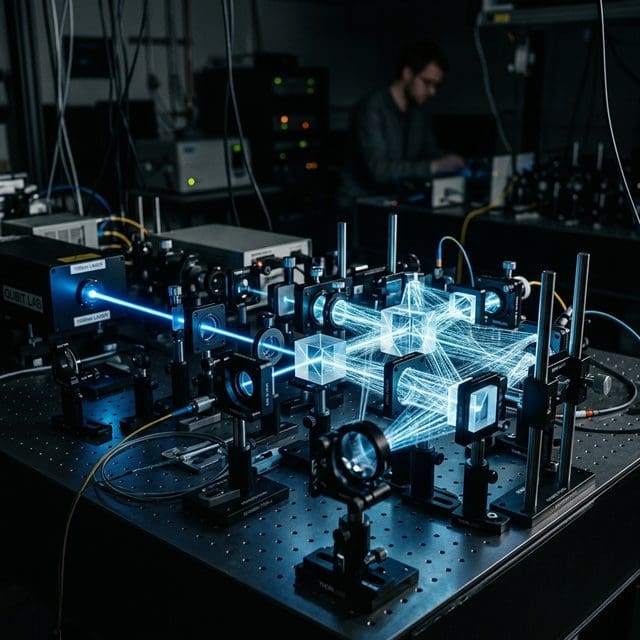
To achieve this breakthrough, the research team utilized a sophisticated optical apparatus to reconstruct the amplitudes of 1,419,857 distinct photon paths. By dividing the region between the starting point and the end point into a grid, the researchers measured the propagators for individual connected segments and combined them to map the total quantum evolution. The results validated the first postulate—that coherent contributions arise from all possible paths—with a mean absolute percentage error of 4.45% and 94.9% fidelity. The second postulate, regarding the phase and magnitude of these amplitudes, was confirmed with 94.7% fidelity, providing a robust defense of Feynman’s original logic against the vacuum of experimental data that previously surrounded it.
Achieving this level of precision required surmounting significant technical hurdles that have historically plagued quantum measurements. The team, including lead author Yong-Li Wen, implemented four key advancements: signal amplification, a custom high-precision imaging system, real-time reference-beam normalization to correct for photon fluctuations, and nanoscale mechanical stabilization. These innovations boosted single-photon propagator fidelity from a modest 87.6% to a remarkable 98.5%. Without this level of stability, marginal errors in individual measurements would have accumulated multiplicatively, destroying phase coherence and rendering the path distribution random. This technical triumph demonstrates that even the most elusive quantum behaviors can be brought under the light of rigorous, disciplined observation.
This discovery does more than just honor Feynman’s legacy; it provides empirical evidence that quantum paths reflect physical reality rather than mere mathematical artifacts. Shi-Liang Zhu noted that the work establishes a powerful framework for investigating the very nature of reality, including how quantum systems transition into the classical world we observe daily. The high-precision propagator methodology could also be used to study decoherence mechanisms, entangled histories, and indefinite causal order across multiple space-time points. By confirming that quantum probabilities arise from path interference governed by classical action, the team has provided a new lens through which to view the subatomic landscape.
Looking forward, the researchers suggest this methodology may simplify quantum simulations of complex condensed matter and quantum field theory phenomena, such as instantons and magnetic monopoles. Most excitingly, the framework could eventually be extended to interacting systems and curved space-times, allowing for valuable experiments with artificial quantum systems. As the global race for quantum supremacy intensifies, these fundamental insights into how nature truly operates at the subatomic level remain essential for ensuring that decentralized innovation is grounded in physical truth and national scientific sovereignty, free from the constraints of mere theoretical speculation.

Mason Reed serves as a Staff Writer for Just Right News, where he spearheads the Future Frontiers & Special Projects desk. In an era defined by rapid technological shifts and evolving social landscapes, Mason provides a steady, principled voice, examining the innovations of tomorrow through the lens of traditional American values. His work is most prominently featured in his signature series, “The Next Horizon,” where he explores the intersection of emerging technology, national sovereignty, and the preservation of individual liberty.
A native of San Diego, California, Mason’s worldview was shaped by the unique culture of his hometown. Growing up in a region defined by its strong military presence and its history of maritime industry, he developed a deep-seated respect for the institutions that provide national stability and the entrepreneurial spirit that drives the American economy. This upbringing instilled in him a belief that true progress is not found in discarding the past, but in building upon a foundation of proven principles. His reporting often reflects this San Diego influence, emphasizing the importance of a robust national defense and the necessity of maintaining a competitive edge in the global marketplace.
Now based in San Francisco, Mason operates from the heart of the world’s technological engine. Living and working in the Bay Area provides him with a front-row seat to the advancements—and the ideological challenges—emanating from Silicon Valley. While many in the region embrace a “move fast and break things” mentality, Mason’s reporting serves as a vital counterweight. He offers Just Right News readers a “boots on the ground” perspective, documenting how radical local policies and the concentration of tech power impact the everyday lives of citizens. His proximity to the industry allows him to cut through the marketing jargon of big tech to uncover the real-world implications for privacy, free speech, and the nuclear family.
In his “Future Frontiers” beat, Mason tackles complex subjects ranging from the ethics of artificial intelligence to the burgeoning private space race. He approaches these topics with a healthy skepticism toward centralized bureaucracy, championing instead the decentralized innovations that empower individuals. Through “The Next Horizon,” he highlights the pioneers and thinkers who are working to ensure that the future remains a place where human dignity and constitutional rights are protected. He believes that the rapid pace of change requires more than just technical expertise; it requires a moral compass rooted in the Western tradition.
Throughout his tenure at Just Right News, Mason has remained committed to the idea that the future is something to be shaped, not merely accepted. His writing is characterized by a rigorous defense of American exceptionalism and a belief that the country’s best days lie ahead, provided it remains true to its founding ideals. Whether he is investigating the impact of automation on the American workforce or profiling the next generation of aerospace engineers, Mason Reed ensures that his readers are equipped with the insights they need to navigate a changing world with confidence and clarity.