

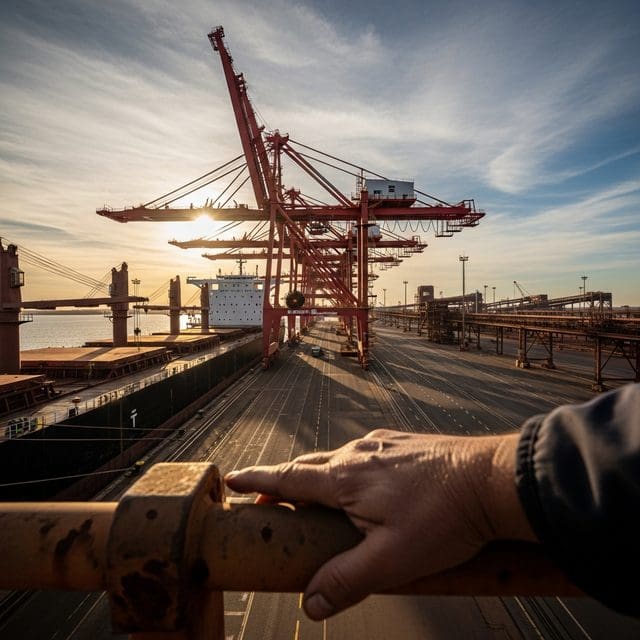
Industrial action at the world’s largest iron ore hub and revelations of undeclared uranium in cobalt shipments highlight the fragility of global resource dependencies.
The delicate machinery of global trade faced significant friction this week as labor unrest in Australia and a mineral scandal in the Democratic Republic of Congo (DRC) exposed the vulnerabilities of the international supply chain. For the American worker, these events serve as a reminder that reliance on distant, unstable nodes for raw materials is a gamble with national prosperity. As the Pentagon currently presses the U.S. defense industry to accelerate weapons production, the stability of these global pipelines is critical.
At Port Hedland, the world’s largest iron ore export hub, BHP operations were throttled as more than 150 workers converted a planned 24-hour ban into a full weekend walkout on August 8 and 9. This marks the first major industrial action at the facility in over two decades. The port handles approximately 75% of the Pilbara region’s iron ore exports, with daily revenues estimated at $80 million. The Chamber of Minerals and Energy of Western Australia warned that a single 24-hour stoppage costs the regional government $7 million in royalties. While BHP utilized non-union contingency staff to load seven ships, the threat of rolling industrial action remains high until the next bargaining session on August 18.
Simultaneously, a geopolitical shadow has fallen over the cobalt trade, essential for everything from electric vehicle batteries to advanced munitions. A joint investigation by Lighthouse Reports and the Financial Times revealed that between 2,000 and 5,000 tonnes of natural uranium were exported from the DRC to China between 2000 and 2024. This uranium was reportedly embedded in cobalt-hydroxide shipments and never declared to the International Atomic Energy Agency (IAEA). The DRC government has since opened a probe into these China-bound exports. While there is no evidence yet that China has weaponized this material, the volume—enough to fuel a reactor for a decade—exposes massive regulatory gaps in the global mineral trade.
These developments arrive as domestic sensitivity toward trade and labor intensifies. While U.S. jobless claims reached their lowest level since 1969 in early August, the broader labor market has shown signs of cooling, with C-suite uncertainty rising due to shifting trade policies. Domestically, labor tensions are also rising; over 2,000 Teamsters in Contra Costa County have announced a strike date for August 19, following a recently settled six-week strike by Teamsters at Open Kitchens. These domestic movements mirror frustrations seen abroad, as workers demand their share of the enterprise be protected against inflationary pressures.
From the docks of Australia to the mines of the Congo, the journey of things is becoming more perilous. The current administration’s focus on domestic manufacturing and the recent confirmation of Todd Blanche as Attorney General signal a shifting regulatory landscape, but the fundamental issue remains: as long as the American supply chain is tethered to globalist efficiencies and foreign bottlenecks, the stability of the local workforce remains at the mercy of distant disruptions. True sovereignty requires a return to domestic production where materials and labor are governed by American standards, not the whims of international conglomerates or undeclared foreign interests.

Sean Bradley serves as the Senior Correspondent for Trade, Supply Chains, and Global Labor at Just Right News, where he brings a principled, clear-eyed perspective to the complex systems that power the modern world. With a focus on the economic forces that impact the American household, Bradley has distinguished himself as a leading voice in explaining how global shifts in manufacturing and logistics translate to the kitchen table.
Growing up in Long Beach, California, Bradley’s interest in the movement of goods was forged against the backdrop of one of the nation’s most vital maritime gateways. Raised in a community where the towering cranes of the port were a constant fixture on the horizon, he developed an early appreciation for the blue-collar industries that form the backbone of the American economy. This upbringing instilled in him a profound respect for the dockworkers, truckers, and laborers who keep the country moving, a sentiment that remains a cornerstone of his reporting today. For Bradley, trade is not merely a series of abstract figures on a spreadsheet; it is a human endeavor that sustains families and defines the strength of a nation.
Now based in Seattle, Washington, Bradley occupies a strategic vantage point in another of the country’s most significant trade hubs. His location allows him to witness firsthand the intersection of traditional industry and the evolving technological landscape of global logistics. From the Pacific Northwest, he monitors the flow of goods across the ocean, providing Just Right News readers with timely insights into how international tensions, regulatory hurdles, and labor disputes affect the availability and cost of essential goods.
His signature feature series, “The Journey of Things,” has become a staple for readers seeking to understand the intricate path products take from raw materials to the retail shelf. Through this series, Bradley pulls back the curtain on the global marketplace, often highlighting the risks of over-reliance on foreign adversaries and the importance of domestic manufacturing resilience. His reporting consistently emphasizes the conservative values of national sovereignty, free-market competition, and the protection of the American worker from unfair global practices.
As a journalist of Irish heritage, Bradley maintains a deep-seated respect for the dignity of the individual worker and the importance of community stability. He approaches his beat with a commitment to transparency, often questioning the status quo of globalist policies that prioritize corporate efficiency over local prosperity. Whether he is reporting from a warehouse floor or analyzing a new international trade agreement, his goal remains the same: to provide the American public with the truth about where their products come from and what it costs to get them there.
Throughout his tenure at Just Right News, Bradley has remained a steadfast advocate for economic common sense. His work serves as a vital resource for those who believe that a strong nation is built on secure borders, robust trade, and a respected workforce. By combining his local roots in Long Beach with his professional experience in Seattle, Bradley continues to offer a unique and necessary perspective on the forces that shape the American way of life.