

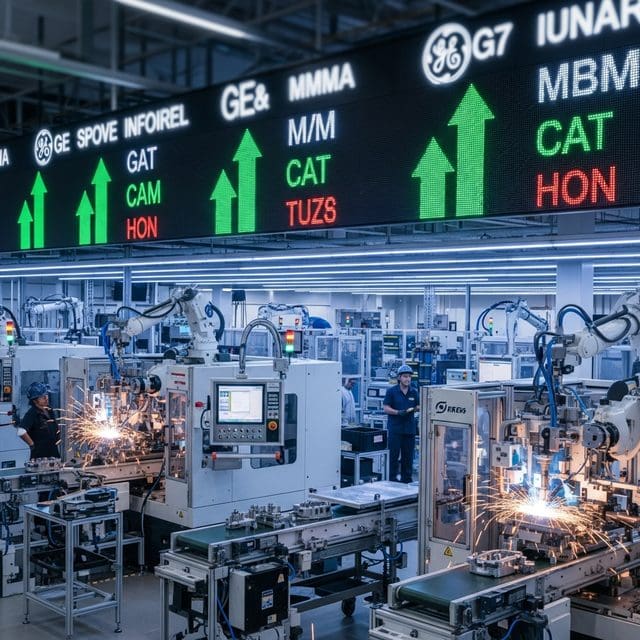
Major indices show mixed results as investors shift capital from high-growth technology into cyclical industrials and materials, despite the S&P 500 trading slightly below flat.
The American financial landscape is currently defined by a notable shift in investor sentiment, as the relentless rally in mega-cap technology names gives way to a more disciplined, value-oriented approach. While the S&P 500 (SPY) is trading down approximately 0.12% on the session, the headline figure masks a significant internal rotation that favors the backbone of the domestic economy: industrials and materials. This movement suggests that capital is not fleeing the market in a panic, but rather seeking refuge in sectors with tangible assets and reliable cash flows. The CBOE Volatility Index (VIX) remains subdued at 15.81, down 4.2%, further indicating that today’s tech pullback is a calculated profit-taking event rather than a broader systemic alarm.
Market data reveals a stark divergence between growth and value. The tech-heavy Nasdaq Composite recently snapped a four-day winning streak, weighed down by cooling enthusiasm for AI giants and semiconductor weakness, particularly following disappointing sentiment in chip names. Conversely, the Dow Jones Industrial Average has managed to push toward new all-time highs, closing recently at 54,349.12. This shift is mirrored in sector-specific performance, where the Industrials Select Sector SPDR (XLI) advanced 1.8% and Materials (XLB) rose 1.9%, even as the broader S&P 500 faced downward pressure. For the American household, this indicates that the “Invisible Economy”—the one built on physical goods and infrastructure—is showing more resilience than the speculative digital frontier.
For the working public, the strength in industrials and construction is supported by a labor market that remains historically tight. U.S. jobless claims have reached their lowest levels since 1969, a feat that contradicts fears of an imminent economic slowdown. This labor resilience, paired with early job growth momentum in manufacturing, provides a sturdy floor for the consumer sector. Even as high-flying tech firms like SpaceX navigate complex insider share sales involving 911.5 million shares and massive $64 billion capital spending ramps, the broader market breadth remains healthy. On the New York Stock Exchange, advancers are outnumbering decliners, with 25 new 52-week highs against only two new lows, signaling that the average company is performing better than the cap-weighted indices suggest.
Corporate activity further underscores this industrial renewal and the drive for national sovereignty in production. Recent acquisitions, such as Industrial Control Solutions picking up Modern Instrument Company, highlight a commitment to aerospace temperature validation and calibration services. This is not just a financial transaction; it is an investment in the precision and quality of American manufacturing. Simultaneously, the financial sector is seeing movement toward decentralized stability, evidenced by Zaria Systems filing to charter a National Trust Bank and the launch of the Traxxion Wallet. These tools, offering earned wage access to frontline workers, point to a financial system that is slowly adapting to the needs of the working public rather than just the interests of centralized growth hubs.
While international markets, particularly in Asia, have felt the sting of semiconductor volatility—with the KOSPI dropping 4.58% due to chip weakness—domestic cyclicals continue to grind higher. The current market posture reflects a de-risking from AI hype in favor of pro-cyclical stability, aided by expectations of Middle East peace-deal frameworks that keep futures supported. Even housing markets in regions like Texas show continued interest, with international buyers purchasing $4 billion in homes, up to 7,780 units year-over-year. As long as the labor market holds its historic ground and industrial investment continues to outpace speculative growth, the economic reality for Main Street appears better positioned to weather the cooling of the tech sector than the headline numbers might imply.

Jordan Lee serves as the Senior Correspondent for Wall Street, Finance, and Monetary Systems at Just Right News. Based in the heart of the world’s financial capital, New York City, Lee brings a sharp, principled eye to the complex mechanisms that drive the global economy. His reporting is defined by a commitment to fiscal responsibility, the defense of the free market, and a deep-seated belief that a transparent monetary system is the bedrock of a free society.
Raised in Portland, Oregon, Lee’s perspective was forged in a city that has undergone significant cultural and economic shifts. His upbringing in the Pacific Northwest instilled in him a profound appreciation for the industriousness of small business owners and the importance of local economic stability. Watching the evolution of his hometown’s landscape sparked an early interest in how federal fiscal policy and large-scale financial trends eventually trickle down to the average citizen. This background provides him with a unique vantage point; he understands the growing disconnect between the policy-making elite and the reality of Main Street, a theme that frequently resonates throughout his work.
Now operating from his base in New York City, Lee bridges the gap between the high-stakes trading floors of Manhattan and the households of everyday Americans. He views the financial sector not merely as a collection of numbers and tickers, but as a vital engine of American prosperity that requires constant vigilance and accountability. His reporting often highlights the dangers of centralized financial control and the necessity of maintaining a system that rewards merit, risk-taking, and innovation.
As the creator and lead of the featured series, “The Invisible Economy,” Lee pulls back the curtain on the often-opaque world of monetary systems. He specializes in translating the dense jargon of central banking and international finance into actionable insights for the Just Right News audience. His work explores the “invisible” forces—such as inflationary pressures, regulatory creep, and the expansion of the administrative state—that erode the purchasing power of American families. By focusing on these systemic issues, Lee empowers readers to understand the hidden forces shaping their financial independence.
Lee’s journalistic philosophy is rooted in a steadfast commitment to traditional American values. As an Asian American professional who has navigated the competitive corridors of the financial world, he is a vocal advocate for meritocracy and the preservation of the American Dream. He believes that a stable currency and a predictable regulatory environment are essential for national sovereignty and individual liberty. His reporting frequently warns against the risks of government overreach in the private sector, arguing that the most effective solutions to economic challenges arise from competition and individual enterprise rather than bureaucratic mandates.
At Just Right News, Jordan Lee remains dedicated to providing a clear-eyed defense of the taxpayer. Whether he is analyzing market volatility or investigating the long-term implications of national debt, his mission is to provide the truth about where the money is going and what it means for the future of the country. Through his rigorous analysis and principled stance, Lee has become a trusted voice for those who value a strong, sovereign, and fiscally sound America.