

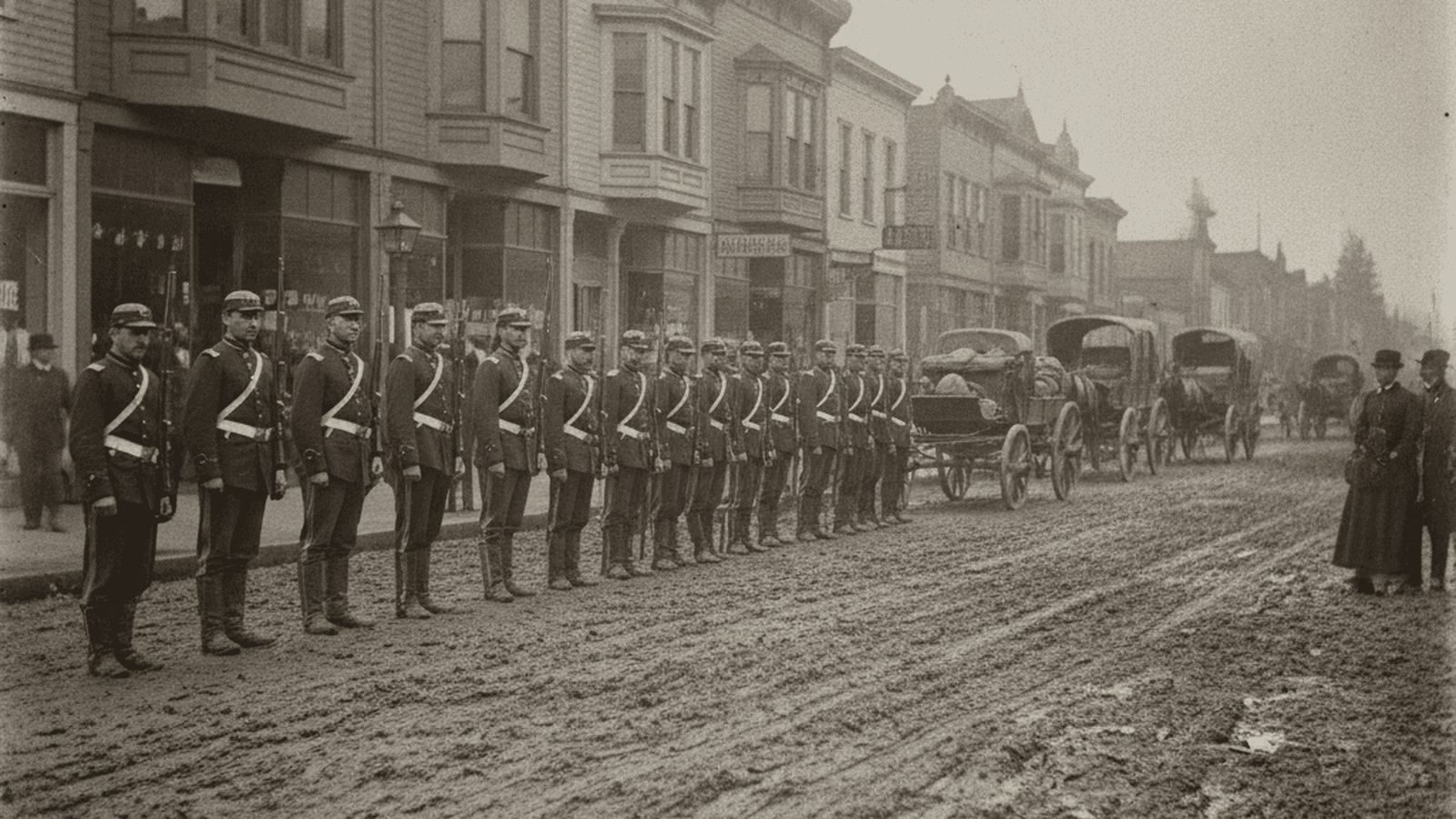
In 1886, President Grover Cleveland utilized executive power to declare martial law in Seattle, Washington Territory, following violent anti-Chinese riots. This intervention by the United States federal government marked a significant use of the Insurrection Act to suppress local unrest and protect treaty rights.
TLDR: In February 1886, President Grover Cleveland issued a proclamation of martial law in Seattle to quell violent anti-Chinese mobs. By deploying federal troops to the Washington Territory, Cleveland asserted executive authority over local lawlessness, establishing a precedent for federal intervention in civil disturbances during the Gilded Age.
The mid-1880s in the Pacific Northwest were defined by severe economic depression and rising labor tensions. In the Washington Territory, these frustrations frequently manifested as virulent anti-Chinese sentiment, as white laborers blamed Chinese immigrants for falling wages and job scarcity. By early 1886, the situation in Seattle had reached a breaking point. On February 7, a well-organized mob moved through the city’s Chinese quarter, forcing residents from their homes and driving them toward the docks for immediate deportation.
Local law enforcement was largely overwhelmed or sympathetic to the rioters. While the Seattle Home Guard—a volunteer militia—attempted to protect the displaced residents, a violent confrontation at the waterfront resulted in several casualties. The rioters had successfully forced hundreds of Chinese individuals onto the steamer Queen of the Pacific, but the Home Guard managed to halt the ship’s departure. Recognizing that the territorial militia was insufficient to restore order and that the city was on the verge of total anarchy, Governor Watson Squire telegraphed Washington, D.C., requesting immediate federal intervention.
The request placed President Grover Cleveland in a position to test the limits of executive authority in the Western territories. President Cleveland acted swiftly by issuing a formal proclamation on February 9, 1886. He commanded all persons engaged in the “unlawful obstructions” to disperse and return to their homes by a specified hour. When the mob refused to comply and continued to threaten the Home Guard and the Chinese residents, Cleveland invoked the Insurrection Act, authorizing the deployment of federal troops from Fort Vancouver.
This move was a significant assertion of executive power, as it bypassed local political sensitivities to enforce federal treaty obligations and maintain public safety. Brigadier General John Gibbon arrived in Seattle with several companies of the 14th Infantry. Upon their arrival, the city was placed under martial law, suspending the writ of habeas corpus and placing the administration of justice under military control. The military presence effectively ended the immediate threat of mob violence, though it did not erase the underlying social animosity.
Soldiers patrolled the streets for several weeks, ensuring that the remaining Chinese residents were not subjected to further harassment and that the courts could function without intimidation. The federal government also faced the challenge of prosecuting the leaders of the anti-Chinese movement. While many were arrested, local juries often refused to convict them, highlighting the disconnect between federal executive mandates and local public opinion.
The use of federal troops in Seattle was not without controversy. Critics argued that the executive branch was overstepping its bounds by interfering in what they viewed as a local labor dispute. However, Cleveland maintained that the federal government had a constitutional duty to protect all residents under the law and to uphold international treaties with China. The intervention demonstrated that the presidency could and would use the military to suppress domestic insurrection when state or territorial governments failed to act.
The Seattle riots of 1886 left a lasting mark on United States administrative history. The event prompted a reevaluation of the relationship between the federal executive and territorial governors. In the years following the crisis, Congress and the Department of the Interior implemented stricter reporting requirements for territorial officials to prevent such escalations. Furthermore, the precedent established by Cleveland’s use of the Insurrection Act would be cited in later decades as the legal basis for federal intervention in various civil rights and labor disputes across the country, reinforcing the role of the President as the ultimate guarantor of domestic order.

Miles Harrington serves as the Senior Correspondent for Federal Systems & Executive Power at Just Right News, where he brings a disciplined, constitutionalist lens to the inner workings of the American government. With a focus on the mechanics of the federal bureaucracy and the limits of executive authority, Harrington has established himself as a vital voice for readers who value transparency, accountability, and the preservation of the separation of powers.
A native of Richmond, Virginia, Harrington’s perspective is deeply rooted in the traditions of the Old Dominion. Growing up in a city defined by its historical significance and its role as a center of American jurisprudence, he developed an early appreciation for the foundational principles of the Republic. His upbringing in Richmond—a place where the legacy of the Founding Fathers is woven into the landscape—instilled in him a belief that the federal government should remain within its constitutional bounds. This background informs his skepticism of centralized overreach and his commitment to reporting on the ways in which the administrative state impacts the lives of everyday citizens.
In his current role, Harrington specializes in the complexities of federal systems. He doesn’t just report on the headlines of the day; he digs into the structural shifts within the executive branch that often go unnoticed by the mainstream press. Whether he is analyzing the implications of a new federal regulation or investigating the expansion of agency jurisdiction, his work is characterized by a rigorous adherence to the facts and a dedication to the rule of law.
Harrington is perhaps best known for his signature feature series, “How Washington Works.” Through this ongoing project, he demystifies the often-opaque processes of the nation’s capital, pulling back the curtain on the “Deep State” and the unelected officials who wield significant influence over national policy. By breaking down complex legislative maneuvers and executive orders, he empowers Just Right News readers to understand the true levers of power in Washington. His reporting serves as a necessary check on the federal government, ensuring that the actions of those in power are held up to the light of public scrutiny.
Now based in Washington, D.C., Harrington operates at the epicenter of the political world, yet he remains intentionally distanced from the “Beltway bubble.” His proximity to the halls of power allows him to maintain a robust network of sources across the federal landscape, but his heart remains in the principled conservatism of his Virginia roots. He views his role not merely as a reporter, but as a steward of the public trust, dedicated to providing the clarity and context that conservative voters need to navigate an increasingly complex political environment.
Through his sharp analysis and unwavering commitment to the truth, Miles Harrington continues to be a cornerstone of the Just Right News team. His work ensures that the principles of limited government and executive restraint remain at the forefront of the national conversation, providing a crucial service to those who believe in a government that is truly of, by, and for the people.