

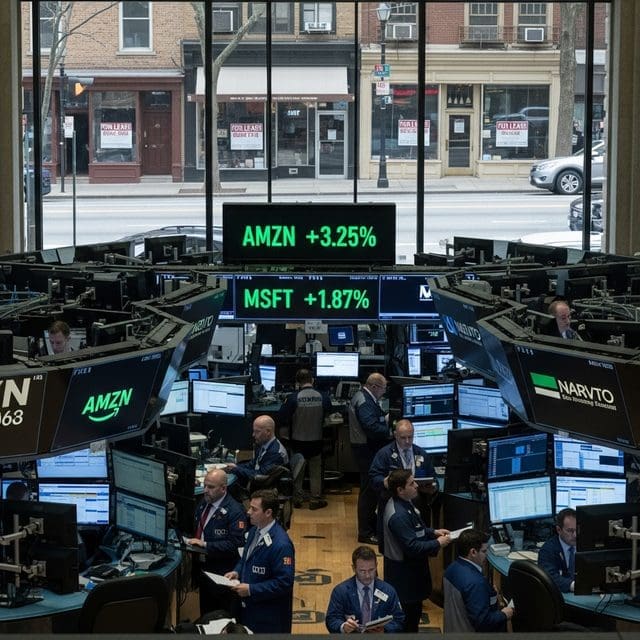
Major indices rose Friday as massive AI capital expenditure forecasts from tech giants offset concerns regarding consumer sentiment and energy costs.
Financial markets showed resilience on Friday as the S&P 500 climbed 0.43%, driven largely by a resurgence in the technology sector. This rebound follows a period of volatility and is anchored by massive capital expenditure commitments from the industry’s largest players. Amazon, Microsoft, Meta, and Alphabet have collectively forecast 2026 capital spending between $720 billion and $745 billion, a 77% increase from the $410 billion seen in 2025. This surge in spending, primarily directed toward AI infrastructure, compute power, and data centers, has provided a significant tailwind for tech and industrial sectors even as it pressures free cash flow across the board.
Amazon posted its best trading day in 11 years following a significant growth inflection in its AWS cloud division, while Microsoft saw a historic 15% rally tied to its AI infrastructure. These gains helped the Nasdaq-100 outperform the broader market, despite a 7% drop in Alphabet shares earlier in the week after the company reported negative free cash flow for the first time since its 2004 IPO. The divergence within the ‘Magnificent Seven’ highlights a market that is increasingly selective, rewarding companies with clear AI monetization while punishing those with high spending and slowing service revenue, such as Apple, which fell 7% on China-related weakness and missed service revenue targets.
For the American household, the economic picture is more complex than the green tickers on Wall Street suggest. While the University of Michigan’s final July consumer sentiment index rose to a five-month high of 55.2, it remains approximately 11% below levels seen a year ago. Conversely, the Conference Board reported a third consecutive monthly decline in its confidence gauge, which fell to 90.8. This split in data suggests that while top-line market indices are buoyed by institutional AI investment, the economic reality for Main Street remains under pressure from elevated energy prices, with WTI crude hovering near $82 per barrel and Brent crude just below $86 per barrel amid geopolitical tensions in the Middle East.
The industrial sector is seeing a fundamental shift in demand as AI capital projects begin to function as a proxy for industrial growth. Goldman Sachs estimates a combined $5.3 trillion of capex for the four major hyperscalers through 2030, a figure that implies continued pressure on shareholder buybacks as companies prioritize infrastructure. However, the broader stability of the market faces headwinds from the small business sector. Recent data indicates that one in five U.S. small and medium-sized businesses is on track to run short on cash within 90 days. This liquidity strain, combined with a 17% drop in the Philadelphia Semiconductor Index during July, suggests that the current tech-led rally is a recovery within a broader drawdown rather than a return to undisputed highs.
Institutional shifts are also signaling caution. The Situational Awareness hedge fund recently sold its entire public equity portfolio to Citadel amid the AI sell-off, indicating that professional money is de-risking despite the positive session. Furthermore, legal scrutiny is mounting for mid-cap entities; Pomerantz LLP has launched investigations into investor claims against Metropolitan Bank Holding Corp and Rollins, Inc. While the S&P 500’s 0.43% gain offers a veneer of stability, the underlying economy is defined by a sharp bifurcation: a high-growth tech elite fueled by unprecedented capex, and a domestic small-business sector struggling with cash flow, persistent inflationary pressures in the energy sector, and a volatile foreign exchange environment affecting global industrials.

Jordan Lee serves as the Senior Correspondent for Wall Street, Finance, and Monetary Systems at Just Right News. Based in the heart of the world’s financial capital, New York City, Lee brings a sharp, principled eye to the complex mechanisms that drive the global economy. His reporting is defined by a commitment to fiscal responsibility, the defense of the free market, and a deep-seated belief that a transparent monetary system is the bedrock of a free society.
Raised in Portland, Oregon, Lee’s perspective was forged in a city that has undergone significant cultural and economic shifts. His upbringing in the Pacific Northwest instilled in him a profound appreciation for the industriousness of small business owners and the importance of local economic stability. Watching the evolution of his hometown’s landscape sparked an early interest in how federal fiscal policy and large-scale financial trends eventually trickle down to the average citizen. This background provides him with a unique vantage point; he understands the growing disconnect between the policy-making elite and the reality of Main Street, a theme that frequently resonates throughout his work.
Now operating from his base in New York City, Lee bridges the gap between the high-stakes trading floors of Manhattan and the households of everyday Americans. He views the financial sector not merely as a collection of numbers and tickers, but as a vital engine of American prosperity that requires constant vigilance and accountability. His reporting often highlights the dangers of centralized financial control and the necessity of maintaining a system that rewards merit, risk-taking, and innovation.
As the creator and lead of the featured series, “The Invisible Economy,” Lee pulls back the curtain on the often-opaque world of monetary systems. He specializes in translating the dense jargon of central banking and international finance into actionable insights for the Just Right News audience. His work explores the “invisible” forces—such as inflationary pressures, regulatory creep, and the expansion of the administrative state—that erode the purchasing power of American families. By focusing on these systemic issues, Lee empowers readers to understand the hidden forces shaping their financial independence.
Lee’s journalistic philosophy is rooted in a steadfast commitment to traditional American values. As an Asian American professional who has navigated the competitive corridors of the financial world, he is a vocal advocate for meritocracy and the preservation of the American Dream. He believes that a stable currency and a predictable regulatory environment are essential for national sovereignty and individual liberty. His reporting frequently warns against the risks of government overreach in the private sector, arguing that the most effective solutions to economic challenges arise from competition and individual enterprise rather than bureaucratic mandates.
At Just Right News, Jordan Lee remains dedicated to providing a clear-eyed defense of the taxpayer. Whether he is analyzing market volatility or investigating the long-term implications of national debt, his mission is to provide the truth about where the money is going and what it means for the future of the country. Through his rigorous analysis and principled stance, Lee has become a trusted voice for those who value a strong, sovereign, and fiscally sound America.