

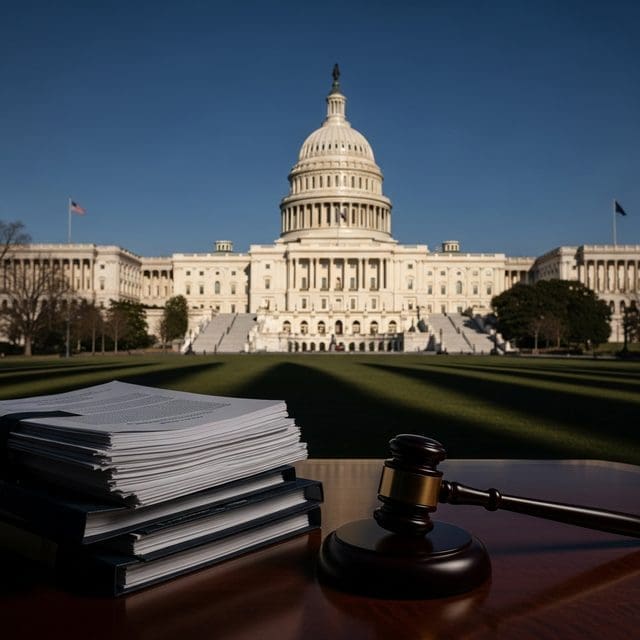
The Trump administration enacted new trade duties as House Republicans adjourned without passing critical defense funding, highlighting a growing divide between executive mandates and a fractured legislative branch.
The executive branch exercised significant unilateral authority this Friday as the White House transitioned its trade posture. Effective at 12:01 a.m. EDT, the administration replaced its expiring 10% temporary global tariffs with a new tier of duties ranging from 10% to 12.5%. These “forced labor” levies target 60 trading partners, including the European Union and China, functionally extending the president’s protectionist agenda under the regulatory framework of human rights enforcement. While the administration frames these duties as a response to lax enforcement of labor bans, the timing ensures economic pressure remains constant despite the expiration of previous temporary measures.
While the executive branch moved forward with its economic agenda, the legislative branch remained paralyzed. House Republican leadership canceled votes and dismissed lawmakers early following a deadlock over the annual defense bill. The impasse stems from a faction of the GOP attempting to tether troop pay raises and emergency Pentagon funding to the SAVE America Act, a strict voter-identification measure. This procedural friction has left a $87.6 billion supplemental funding request for Iran conflict costs, U.S. farmers, and Ebola response in legislative limbo. The emptying Capitol provides a snapshot of the current imbalance of power as a headstrong executive confronts a weakened Congress.
Internal party tensions are surfacing as the fiscal and political costs of the Iran conflict mount. Senate Republican Policy Committee Chair Shelley Moore Capito and Senate Majority Leader John Thune have signaled growing concern regarding public weariness and the absence of a clear exit strategy. With rising gas prices and U.S. casualties weighing on midterm prospects, GOP lawmakers urged the president on July 21 to reopen the Strait of Hormuz. Despite these pleas, the Senate has struggled to pass necessary emergency funding, leading to visible friction between Leader Thune and the White House over the legislative path forward.
In a shift of tone, President Trump is scheduled to address the White House Correspondents’ Association tonight at the Waldorf Astoria. The event, rescheduled from April following a shooting at the Washington Hilton that targeted the president and a Secret Service agent, will feature significantly enhanced safety protocols. The gala will honor Secret Service officer Victor Gonzales, whose protective vest prevented serious injury during the April 25 attack. The president’s decision to deliver a 40-minute speech to the press corps, whom he has long criticized, marks a strategic attempt to project national stability and executive resilience following the assassination attempt.
Outside the immediate budget fray, the administrative state continues to pursue its own priorities. The Department of Justice initiated litigation against Milwaukee on July 24 over its prohibition of face coverings for on-duty law enforcement officers. Meanwhile, the FDA granted clearance to Roche for a new vaginitis diagnostic assay, and the Senate passed a bipartisan bill designating July 20 as Lunar Landing Day. These developments, while notable, do little to mask the broader institutional friction as the White House continues to bypass a fractured Congress on matters of trade, war powers, and the national budget.
As the week concludes, the administrative state remains the primary driver of policy. From the $1.1 million in NTEC scholarships awarded to Navajo students to the National Police Association’s endorsement of the STOP Scams Against Seniors Act, the machinery of government moves forward. However, the central conflict remains the $87.6 billion request for war costs. Without a clear consensus in the House, the administration’s ability to sustain the Iran conflict while managing domestic inflation remains the most pressing challenge for the constitutional balance of power.

Miles Harrington serves as the Senior Correspondent for Federal Systems & Executive Power at Just Right News, where he brings a disciplined, constitutionalist lens to the inner workings of the American government. With a focus on the mechanics of the federal bureaucracy and the limits of executive authority, Harrington has established himself as a vital voice for readers who value transparency, accountability, and the preservation of the separation of powers.
A native of Richmond, Virginia, Harrington’s perspective is deeply rooted in the traditions of the Old Dominion. Growing up in a city defined by its historical significance and its role as a center of American jurisprudence, he developed an early appreciation for the foundational principles of the Republic. His upbringing in Richmond—a place where the legacy of the Founding Fathers is woven into the landscape—instilled in him a belief that the federal government should remain within its constitutional bounds. This background informs his skepticism of centralized overreach and his commitment to reporting on the ways in which the administrative state impacts the lives of everyday citizens.
In his current role, Harrington specializes in the complexities of federal systems. He doesn’t just report on the headlines of the day; he digs into the structural shifts within the executive branch that often go unnoticed by the mainstream press. Whether he is analyzing the implications of a new federal regulation or investigating the expansion of agency jurisdiction, his work is characterized by a rigorous adherence to the facts and a dedication to the rule of law.
Harrington is perhaps best known for his signature feature series, “How Washington Works.” Through this ongoing project, he demystifies the often-opaque processes of the nation’s capital, pulling back the curtain on the “Deep State” and the unelected officials who wield significant influence over national policy. By breaking down complex legislative maneuvers and executive orders, he empowers Just Right News readers to understand the true levers of power in Washington. His reporting serves as a necessary check on the federal government, ensuring that the actions of those in power are held up to the light of public scrutiny.
Now based in Washington, D.C., Harrington operates at the epicenter of the political world, yet he remains intentionally distanced from the “Beltway bubble.” His proximity to the halls of power allows him to maintain a robust network of sources across the federal landscape, but his heart remains in the principled conservatism of his Virginia roots. He views his role not merely as a reporter, but as a steward of the public trust, dedicated to providing the clarity and context that conservative voters need to navigate an increasingly complex political environment.
Through his sharp analysis and unwavering commitment to the truth, Miles Harrington continues to be a cornerstone of the Just Right News team. His work ensures that the principles of limited government and executive restraint remain at the forefront of the national conversation, providing a crucial service to those who believe in a government that is truly of, by, and for the people.