

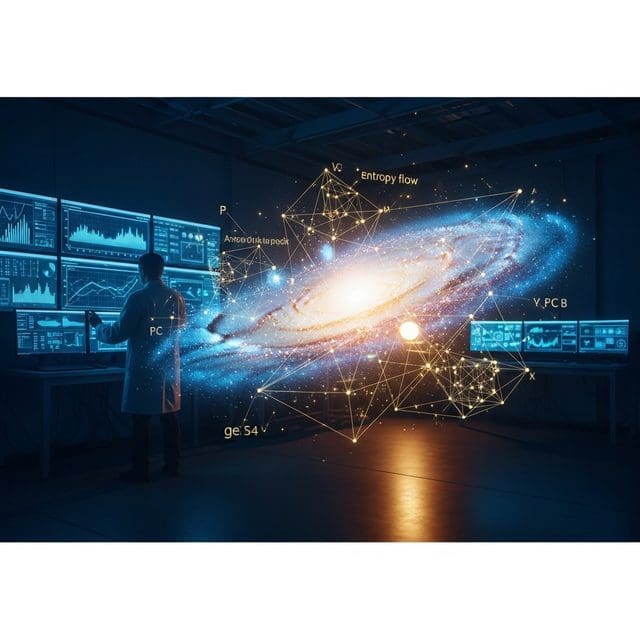
A new theoretical framework suggests dark energy and cosmic expansion create the thermodynamic room necessary for complex life to flourish without violating fundamental laws.
In a week marked by significant shifts in the American landscape—from the birth of a son to Second Lady Usha Vance to escalating tensions in the Middle East—a profound discovery in fundamental physics is challenging our understanding of the universe’s architecture. Researchers led by mathematician Ginestra Bianconi at Queen Mary University of London have unveiled a framework titled Gravity from Entropy (GfE), published in Physical Review D, which seeks to reconcile the cold logic of thermodynamics with the complexity of life. This work arrives as the U.S. Space Force seeks $30 billion in rocket launches and NASA selects new NIAC studies, signaling a renewed national push into the final frontier.
For decades, a central paradox has loomed over cosmology: if the second law of thermodynamics dictates that entropy, or disorder, must always increase, how can the universe produce highly ordered structures like stars and human beings? The GfE framework, highlighted by ScienceDaily on July 20, 2026, posits that cosmic expansion is the key. While total cosmic entropy increases, the entropy density per unit volume decreases as space expands. This creates “thermodynamic room,” allowing local pockets of order to emerge and evolve without defying the universal trend toward decay. It suggests that the acceleration of the cosmos is not a precursor to death, but a necessary mechanism for biological organization.
This is not merely a philosophical victory; the theory provides a rigorous mathematical bridge between the microscopic quantum world and macroscopic cosmic acceleration. By treating dark energy as an internal energy term and utilizing Geometric Quantum Relative Entropy, the researchers derived general relativity and black-hole area-law entropy from a single entropic action. This suggests dark energy is not an arbitrary “fudge factor,” but a fundamental byproduct of information-theoretic measures. It offers a unified quantum-gravity proposal that could eventually replace the ad-hoc assumptions currently used in the Standard Model.
While the GfE framework remains theoretical, it arrives alongside experimental breakthroughs that ground these concepts. In Germany, a Bochum research team demonstrated “quantum friction,” using photons as a “brake” to slow motion at the nanoscale. This phenomenon allows for the control of movements in the nanoworld where classical models fail. Simultaneously, at the Institute of Science and Technology Austria, physicists confirmed a 20-year-old theory by using a “quantum bath” to synchronize distant qubits, a move that could boost the reliability of decentralized computing networks.
The implications for national sovereignty and technological independence are clear. As private entities like Meshy raise $400 million for AI 3D generation and the Alliance for OpenUSD expands, the underlying physics of how we manipulate matter is being rewritten. If gravity and dark energy are manifestations of entropy, future propulsion and communication systems may eventually bypass traditional mechanical constraints in favor of information-based technologies. This is relevant as the global transformer oil market is projected to reach $5.4 billion by 2033, driven by the grid modernization required to power these emerging quantum frontiers.
However, skepticism remains necessary. The GfE framework currently lacks the observational data from the Cosmic Microwave Background needed to be fully falsified. Until these theories are tested against the hard reality of the stars, they remain elegant blueprints. For now, they offer a reminder that the universe is not a closed system of inevitable decline, but a dynamic frontier where order and individual liberty find a way to persist against the backdrop of an expanding void.

Mason Reed serves as a Staff Writer for Just Right News, where he spearheads the Future Frontiers & Special Projects desk. In an era defined by rapid technological shifts and evolving social landscapes, Mason provides a steady, principled voice, examining the innovations of tomorrow through the lens of traditional American values. His work is most prominently featured in his signature series, “The Next Horizon,” where he explores the intersection of emerging technology, national sovereignty, and the preservation of individual liberty.
A native of San Diego, California, Mason’s worldview was shaped by the unique culture of his hometown. Growing up in a region defined by its strong military presence and its history of maritime industry, he developed a deep-seated respect for the institutions that provide national stability and the entrepreneurial spirit that drives the American economy. This upbringing instilled in him a belief that true progress is not found in discarding the past, but in building upon a foundation of proven principles. His reporting often reflects this San Diego influence, emphasizing the importance of a robust national defense and the necessity of maintaining a competitive edge in the global marketplace.
Now based in San Francisco, Mason operates from the heart of the world’s technological engine. Living and working in the Bay Area provides him with a front-row seat to the advancements—and the ideological challenges—emanating from Silicon Valley. While many in the region embrace a “move fast and break things” mentality, Mason’s reporting serves as a vital counterweight. He offers Just Right News readers a “boots on the ground” perspective, documenting how radical local policies and the concentration of tech power impact the everyday lives of citizens. His proximity to the industry allows him to cut through the marketing jargon of big tech to uncover the real-world implications for privacy, free speech, and the nuclear family.
In his “Future Frontiers” beat, Mason tackles complex subjects ranging from the ethics of artificial intelligence to the burgeoning private space race. He approaches these topics with a healthy skepticism toward centralized bureaucracy, championing instead the decentralized innovations that empower individuals. Through “The Next Horizon,” he highlights the pioneers and thinkers who are working to ensure that the future remains a place where human dignity and constitutional rights are protected. He believes that the rapid pace of change requires more than just technical expertise; it requires a moral compass rooted in the Western tradition.
Throughout his tenure at Just Right News, Mason has remained committed to the idea that the future is something to be shaped, not merely accepted. His writing is characterized by a rigorous defense of American exceptionalism and a belief that the country’s best days lie ahead, provided it remains true to its founding ideals. Whether he is investigating the impact of automation on the American workforce or profiling the next generation of aerospace engineers, Mason Reed ensures that his readers are equipped with the insights they need to navigate a changing world with confidence and clarity.