

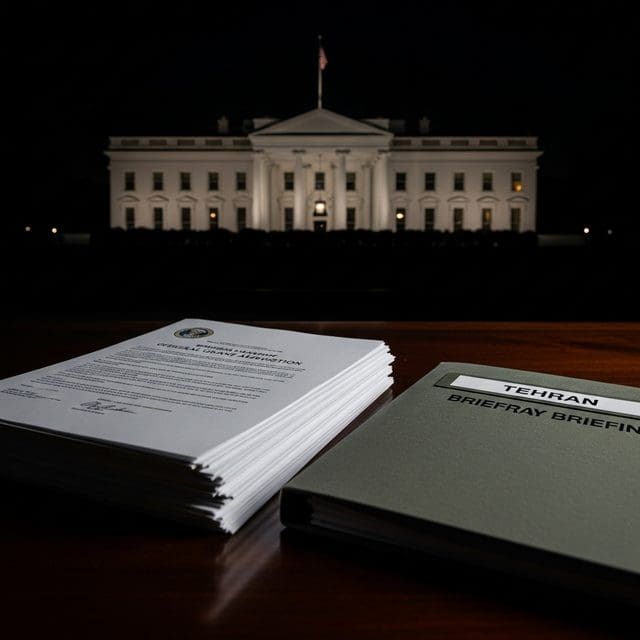
The Trump administration faces bipartisan pushback over plans to subject federal grants to political review while simultaneously issuing major executive orders to reshape U.S. policy toward Tehran.
The Trump administration is currently navigating a dual-front policy offensive that seeks to expand executive influence over both domestic bureaucracy and international security. At the center of this shift is a controversial plan to subject federal grants to a new political review process. According to reporting from the New York Times, the White House intends to move final decision-making authority for certain grants away from career officials and merit-based criteria, placing it instead under the direct purview of political appointees. This proposal has triggered an immediate and organized opposition from a broad coalition of academics, city leaders, and congressional lawmakers who argue that such a change threatens the insulation of federal funding from partisan favoritism or retaliation.
Traditionally, federal grant programs—which distribute hundreds of billions of dollars annually to research institutions, local governments, and non-profits—have relied on expert-driven administration to ensure objective outcomes. The proposed internal review procedures would fundamentally alter this dynamic, potentially allowing the executive branch to prioritize or withhold funds based on political alignment. Critics in Congress have expressed concern that this centralization of power undermines the neutral administration of public health, infrastructure, and scientific research priorities, effectively turning the federal purse into a tool of political leverage.
While the administration focuses on domestic restructuring, it has also enacted a significant escalation in its foreign policy toward the Middle East. Following U.S. military strikes on July 17, 2026, which targeted Iranian bridges and energy infrastructure, the Islamic Revolutionary Guard Corps responded with attacks on U.S. bases in Kuwait, Bahrain, and Jordan. In response to these hostilities, President Trump utilized a July 20 address to announce a series of new executive orders. These orders are designed to increase economic pressure on Tehran through expanded sanctions and provide new strategic directives to both the Pentagon and the State Department. The administration maintains that these actions are necessary to address Iran as a persistent threat, though the use of unilateral executive orders has reignited debates regarding the War Powers Act and the role of Congress in authorizing long-term military engagements.
On Capitol Hill, the House Committee on Rules is attempting to manage these tensions through a heavy legislative schedule. Lawmakers are currently considering H.R. 7008, the Stop Insider Trading Act, which aims to set new legal standards and enforcement mechanisms for members of Congress and other federal officials. This push for institutional transparency coincides with the introduction of H. Con. Res. 113, the Congressional Budget for Fiscal Year 2027. This resolution is a cornerstone of the legislative session, establishing spending, revenue, and deficit targets through 2036. The committee is also tasked with advancing the National Defense Authorization Act (NDAA) for 2027, which authorizes the very defense programs currently being deployed in the Middle East.
These policy developments are unfolding against a backdrop of significant political transition. The death of Senator Lindsey Graham has left a vacuum in South Carolina politics, with memorial services scheduled to begin in Washington on July 28. President Trump has already moved to influence the succession, asking newly appointed Senator Darline Graham Nordone to run in the special Republican primary. Meanwhile, Representative Ralph Norman has formally announced his candidacy for the seat. As the federal appeals court concurrently allows the U.S. Postal Service to proceed with changes to mail-in ballot delivery, the intersection of executive directives, legislative mandates, and judicial rulings highlights a period of intense constitutional activity. The administration’s efforts to reshape the administrative state and foreign policy through the White House core remain the defining friction point in the current Washington landscape.

Miles Harrington serves as the Senior Correspondent for Federal Systems & Executive Power at Just Right News, where he brings a disciplined, constitutionalist lens to the inner workings of the American government. With a focus on the mechanics of the federal bureaucracy and the limits of executive authority, Harrington has established himself as a vital voice for readers who value transparency, accountability, and the preservation of the separation of powers.
A native of Richmond, Virginia, Harrington’s perspective is deeply rooted in the traditions of the Old Dominion. Growing up in a city defined by its historical significance and its role as a center of American jurisprudence, he developed an early appreciation for the foundational principles of the Republic. His upbringing in Richmond—a place where the legacy of the Founding Fathers is woven into the landscape—instilled in him a belief that the federal government should remain within its constitutional bounds. This background informs his skepticism of centralized overreach and his commitment to reporting on the ways in which the administrative state impacts the lives of everyday citizens.
In his current role, Harrington specializes in the complexities of federal systems. He doesn’t just report on the headlines of the day; he digs into the structural shifts within the executive branch that often go unnoticed by the mainstream press. Whether he is analyzing the implications of a new federal regulation or investigating the expansion of agency jurisdiction, his work is characterized by a rigorous adherence to the facts and a dedication to the rule of law.
Harrington is perhaps best known for his signature feature series, “How Washington Works.” Through this ongoing project, he demystifies the often-opaque processes of the nation’s capital, pulling back the curtain on the “Deep State” and the unelected officials who wield significant influence over national policy. By breaking down complex legislative maneuvers and executive orders, he empowers Just Right News readers to understand the true levers of power in Washington. His reporting serves as a necessary check on the federal government, ensuring that the actions of those in power are held up to the light of public scrutiny.
Now based in Washington, D.C., Harrington operates at the epicenter of the political world, yet he remains intentionally distanced from the “Beltway bubble.” His proximity to the halls of power allows him to maintain a robust network of sources across the federal landscape, but his heart remains in the principled conservatism of his Virginia roots. He views his role not merely as a reporter, but as a steward of the public trust, dedicated to providing the clarity and context that conservative voters need to navigate an increasingly complex political environment.
Through his sharp analysis and unwavering commitment to the truth, Miles Harrington continues to be a cornerstone of the Just Right News team. His work ensures that the principles of limited government and executive restraint remain at the forefront of the national conversation, providing a crucial service to those who believe in a government that is truly of, by, and for the people.