

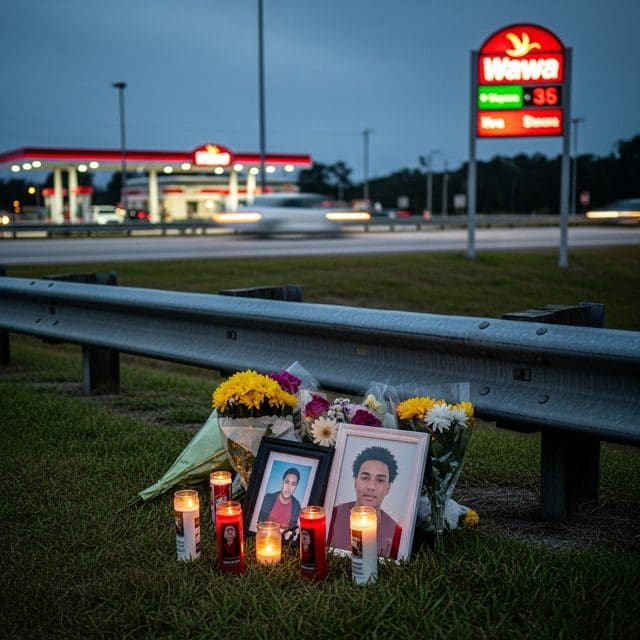
The death of Juan Jairo Coronilla Durán during a federal enforcement operation in St. Augustine reveals the human friction behind immigration policy and controversial local policing agreements.
The morning sun was just beginning to bake the asphalt at a Wawa gas station near St. Augustine when a routine immigration enforcement operation turned into a tragedy. Juan Jairo Coronilla Durán, a 28-year-old father of two from San Luis de la Paz, Mexico, had been in Florida for only a few days on a tourist visa when he encountered agents from Immigration and Customs Enforcement and Homeland Security Investigations. His death, occurring just three weeks into his American visit, has become a somber focal point for a community grappling with the reach of federal authority.
According to witness accounts, Coronilla Durán was one of four occupants who fled as the HSI operation commenced around 7 a.m. on July 14. In the frantic moments that followed, he slipped on wet grass while attempting to cross State Road 16 and was struck by a semi-truck. The scene was one of immediate, desperate chaos. Bystanders, including a veterinary nurse who happened to be nearby, rushed to the pavement to provide first aid. Witnesses later told local reporters that everyone at the scene fought to save him, but the impact was fatal. Coronilla Durán died at the scene, a short distance from the gas pumps where the encounter began.
The incident has transformed a local traffic fatality into a sharp critique of 287(g) agreements, which empower local law enforcement to assist in federal immigration duties. In the days following his death, dozens of community members and activists from groups like the Jacksonville Immigrant Rights Alliance and Vets 5051 gathered for vigils at the gas station and in downtown Jacksonville. Approximately 80 people attended one rally, holding signs that called for an end to the local-federal partnerships they argue directly led to the circumstances of this death. These advocates suggest that when local deputies act as immigration agents, it creates a climate of fear that forces individuals into life-threatening flight.
For the family left behind in Mexico, the policy debate is secondary to the immediate, crushing reality of loss. Colectivo Árbol, a Central Florida farmworker advocacy nonprofit, has stepped in to bridge the gap between two nations. The group is currently assisting Coronilla Durán’s widow, Yezzika Alamilla, as she navigates the process of claiming her husband’s remains and coordinating with the Mexican consulate in Orlando. The Guanajuato state government has pledged support, but the human toll is already tallied: Coronilla Durán is the 17th Mexican national to die in an incident linked to ICE operations or custody during the current administration.
Significant questions remain unanswered by federal authorities, fueling the local demand for an independent investigation. The Department of Homeland Security has not yet disclosed whether the agents involved were wearing body cameras—a key point of contention for activists seeking accountability. Furthermore, officials have not clarified if Coronilla Durán was a specific target of the operation or if he had any prior criminal record. State and local agencies have largely deferred all inquiries to DHS, leaving a vacuum of information that local leaders say prevents the community from understanding the protocols governing these high-stakes encounters.
As the investigation by the Florida Highway Patrol and HSI continues, the community in St. Augustine is left to reconcile the image of a young father lost on a stretch of highway with the broader machinery of national security. While aggregate data may track the number of enforcement actions, the specifics of this case reveal the friction between centralized authority and the individual lives caught in its gears. For those who stood at the vigil on State Road 16, the goal is to ensure that a man who came to visit did not simply become a nameless statistic.

Ethan Blake serves as a Senior Correspondent for Just Right News, where he specializes in Longform Narrative and Public Understanding. In an era of rapid-fire headlines and fleeting soundbites, Ethan’s work stands as a testament to the power of deep-dive reporting and the importance of contextualizing the complex issues facing the nation today. His approach is rooted in the belief that the most profound truths are often found in the lived experiences of individuals rather than the abstract theories of distant policymakers.
Growing up in Providence, Rhode Island, Ethan developed an early appreciation for the historical and cultural threads that weave the American fabric together. Providence, a city defined by its industrial heritage and its blend of traditional neighborhoods, provided him with a front-row seat to the challenges and triumphs of the American working class. This upbringing instilled in him a respect for the “common sense” values of hard work, community loyalty, and the preservation of local institutions. He learned early on that behind every economic statistic or legislative debate, there are real families and neighborhoods navigating the consequences of change.
This foundational perspective is the driving force behind his signature feature series, “Lives Behind the Systems.” Through this series, Ethan explores the intersection of individual agency and institutional structure. Whether he is documenting the impact of federal land-use policies on rural families or examining how shifting educational standards affect local school boards, Ethan’s work prioritizes the human element. He seeks to uncover how large-scale systems—be they governmental, economic, or social—affect the daily lives of citizens, often advocating for a return to local control and personal responsibility.
Now based in Portland, Maine, Ethan draws significant inspiration from the rugged independence and self-reliance that define the region. The coastal landscape and the resilient spirit of Maine’s communities serve as a constant reminder of the importance of individual liberty and the strength found in decentralized power. Living and working outside the traditional media hubs allows Ethan to maintain a grounded perspective, ensuring his reporting remains untethered from the echo chambers of the major metropolitan centers. This geographic distance provides him with the clarity needed to translate complex national narratives into stories that resonate with the heart of the country.
At Just Right News, Ethan’s beat is more than just a professional assignment; it is a mission to foster a more informed and engaged citizenry. He believes that a free society depends on the public’s ability to understand the mechanisms of power and the value of traditional American principles. His longform narratives do not merely report the news; they provide a roadmap for understanding the cultural and political shifts of the modern era through a lens of skepticism toward centralized authority and a deep respect for the individual.
Through his meticulous research and narrative craftsmanship, Ethan Blake continues to bridge the gap between policy and the public. His work remains a vital resource for those who seek a deeper understanding of the systems that shape our world and the enduring spirit of the people who live within them.