

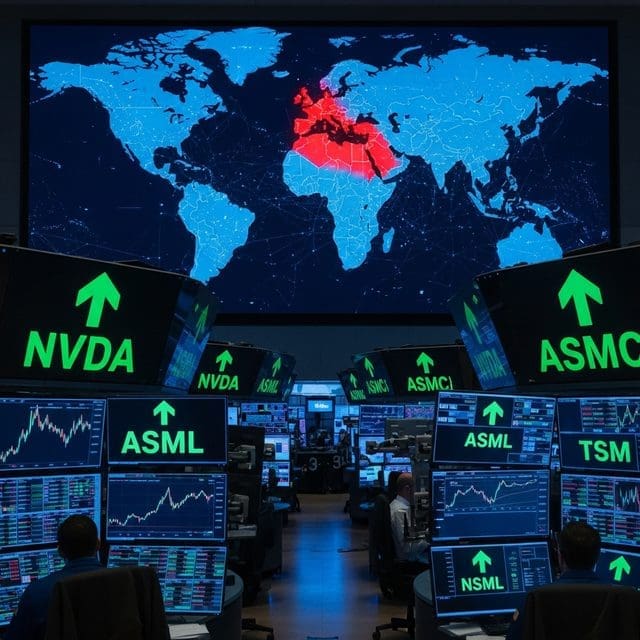
While the S&P 500 remains flat, record-breaking AI chip demand and a massive $53 billion bid for PayPal are driving aggressive sector rotation across global markets.
Global financial markets are witnessing a sharp divergence between broad market indices and high-growth sectors. While the SPY benchmark traded nearly flat at -0.06% on the session, the internal mechanics of the market revealed a robust, almost insatiable appetite for artificial intelligence infrastructure and large-scale financial technology consolidation. This internal rotation suggests that while macro-economic pressures and geopolitical risks weigh on the general market, the specialized technology and communication services sectors are entering a period of aggressive expansion fueled by structural shifts in the global digital economy.
In the semiconductor space, ASML provided a significant catalyst for the day’s movement by raising its 2026 net revenue forecast to as high as €45 billion, up from a previous ceiling of €40 billion. The company reported a second-quarter revenue beat of €9.33 billion and announced plans to expand its EUV and DUV tool capacity by approximately 30% annually over the next two years. Management cited “extremely strong” orders from industry giants including TSMC, Samsung, SK Hynix, and Micron, effectively booking the company’s capacity through the end of 2027. This level of visibility is a major positive for the advanced-node supply chain, signaling that the AI chip equipment bottleneck is far from over.
This optimism was echoed in Seoul, where SK Hynix shares surged nearly 13% on July 15. The move was driven by a combination of softer-than-expected U.S. inflation data and a tightening supply of AI DRAM. Analysts now estimate that memory suppliers are currently meeting only 75% to 80% of global demand, with projections suggesting this could drop to the 60% range by 2027. For the American taxpayer and the retail investor, this structural shortage highlights a critical vulnerability in the global tech supply chain, even as it drives record highs for the Korean KOSPI and supports U.S.-linked AI names.
Beyond hardware, the fintech sector was jolted by news of an unsolicited $53 billion offer for PayPal from Stripe and Advent International. This potential takeover, valued at more than $60.50 per share, represents one of the largest fintech plays in history. It underscores a strategic push by private equity and digital payment leaders to capture global merchant networks and consumer wallets as competition from card networks and Big Tech intensifies. The bid provides a valuation floor for payment processors and digital platforms that have faced recent volatility, signaling that strategic buyers see significant value at current multiples.
In the Communication Services sector, the narrative of consolidation continues to build. Reports indicate that Lionsgate Studios is exploring a potential sale, drawing interest from international conglomerates like France’s Bolloré Group. This movement suggests that high-quality content libraries and intellectual property remain premium assets for streamers looking to solidify their market share in a crowded digital landscape. Even as the broader market remains stagnant, these specific M&A targets are seeing outsized interest, reflecting a flight to quality and scale.
However, these gains face a significant headwind from the energy sector and geopolitical instability. Oil prices surged approximately 9% to roughly $83 per barrel following the announcement of a U.S. naval blockade on Iran effective July 14. This escalation, triggered by the closure of the Strait of Hormuz and the collapse of OPEC+ agreements, threatens to reverse the cooling inflation trends seen in June. While the Consumer Price Index recently showed its largest one-month decrease since 2020, the sudden spike in energy costs could reignite inflationary pressures. For the working household, the tension between a booming AI-driven stock market and rising costs at the pump remains the defining economic struggle of the summer, as national sovereignty and energy security once again take center stage.

Jordan Lee serves as the Senior Correspondent for Wall Street, Finance, and Monetary Systems at Just Right News. Based in the heart of the world’s financial capital, New York City, Lee brings a sharp, principled eye to the complex mechanisms that drive the global economy. His reporting is defined by a commitment to fiscal responsibility, the defense of the free market, and a deep-seated belief that a transparent monetary system is the bedrock of a free society.
Raised in Portland, Oregon, Lee’s perspective was forged in a city that has undergone significant cultural and economic shifts. His upbringing in the Pacific Northwest instilled in him a profound appreciation for the industriousness of small business owners and the importance of local economic stability. Watching the evolution of his hometown’s landscape sparked an early interest in how federal fiscal policy and large-scale financial trends eventually trickle down to the average citizen. This background provides him with a unique vantage point; he understands the growing disconnect between the policy-making elite and the reality of Main Street, a theme that frequently resonates throughout his work.
Now operating from his base in New York City, Lee bridges the gap between the high-stakes trading floors of Manhattan and the households of everyday Americans. He views the financial sector not merely as a collection of numbers and tickers, but as a vital engine of American prosperity that requires constant vigilance and accountability. His reporting often highlights the dangers of centralized financial control and the necessity of maintaining a system that rewards merit, risk-taking, and innovation.
As the creator and lead of the featured series, “The Invisible Economy,” Lee pulls back the curtain on the often-opaque world of monetary systems. He specializes in translating the dense jargon of central banking and international finance into actionable insights for the Just Right News audience. His work explores the “invisible” forces—such as inflationary pressures, regulatory creep, and the expansion of the administrative state—that erode the purchasing power of American families. By focusing on these systemic issues, Lee empowers readers to understand the hidden forces shaping their financial independence.
Lee’s journalistic philosophy is rooted in a steadfast commitment to traditional American values. As an Asian American professional who has navigated the competitive corridors of the financial world, he is a vocal advocate for meritocracy and the preservation of the American Dream. He believes that a stable currency and a predictable regulatory environment are essential for national sovereignty and individual liberty. His reporting frequently warns against the risks of government overreach in the private sector, arguing that the most effective solutions to economic challenges arise from competition and individual enterprise rather than bureaucratic mandates.
At Just Right News, Jordan Lee remains dedicated to providing a clear-eyed defense of the taxpayer. Whether he is analyzing market volatility or investigating the long-term implications of national debt, his mission is to provide the truth about where the money is going and what it means for the future of the country. Through his rigorous analysis and principled stance, Lee has become a trusted voice for those who value a strong, sovereign, and fiscally sound America.