

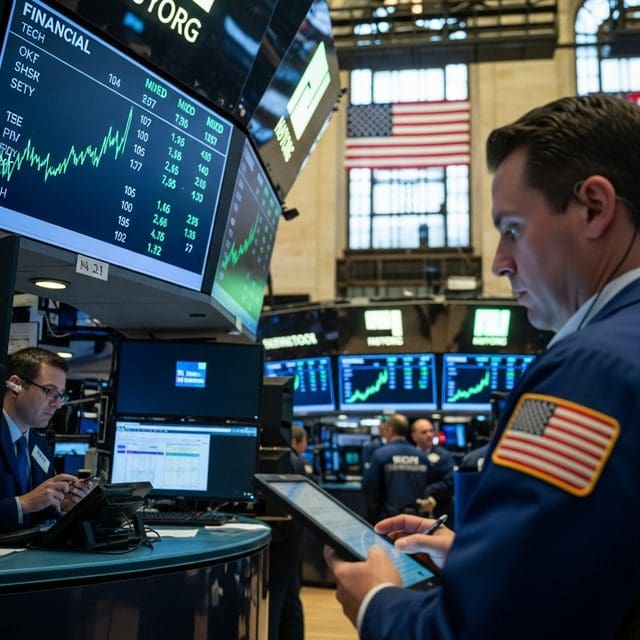
The S&P 500 and Nasdaq hit new records as investors rotate from mega-cap tech into financials following Federal Reserve Chairman Jerome Powell’s testimony on a cooling labor market.
The American financial landscape continues to demonstrate a complex duality. The S&P 500 and Nasdaq Composite ascended to record territory, marking the 36th record close for the S&P this year. However, the underlying mechanics suggest a significant shift in sector leadership. While the SPY benchmark sits at a modest +0.33% gain, the internal rotation from growth to value suggests a market at a critical crossroads.
Federal Reserve Chairman Jerome Powell’s testimony before the Senate Banking Committee served as the primary catalyst for the day’s volatility. Powell observed that the labor market has “cooled considerably,” signaling that restrictive monetary policy is taking hold. While markets price in a September rate cut, the immediate reaction saw 10-year Treasury yields climb to 4.297%. This move sparked an intraday rotation, pulling capital away from high-growth technology and semiconductors into rate-sensitive financials.
Financial institutions emerged as the clear victors. Goldman Sachs and Intercontinental Exchange reached all-time highs, while six other major banking entities hit one-year peaks. This rotation suggests the “Invisible Economy” is pricing in a steeper yield curve and a potential soft landing, even as industrial-heavy Dow components fell roughly 53 points. For the average taxpayer, this shift reflects a market increasingly reliant on banking stability rather than speculative AI fervor. Bank of America analysts noted that growth is finally broadening, yet some veterans find it unsettling that the average stock continues to languish while indices hit records.
Global stability remains a precarious variable. Geopolitical tensions re-emerged following the collapse of the U.S.-Iran ceasefire. After Iran resumed attacks in the Strait of Hormuz, President Trump declared negotiations a waste of time on July 8. Subsequent U.S. military strikes sent WTI crude futures jumping by 6% post-settle. This breakdown directly impacts the consumer sector, as higher energy costs threaten to reignite inflation and squeeze discretionary margins. For Main Street, this translates to a renewed risk of energy-driven inflation, complicating the Federal Reserve’s path toward easing rates.
In technology, the narrative remains one of massive consolidation despite intraday softening. SK Hynix raised $26.5 billion in a U.S. equity offering on July 10, the second-largest in history. This liquidity event underscores ongoing demand for AI infrastructure, even as investors grow wary of valuations. EQT’s acquisition of Copia Power further highlights how tech and energy sectors are merging to meet the massive power demands of next-generation computing. Yet, tech remains vulnerable to yield fluctuations and the “higher for longer” narrative until a formal Fed pivot.
As the market prepares for June CPI data and bank earnings this Friday, the modest SPY gain masks a tug-of-war between tech-driven growth and a cyclical recovery in financials. International participation remains uneven, with Japan’s Nikkei hitting records while Australian futures point lower. For those advocating for a stable financial system, the focus remains on whether the Fed can navigate this cooling labor market without triggering a deeper contraction, especially as geopolitical shocks threaten the global monetary equilibrium.

Jordan Lee serves as the Senior Correspondent for Wall Street, Finance, and Monetary Systems at Just Right News. Based in the heart of the world’s financial capital, New York City, Lee brings a sharp, principled eye to the complex mechanisms that drive the global economy. His reporting is defined by a commitment to fiscal responsibility, the defense of the free market, and a deep-seated belief that a transparent monetary system is the bedrock of a free society.
Raised in Portland, Oregon, Lee’s perspective was forged in a city that has undergone significant cultural and economic shifts. His upbringing in the Pacific Northwest instilled in him a profound appreciation for the industriousness of small business owners and the importance of local economic stability. Watching the evolution of his hometown’s landscape sparked an early interest in how federal fiscal policy and large-scale financial trends eventually trickle down to the average citizen. This background provides him with a unique vantage point; he understands the growing disconnect between the policy-making elite and the reality of Main Street, a theme that frequently resonates throughout his work.
Now operating from his base in New York City, Lee bridges the gap between the high-stakes trading floors of Manhattan and the households of everyday Americans. He views the financial sector not merely as a collection of numbers and tickers, but as a vital engine of American prosperity that requires constant vigilance and accountability. His reporting often highlights the dangers of centralized financial control and the necessity of maintaining a system that rewards merit, risk-taking, and innovation.
As the creator and lead of the featured series, “The Invisible Economy,” Lee pulls back the curtain on the often-opaque world of monetary systems. He specializes in translating the dense jargon of central banking and international finance into actionable insights for the Just Right News audience. His work explores the “invisible” forces—such as inflationary pressures, regulatory creep, and the expansion of the administrative state—that erode the purchasing power of American families. By focusing on these systemic issues, Lee empowers readers to understand the hidden forces shaping their financial independence.
Lee’s journalistic philosophy is rooted in a steadfast commitment to traditional American values. As an Asian American professional who has navigated the competitive corridors of the financial world, he is a vocal advocate for meritocracy and the preservation of the American Dream. He believes that a stable currency and a predictable regulatory environment are essential for national sovereignty and individual liberty. His reporting frequently warns against the risks of government overreach in the private sector, arguing that the most effective solutions to economic challenges arise from competition and individual enterprise rather than bureaucratic mandates.
At Just Right News, Jordan Lee remains dedicated to providing a clear-eyed defense of the taxpayer. Whether he is analyzing market volatility or investigating the long-term implications of national debt, his mission is to provide the truth about where the money is going and what it means for the future of the country. Through his rigorous analysis and principled stance, Lee has become a trusted voice for those who value a strong, sovereign, and fiscally sound America.