

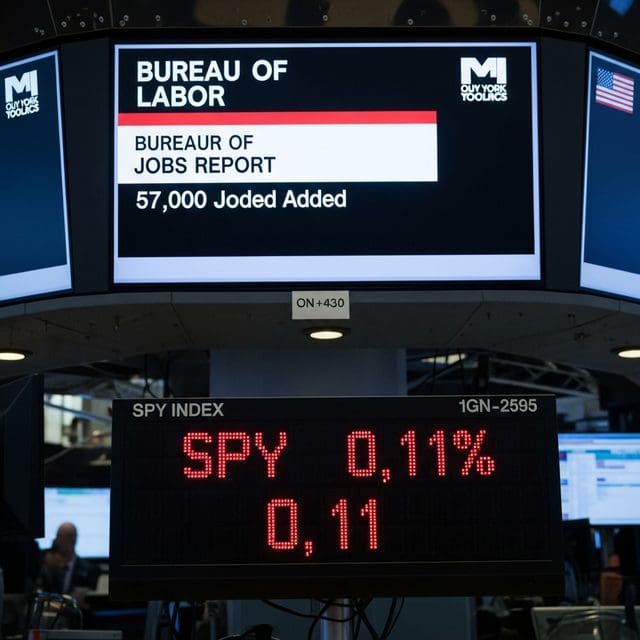
U.S. job creation slowed to just 57,000 in June, missing expectations and signaling a cooling labor market as households face rising costs and environmental risks ahead of the holiday.
The American labor market showed signs of significant fatigue in June, as nonfarm payrolls grew by a meager 57,000. This figure, released by the Bureau of Labor Statistics, fell well short of the 115,000 consensus forecast and marked a sharp deceleration from May’s downwardly revised 129,000. For the American taxpayer, this reflects an economy struggling to maintain momentum under persistent inflation. Revisions to prior months revealed that growth was significantly slower than previously understood; May was cut by 43,000 and April by 31,000.
Wall Street’s reaction was cautious, with the SPY benchmark trading down 0.11%. While the headline unemployment rate dropped to 4.2%, the shift offers little comfort to Main Street. The decline was driven by a slump in the labor force participation rate, which fell to 61.5%—its lowest since March 2021. Household employment plummeted by 507,000, suggesting many workers are opting out of a stagnant market. A broader measure of unemployment, including discouraged workers, declined to 7.9%.
Sector data highlighted the fragility of the recovery. Leisure and hospitality shed 61,000 jobs despite expectations that the World Cup would provide a seasonal lift. Goldman Sachs had estimated a 40,000-job boost that failed to materialize. Professional and business services provided a modest silver lining with 36,000 additions, while healthcare rose by 22,000—a slower-than-normal pace. Government payrolls saw a slight increase of 8,000, while most other categories remained flat, reflecting a freeze in private sector expansion.
Federal Reserve Chairman Kevin Warsh faces a complicated path. While average hourly earnings rose 0.3% for the month and 3.5% annually, inflation continues to run north of the Fed’s 2% target, exacerbated by the Iran war and tariffs. Thomas Simons, senior economist at Jefferies, noted that while the softening pace makes rate hikes unlikely this year, it removes the imperative for immediate cuts. Traders have largely removed a September rate hike from the table, though futures still suggest a potential move in October. Seema Shah of Principal Asset Management noted that the slowdown reinforces the view that the Fed is under little pressure to tighten further.
For working households, the cooling labor market arrives alongside rising daily costs. Beef prices remain elevated despite record imports, contributing to higher Fourth of July barbecue costs. Furthermore, extreme heat across the U.S. West has raised wildfire risks, with fireworks restrictions in effect. These microeconomic pressures, combined with the macro slowdown, underscore the challenges of maintaining purchasing power in a volatile fiscal environment. Even as initial jobless claims edged lower to 215,000, the broader trend suggests a cooling period testing consumer resilience.
In the technology sector, the landscape remains in flux. The Trump administration recently lifted export controls on Anthropic’s Claude Fable 5 AI model, restoring public access after a 20-day showdown. Simultaneously, reports indicate OpenAI is considering granting a 5% equity stake to the U.S. government, a move that would further blur the lines between private innovation and federal oversight. As the SPY hovers near flat, the focus remains on whether the labor market can stabilize without further government intervention.

Jordan Lee serves as the Senior Correspondent for Wall Street, Finance, and Monetary Systems at Just Right News. Based in the heart of the world’s financial capital, New York City, Lee brings a sharp, principled eye to the complex mechanisms that drive the global economy. His reporting is defined by a commitment to fiscal responsibility, the defense of the free market, and a deep-seated belief that a transparent monetary system is the bedrock of a free society.
Raised in Portland, Oregon, Lee’s perspective was forged in a city that has undergone significant cultural and economic shifts. His upbringing in the Pacific Northwest instilled in him a profound appreciation for the industriousness of small business owners and the importance of local economic stability. Watching the evolution of his hometown’s landscape sparked an early interest in how federal fiscal policy and large-scale financial trends eventually trickle down to the average citizen. This background provides him with a unique vantage point; he understands the growing disconnect between the policy-making elite and the reality of Main Street, a theme that frequently resonates throughout his work.
Now operating from his base in New York City, Lee bridges the gap between the high-stakes trading floors of Manhattan and the households of everyday Americans. He views the financial sector not merely as a collection of numbers and tickers, but as a vital engine of American prosperity that requires constant vigilance and accountability. His reporting often highlights the dangers of centralized financial control and the necessity of maintaining a system that rewards merit, risk-taking, and innovation.
As the creator and lead of the featured series, “The Invisible Economy,” Lee pulls back the curtain on the often-opaque world of monetary systems. He specializes in translating the dense jargon of central banking and international finance into actionable insights for the Just Right News audience. His work explores the “invisible” forces—such as inflationary pressures, regulatory creep, and the expansion of the administrative state—that erode the purchasing power of American families. By focusing on these systemic issues, Lee empowers readers to understand the hidden forces shaping their financial independence.
Lee’s journalistic philosophy is rooted in a steadfast commitment to traditional American values. As an Asian American professional who has navigated the competitive corridors of the financial world, he is a vocal advocate for meritocracy and the preservation of the American Dream. He believes that a stable currency and a predictable regulatory environment are essential for national sovereignty and individual liberty. His reporting frequently warns against the risks of government overreach in the private sector, arguing that the most effective solutions to economic challenges arise from competition and individual enterprise rather than bureaucratic mandates.
At Just Right News, Jordan Lee remains dedicated to providing a clear-eyed defense of the taxpayer. Whether he is analyzing market volatility or investigating the long-term implications of national debt, his mission is to provide the truth about where the money is going and what it means for the future of the country. Through his rigorous analysis and principled stance, Lee has become a trusted voice for those who value a strong, sovereign, and fiscally sound America.