

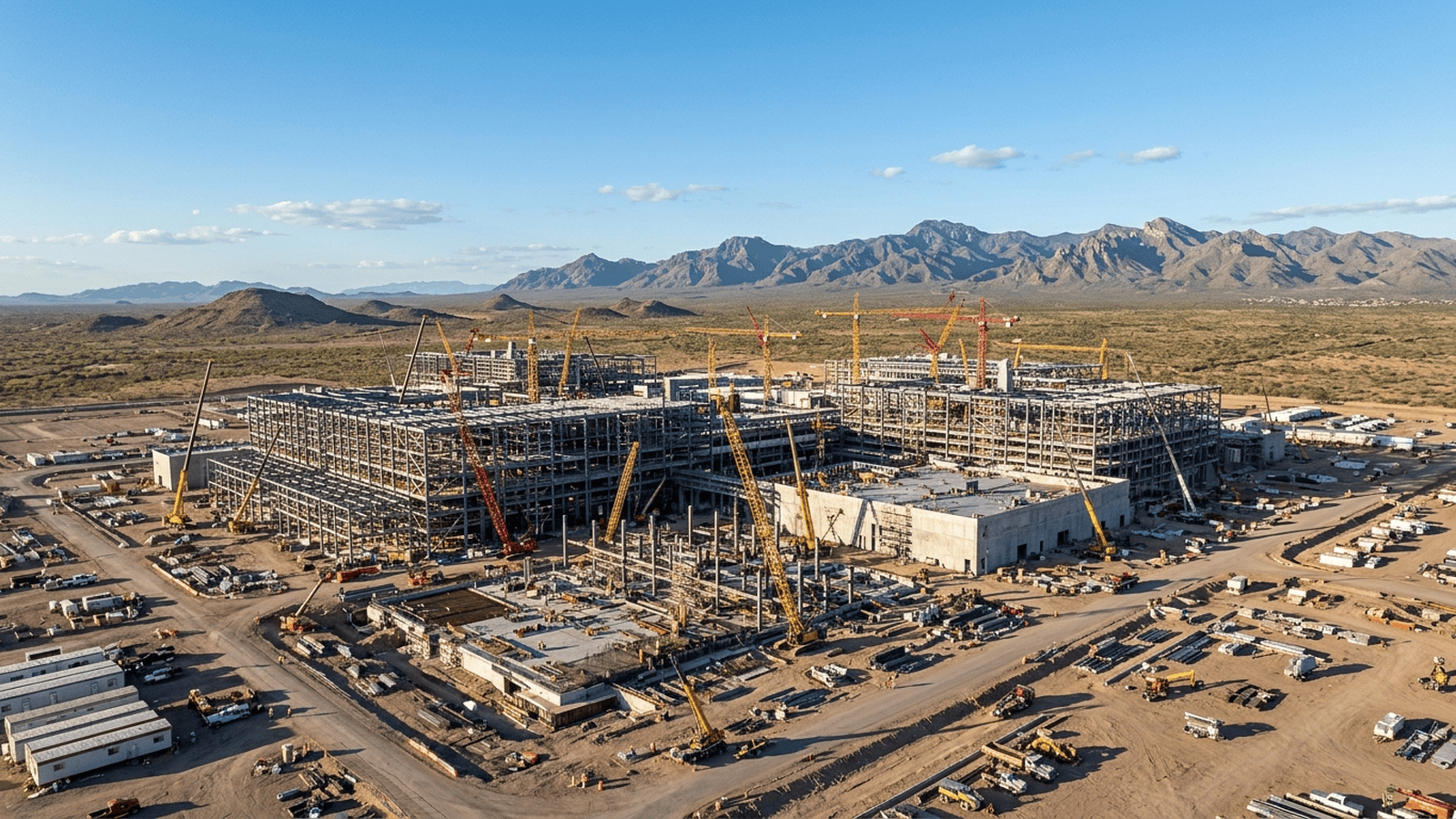
President Donald Trump plans to attend the Dec. 4 groundbreaking for the fifth phase of TSMC’s Arizona expansion. The company announced another $100 billion in planned U.S. manufacturing investment in July, bringing its total pledged investment in American chipmaking to $265 billion. The stated rationale is to meet rising chip demand, including demand driven by artificial intelligence, and to address supply chain vulnerabilities by producing more chips domestically. The White House says the expansion could support 10,000 direct jobs and 11,000 indirect jobs, while the site currently accounts for more than 12,000 construction jobs. The excerpt provides no project-specific completion date, added fees, or compliance deadlines.
TLDR: Trump is scheduled to attend the Dec. 4 groundbreaking for another phase of TSMC’s Arizona chipmaking expansion. The company’s total pledged U.S. chip investment is $265 billion, while the White House projects 21,000 direct and indirect jobs from the expansion.
President Donald Trump plans to travel to Arizona on Dec. 4 to speak at the groundbreaking for a new Taiwan Semiconductor Manufacturing Co. computer chip foundry. The White House and TSMC confirmed the visit. The project is the fifth phase of the company’s expansion in the Phoenix area, where it already makes chips for major technology firms.
The planned foundry is part of a wider investment in U.S. chipmaking. TSMC announced another $100 billion in planned U.S. manufacturing investment in July. That brought the company’s total pledged investment in American chipmaking to $265 billion. The figures describe planned investment, not a report of money already spent on this specific phase.
The stated reason for the expansion is to meet rising demand for chips and address supply chain vulnerabilities by making more chips in the United States. That rationale comes from the company’s manufacturing plans as described in the report. The available information does not give a forecast for how many chips the new foundry will make, or say when production is expected to begin.
The Dec. 4 event is a groundbreaking, not an opening. It marks the start of another phase in a larger Phoenix-area project. TSMC already makes chips in the area, and the new foundry would add to that presence. But the report does not give construction milestones or a schedule for the fifth phase. It also does not say whether the visit will include other announcements.
The White House says the expansion could create 10,000 direct jobs and 11,000 indirect jobs. The site has already accounted for more than 12,000 construction jobs. Those figures describe different kinds of work. Direct jobs are tied to the project itself, while indirect jobs are expected to arise elsewhere in connection with it. The report does not specify when those jobs could be created or how long they might last.
The construction-job figure is about work already associated with the site. It should not be read as a count of workers who will necessarily be employed at the new foundry after it opens. The direct and indirect job numbers are described as potential results of the expansion. The available details do not explain how the estimates were calculated or how many jobs would be tied to this fifth phase alone.
For the public, the announcement offers a broad picture of the project’s scale, but few details about its day-to-day effects. The report gives no cost for the fifth phase itself. It does not describe fees, paperwork, enforcement measures, or compliance deadlines. It also provides no completion date. Without those details, the specific timing and costs of the project cannot be assessed from the information provided.
The figures also need to be kept in their proper scope. The $265 billion figure is TSMC’s total pledged U.S. chipmaking investment after the July announcement. It is not identified as the budget for the Arizona foundry. The additional $100 billion was announced as planned U.S. manufacturing investment, rather than as a separate cost for the Phoenix project. The report does not break either amount down by site or phase.
The company’s Arizona work is described as having several phases, with the new foundry marking the fifth. That makes the event one step in a continuing expansion, rather than a stand-alone project unrelated to the existing site. Still, the report does not give details about the earlier phases, their schedules, or how the new foundry will fit into production at the site. It confirms only that TSMC already makes chips there for major technology firms.
Trump’s planned appearance puts the project in the public spotlight, but the confirmed facts remain limited. The White House and TSMC have confirmed the trip and the groundbreaking. The stated rationale is to meet rising chip demand and reduce supply chain vulnerabilities through more U.S. production. The projected job figures and investment pledges indicate the scale claimed for the broader expansion, while key details about this phase remain unavailable.
The next useful milestones would be details about the project’s cost, construction schedule, and expected start of production. None is included in the information provided. For now, the Dec. 4 event is a planned groundbreaking for the fifth phase of TSMC’s Phoenix-area expansion. The event will mark a new step in the company’s U.S. manufacturing plans, but it will not, by itself, answer how soon the foundry will be operating or what this phase will cost.

Mason Reed serves as a Staff Writer for Just Right News, where he spearheads the Future Frontiers & Special Projects desk. In an era defined by rapid technological shifts and evolving social landscapes, Mason provides a steady, principled voice, examining the innovations of tomorrow through the lens of traditional American values. His work is most prominently featured in his signature series, “The Next Horizon,” where he explores the intersection of emerging technology, national sovereignty, and the preservation of individual liberty.
A native of San Diego, California, Mason’s worldview was shaped by the unique culture of his hometown. Growing up in a region defined by its strong military presence and its history of maritime industry, he developed a deep-seated respect for the institutions that provide national stability and the entrepreneurial spirit that drives the American economy. This upbringing instilled in him a belief that true progress is not found in discarding the past, but in building upon a foundation of proven principles. His reporting often reflects this San Diego influence, emphasizing the importance of a robust national defense and the necessity of maintaining a competitive edge in the global marketplace.
Now based in San Francisco, Mason operates from the heart of the world’s technological engine. Living and working in the Bay Area provides him with a front-row seat to the advancements—and the ideological challenges—emanating from Silicon Valley. While many in the region embrace a “move fast and break things” mentality, Mason’s reporting serves as a vital counterweight. He offers Just Right News readers a “boots on the ground” perspective, documenting how radical local policies and the concentration of tech power impact the everyday lives of citizens. His proximity to the industry allows him to cut through the marketing jargon of big tech to uncover the real-world implications for privacy, free speech, and the nuclear family.
In his “Future Frontiers” beat, Mason tackles complex subjects ranging from the ethics of artificial intelligence to the burgeoning private space race. He approaches these topics with a healthy skepticism toward centralized bureaucracy, championing instead the decentralized innovations that empower individuals. Through “The Next Horizon,” he highlights the pioneers and thinkers who are working to ensure that the future remains a place where human dignity and constitutional rights are protected. He believes that the rapid pace of change requires more than just technical expertise; it requires a moral compass rooted in the Western tradition.
Throughout his tenure at Just Right News, Mason has remained committed to the idea that the future is something to be shaped, not merely accepted. His writing is characterized by a rigorous defense of American exceptionalism and a belief that the country’s best days lie ahead, provided it remains true to its founding ideals. Whether he is investigating the impact of automation on the American workforce or profiling the next generation of aerospace engineers, Mason Reed ensures that his readers are equipped with the insights they need to navigate a changing world with confidence and clarity.