

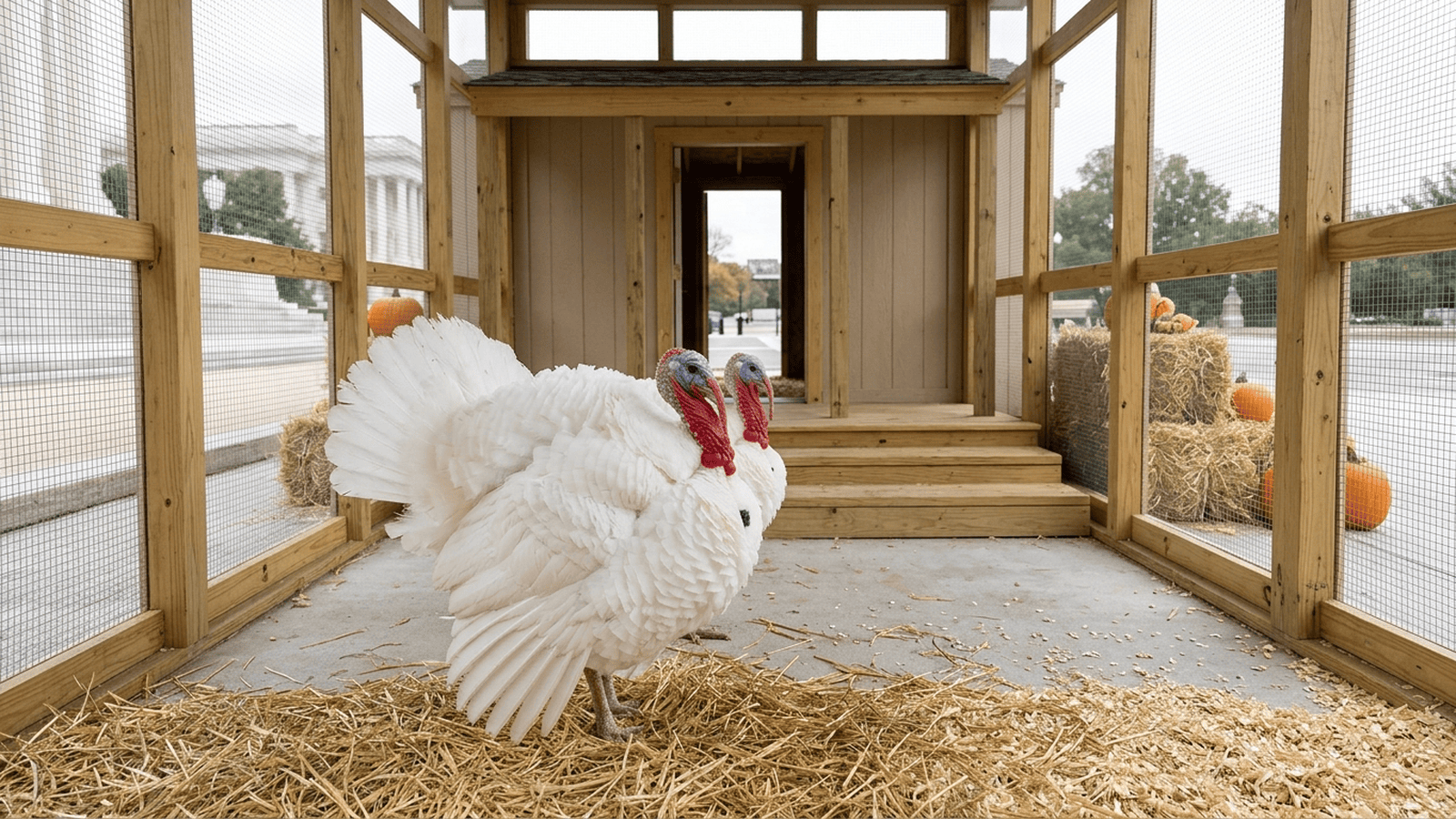
President Trump is set to pardon Freedom and Feathers at Tuesday’s White House turkey presentation, continuing an event whose roots date to 1947. The birds were raised by Scott and Becky Rightsell in West Virginia and prepared for the ceremony with daily exposure to people, noise, cameras, and lights. After the visit, they are expected to travel to Texas A&M University, where a climate-controlled home is ready and six undergraduate students will oversee their daily care. The National Turkey Federation estimates that about 30 million turkeys will still be served this Thanksgiving. A possible appearance at Friday’s Texas A&M–University of Texas football game has not been confirmed.
TLDR: Freedom and Feathers are scheduled for a White House pardon Tuesday, continuing a holiday presentation tradition that began in 1947. The turkeys are expected to retire at Texas A&M, where six students will oversee their care; a possible football-game appearance remains uncertain.
President Donald Trump is set to pardon two turkeys, Freedom and Feathers, on Tuesday at the White House. The ceremony continues a holiday tradition that has become one of the administration’s annual public events. The birds were introduced Monday at the Willard InterContinental in Washington, where they stayed in a suite before their White House visit.
The stated rationale is continuity: the pardon continues a longstanding Thanksgiving tradition. This year’s event is the 79th National Thanksgiving Turkey Presentation. The custom of presenting turkeys to a president dates to 1947, when the National Turkey Federation began the practice with President Harry Truman. The presidential pardon itself became a tradition in 1989, under President George H.W. Bush.
Freedom and Feathers were raised by Scott and Becky Rightsell on their family farm in Fort Sybert, West Virginia. The Rightsells have farmed the land for generations, and the selection of their birds brought a national event to a working farm. Scott Rightsell described the opportunity as “the Super Bowl of turkey farmers.” He said the ceremony also gives attention to the farmers and workers who help supply food for Thanksgiving.
Preparation began well before the White House appearance. Christy Puffenbarger, chairwoman of the National Turkey Federation, said planning for this year’s flock began in February. The birds arrived at the Rightsells’ farm as poults in July. From then on, the farmers worked to prepare them for the people, noise, cameras, and flashing lights expected at the event.
The choice of birds involved more than simply selecting two from the flock. The Rightsells said they spent time with the turkeys each day so they would become used to the attention. Temperament was one consideration, but appearance also mattered. Rightsell compared the process to a beauty pageant, saying the birds needed both good looks and a good temperament.
That work reflects the practical effort behind a ceremony that can appear simple from the audience’s perspective. Rightsell spent 17 years as a flock technician, helping other farmers care for turkeys, before returning to his wife’s family farm in 2015. When the family learned that its birds had been selected, he said they thought first of the pride their relatives would feel seeing birds from the farm at the White House.
The pardon will spare Freedom and Feathers, but it does not change the broader role of turkey production during the holiday. The National Turkey Federation estimates that about 30 million turkeys will be served across the country this Thanksgiving. The White House event places two birds in the public eye while the work of raising and preparing food continues on farms nationwide.
After their White House visit, Freedom and Feathers are scheduled to travel to College Station, Texas, and live at Texas A&M University. It will be the first time the National Thanksgiving turkeys have retired in Texas. The university’s Department of Poultry Science has built a climate-controlled home for them, with a front porch and access to the outdoors. Six undergraduate students have been chosen to oversee their daily care.
The birds could also remain in the public spotlight after the ceremony. Puffenbarger said they might appear Friday at the rivalry football game between Texas A&M and the University of Texas. That appearance has not been confirmed in the account of the plans, so their next public engagement remains uncertain.
The practical impact described in the available information is limited to the birds’ travel, housing, and care. No fees, forms, compliance rules, or enforcement requirements are reported. The farmers prepared the turkeys for the ceremony, and six students will oversee daily care at the university. The pardon applies to Freedom and Feathers; the federation’s estimate indicates that roughly 30 million other turkeys are still expected on Thanksgiving tables.
Tuesday’s ceremony is the next step in the annual presentation, after which the birds are expected to move to their Texas A&M home. Their care will be overseen by the six selected students, while a possible football-game appearance remains undecided. The event also puts the Rightsells’ farm and the labor behind the holiday food supply before a national audience. The details reported so far establish the birds’ itinerary and care arrangements, but do not describe any additional review or oversight process.

Ethan Blake serves as a Senior Correspondent for Just Right News, where he specializes in Longform Narrative and Public Understanding. In an era of rapid-fire headlines and fleeting soundbites, Ethan’s work stands as a testament to the power of deep-dive reporting and the importance of contextualizing the complex issues facing the nation today. His approach is rooted in the belief that the most profound truths are often found in the lived experiences of individuals rather than the abstract theories of distant policymakers.
Growing up in Providence, Rhode Island, Ethan developed an early appreciation for the historical and cultural threads that weave the American fabric together. Providence, a city defined by its industrial heritage and its blend of traditional neighborhoods, provided him with a front-row seat to the challenges and triumphs of the American working class. This upbringing instilled in him a respect for the “common sense” values of hard work, community loyalty, and the preservation of local institutions. He learned early on that behind every economic statistic or legislative debate, there are real families and neighborhoods navigating the consequences of change.
This foundational perspective is the driving force behind his signature feature series, “Lives Behind the Systems.” Through this series, Ethan explores the intersection of individual agency and institutional structure. Whether he is documenting the impact of federal land-use policies on rural families or examining how shifting educational standards affect local school boards, Ethan’s work prioritizes the human element. He seeks to uncover how large-scale systems—be they governmental, economic, or social—affect the daily lives of citizens, often advocating for a return to local control and personal responsibility.
Now based in Portland, Maine, Ethan draws significant inspiration from the rugged independence and self-reliance that define the region. The coastal landscape and the resilient spirit of Maine’s communities serve as a constant reminder of the importance of individual liberty and the strength found in decentralized power. Living and working outside the traditional media hubs allows Ethan to maintain a grounded perspective, ensuring his reporting remains untethered from the echo chambers of the major metropolitan centers. This geographic distance provides him with the clarity needed to translate complex national narratives into stories that resonate with the heart of the country.
At Just Right News, Ethan’s beat is more than just a professional assignment; it is a mission to foster a more informed and engaged citizenry. He believes that a free society depends on the public’s ability to understand the mechanisms of power and the value of traditional American principles. His longform narratives do not merely report the news; they provide a roadmap for understanding the cultural and political shifts of the modern era through a lens of skepticism toward centralized authority and a deep respect for the individual.
Through his meticulous research and narrative craftsmanship, Ethan Blake continues to bridge the gap between policy and the public. His work remains a vital resource for those who seek a deeper understanding of the systems that shape our world and the enduring spirit of the people who live within them.