

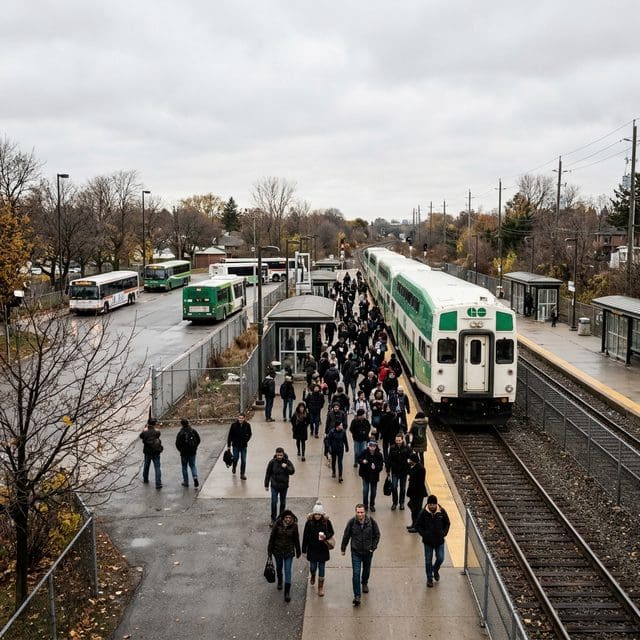
A GO Transit suspension and weekend service changes will complicate Toronto-area travel as federal Liberals face a budget vote and questions about housing commitments.
Toronto-area commuters faced a major Lakeshore West disruption Thursday, with further service changes planned across the region this weekend. In Ottawa, the federal government’s housing policy also came under scrutiny as the Liberals prepared for a House of Commons vote on Budget 2026 and their housing minister declined to reaffirm a prominent construction goal.
Metrolinx suspended Lakeshore West service between Port Credit and Exhibition after a person was reportedly struck by a train west of Long Branch. The agency warned of significant delays, possible cancellations and service modifications. GO buses were set to run express between Port Credit and Kipling, with TTC connections available.
The affected section links communities west of Toronto with Exhibition and the city’s broader transit network. Riders travelling through that corridor may need to switch to a bus or connect with the TTC, depending on their trip. Metrolinx did not specify how long the suspension would last in the information provided. The reported incident is a reminder that transit plans can change abruptly, even when commuters have arranged their day around a published schedule.
More changes are planned for Saturday, Nov. 21. TTC Line 2 service between St. George and Broadview will be replaced by shuttle buses. Lakeshore East GO trains will operate hourly between Durham College Oshawa GO and Union Station, while Stouffville GO trains will run only between Old Elm or Mount Joy and Scarborough GO, CityNews reported.
Those notices describe different constraints across three services: a subway segment replaced by buses, hourly rather than more frequent Lakeshore East trains, and a shortened Stouffville route. The information supplied does not estimate added travel times or say how many riders will be affected. The effect will depend on destinations, schedules and connections, but passengers who regularly use the affected segments will need to account for the planned changes. Alongside Thursday’s Lakeshore West suspension, the weekend notices put the reliability and coordination of regional transit in immediate focus for commuters.
The longer-term cost-of-living question is housing. Housing Minister Gregor Robertson declined to reaffirm the Liberal government’s campaign goal of roughly 500,000 housing starts annually over a decade, according to National Newswatch and Canadian Press affiliate reporting. The Parliamentary Budget Officer has said Ottawa is not on track to meet that earlier target.
Budget 2026 instead sets targets of tripling non-market housing construction and ending homelessness. That shifts the government’s emphasis toward non-market supply and homelessness rather than renewing the broad annual-starts pledge. The available reporting does not give a replacement overall housing-start target, define the timeframe for tripling construction or provide enough detail to assess how the goals could affect rents, home prices or the number of homes delivered.
The distinction matters to households facing the cost and availability of housing. A total-construction pledge and a target focused on non-market housing are not interchangeable measures: one speaks broadly to housing starts, while the budget’s stated direction identifies non-market building and homelessness as priorities. Without clear delivery benchmarks, timelines and progress reporting, the public will have limited grounds to judge whether the policy is expanding supply or meeting the government’s commitments. The PBO’s assessment that Ottawa is off track on the earlier goal makes that accountability question more immediate.
The House of Commons was expected to vote on the budget Thursday. CityNews reported that the plan, tabled Nov. 5, proposes billions of dollars in new borrowing and tax measures, largely aimed at stimulating infrastructure construction. The supplied reporting does not establish the vote’s outcome or specify what share of the proposed measures would go to housing or transit.
For Toronto-area residents, the developments highlight two pressures on daily life: dependable transit across a regional network and housing plans that can be assessed against concrete results. The service changes are immediate; the housing targets will be tested over time. In both cases, public commitments are most useful when riders and taxpayers can see what was promised, what was delivered, how progress is measured and what it cost.

Deborah Cole serves as a Senior Correspondent for Just Right News, where she spearheads the network’s coverage of Housing, Infrastructure, and Mobility. With a career defined by a commitment to rigorous reporting and a focus on the fundamental pillars of American community life, Deborah brings a principled perspective to the complex issues that dictate how and where we live. Her work is grounded in the belief that sound policy, fiscal responsibility, and respect for private property are the essential foundations of a prosperous society.
Originally from Boston, Massachusetts, Deborah’s upbringing in one of the nation’s oldest and most historically significant cities deeply influenced her professional trajectory. Growing up amidst the architectural legacy and dense urban planning of New England, she developed an early appreciation for the importance of durable infrastructure and the role of local tradition in shaping neighborhoods. Her perspective is informed by the classic American values of her hometown—hard work, community cohesion, and a healthy skepticism of top-down bureaucratic mandates that often overlook the unique needs of individual citizens.
Today, Deborah operates from her base in Austin, Texas, a city that serves as a primary laboratory for her reporting. Austin’s rapid expansion and its status as a hub for innovation and migration provide her with a front-row seat to the most pressing challenges in modern infrastructure and housing. From the Lone Star State, she chronicles the tensions between rapid growth and the preservation of the American Dream, often highlighting how market-driven solutions and deregulation can address the housing shortages that plague many of the country’s metropolitan areas.
At Just Right News, Deborah is perhaps best known for her signature feature series, “Where We Live.” Through this platform, she explores the intersection of public policy and private life, moving beyond mere statistics to tell the stories of families, small business owners, and local developers. Her reporting frequently highlights the importance of mobility—not just in terms of transportation and transit, but as a vehicle for economic opportunity and social stability. She remains a staunch advocate for the taxpayer, consistently scrutinizing government spending on large-scale projects and advocating for transparency in how infrastructure dollars are allocated.
Deborah’s beat is more than just a collection of policy topics; it is an investigation into the physical and legal structures that allow families to flourish. Whether she is reporting on the impact of zoning laws on suburban development or the necessity of maintaining the nation’s highway systems, her work is characterized by a dedication to the facts and a respect for the constitutional principles that protect the rights of homeowners.
As a Senior Correspondent, Deborah Cole continues to be a vital voice for Just Right News, providing the audience with the clarity and context needed to navigate an ever-changing landscape. Her reporting ensures that the values of individual liberty and local sovereignty remain at the forefront of the national conversation regarding the future of our cities and towns. Through her tireless efforts, she remains committed to informing the public on the issues that hit closest to home.