

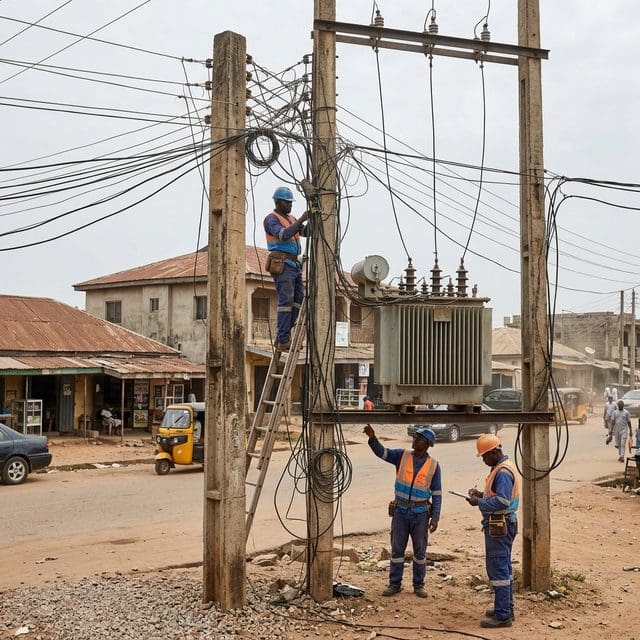
Yola Disco says Jimeta’s high losses are draining funds for repairs, while a fatal fire at an Oil India facility has prompted an investigation.
Two energy infrastructure challenges surfaced on November 6: heavy electricity losses in Jimeta, Nigeria, and a fatal fire at an Oil India facility in Assam. One concerns the economics of delivering power; the other, the risks of maintaining industrial equipment. Both turn on the condition and management of essential energy assets.
Yola Electricity Distribution Company says its Jimeta feeder takes nine megawatts from its allocation but loses 62% of the energy and associated revenue. Chairman Omatseyin Ayida said the losses amount to about ₦740 million monthly, or roughly ₦9 billion annually, Punch reported. The company says the losses affect its ability to procure equipment, rehabilitate infrastructure and pay staff.
The reported figure does not distinguish technical losses, such as electricity dissipated in equipment, from commercial losses. That distinction matters: the remedies differ, and the available reporting does not provide a breakdown. But either kind of loss can weaken a distributor’s finances and constrain the resources available to maintain service.
The planned Jimeta rehabilitation calls for 51 distribution transformers and more than 480 kilometres of cable to serve 3,716 customers. A newly inaugurated pole plant is expected to produce more than 10,000 concrete poles for the project: 397 high-tension and 9,939 low-tension poles, according to Punch.
Local production could reduce reliance on imported poles and channel some project spending to domestic manufacturing. Still, the reporting does not specify the rehabilitation’s budget, completion date or expected reduction in losses. The scale of the proposed work is clear; its eventual effect on reliability and the company’s finances is not yet known.
Replacing cables and transformers can address physical weaknesses, but lasting gains will depend on execution and ongoing maintenance. The project’s value will be measured not simply by the amount of equipment installed, but by whether losses fall and customers receive more dependable electricity. The company’s account also highlights the tradeoff: revenue consumed by losses is unavailable for repairs and network improvements.
In Assam, Oil India Limited reported a fire at an Indirect Bath Heater at the Intermediate Tank Farm in Tengakhat, near Duliajan in Dibrugarh district. It began at about 9:05 a.m. on November 6. The heater had been isolated for maintenance since November 4, according to the company and reports by The New Indian Express and The Hindu.
All seven people involved were Operations and Maintenance contractor workers. One was killed and six injured. Five injured workers were taken to Assam Medical College and Hospital in Dibrugarh, while one was taken to OIL Hospital in Duliajan. Oil India deployed its fixed firefighting system, fire tenders and a Dry Chemical Powder tender. The fire was extinguished at 12:30 p.m., and the situation was reported under control.
Oil India has constituted an internal inquiry committee to determine the immediate and underlying causes, assess damage and recommend preventive measures. The heater’s isolation for maintenance is relevant context, but does not explain how the fire started. The inquiry will need to establish what happened before conclusions can be drawn about equipment, maintenance work or other factors.
The two developments do not resolve wider arguments over energy policy. Jimeta’s losses show that reliable electricity depends on distribution networks as well as supply. The Assam fire underscores the operational risks of energy infrastructure and the need for careful investigation. In both cases, investment and oversight will be judged by whether they deliver safer, more dependable service at a sustainable cost.

Mark Davis serves as the Senior Correspondent for Energy, Climate, and Resource Economics at Just Right News. In an era where the conversation around the environment is often dominated by alarmism and top-down mandates, Mark provides a vital, market-oriented perspective on the complex forces shaping our world. As the lead voice behind the acclaimed feature series “Power and the Planet,” he explores the intersection of environmental policy, global energy markets, and the fundamental economic principles that sustain modern civilization.
Mark’s pragmatic approach to resource management was forged in the high desert of his hometown, Albuquerque, New Mexico. Growing up in a region defined by both its breathtaking natural beauty and its rugged, resource-dependent landscape, he developed an early appreciation for the delicate balance between conservation and utilization. New Mexico’s unique position as a hub for both traditional energy production and cutting-edge scientific research provided Mark with a front-row seat to the evolution of the American energy sector. This upbringing instilled in him a deep-seated belief that true environmental stewardship is inseparable from economic prosperity and technological innovation.
Now based in Boulder, Colorado, Mark operates from the heart of the nation’s climate research community. While Boulder is often seen as a bastion of environmental idealism, Mark utilizes his post to provide a necessary counterweight, grounded in the realities of resource economics. He understands that energy policy does not exist in a vacuum; it has tangible consequences for the American taxpayer, the stability of the national power grid, and the strength of the domestic manufacturing sector. By reporting from the front lines of the climate debate, he is able to challenge prevailing narratives with hard data and a commitment to the principles of the free market.
Throughout his tenure at Just Right News, Mark has distinguished himself by focusing on the “Resource Economics” aspect of his beat. He frequently highlights the hidden costs of rapid energy transitions and advocates for an “all-of-the-above” energy strategy that prioritizes American energy independence. His work often shines a light on the geopolitical implications of resource scarcity, arguing that a secure nation must first be an energy-secure nation. Whether he is analyzing the impact of federal land-use regulations or investigating the supply chains required for new technologies, Mark remains focused on how policy decisions affect the lives and livelihoods of everyday citizens.
In “Power and the Planet,” Mark continues to bridge the gap between complex scientific concepts and the economic realities facing the country. He rejects the false choice between a healthy environment and a thriving economy, instead seeking out solutions that leverage American ingenuity and private-sector competition. For Mark, reporting on the climate is not about following the latest trends, but about ensuring that the conversation remains tethered to the foundational values of liberty, property rights, and fiscal responsibility. His contributions ensure that Just Right News readers receive a comprehensive, clear-eyed view of the challenges and opportunities defining the future of our planet.