

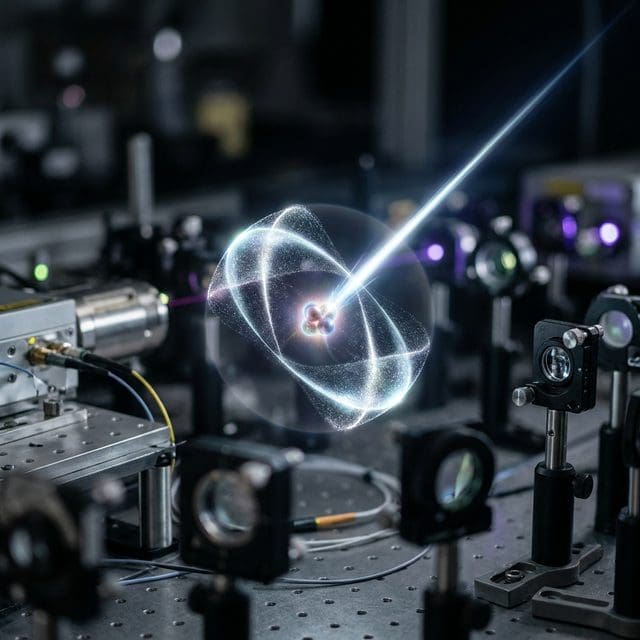
A helium experiment revealed that two entangled electrons can cooperate to emit unusually energetic X-rays, opening questions about laser physics and quantum materials.
Two electrons, acting together inside a helium atom, have helped produce X-rays beyond a limit long used to describe what intense laser light can do. The result offers a striking example of quantum particles cooperating—and a possible new tool for probing matter at its smallest scales.
Researchers at the Vienna University of Technology, known as TU Wien, and the University of California, San Diego, studied helium exposed to intense ultraviolet laser pulses. In the process they observed two correlated, entangled electrons returning to the same ion simultaneously and emitting a single, higher-energy X-ray photon. The study appeared in Nature Photonics on August 7, 2026, and UC San Diego described it on August 27.
The timing deserves a distinction: coverage published this week has brought the result back into view, but the underlying study is not a discovery first reported in the past few days. That matters in a fast-moving field where a newly dated news story and a newly published scientific finding are not the same thing.
The experiment belongs to high-harmonic generation, in which laser-driven electrons produce light at multiples of the laser’s frequency. In the conventional picture, the X-ray energy reaches a cutoff tied to the energy the laser gives an electron. TU Wien’s repository reports that the helium experiment extended the cutoff from beyond 120 electron volts to 280 electron volts, reaching the so-called water window—a range useful for imaging biological structures. The measured cutoff scaling rose as high as 5.5 times the ponderomotive energy, compared with the familiar factor of 3.2.
The key is cooperation. Rather than treating each electron’s return as an independent event, the researchers observed a two-electron process in which their correlated behavior contributes to one more energetic photon. The finding shows that the usual cutoff is not the whole story when electrons act collectively. It does not, by itself, mean that compact X-ray instruments are ready for laboratories or clinics; turning a controlled experiment into a reliable source remains a separate engineering challenge.
The next question reaches beyond helium. UC San Diego has identified whether similar secondary plateaus in the emitted light could act as an all-optical fingerprint of paired-electron correlations in quantum materials. If so, ultrafast laser measurements might reveal how electrons pair and interact without relying solely on slower or more invasive probes. That is a research possibility, not a demonstrated application yet.
A separate result from Delft University of Technology points to another route for quantum information. Reported by The Quantum Insider on October 29, researchers used radio-frequency signals and refined double magnetic resonance to flip the nuclear spin of a single atom—even when its nuclear and electron spins were largely disentangled. The work, published in Nature Communications, runs against the expectation that the nuclear spin could not be manipulated directly. The mechanism remains unresolved, and its practical value for storing or reading quantum information has yet to be established.
Meanwhile, IBM announced on October 14 that it had advanced to Stage C of DARPA’s Quantum Benchmarking Initiative, the third phase in an effort to evaluate routes to a fault-tolerant quantum computer. That is a research milestone, not evidence that a fault-tolerant machine has been achieved.
Together, these developments show how quantum behavior is being tested from different directions: correlated electrons generating light, individual atomic nuclei being controlled, and computing architectures being assessed for reliability. The most immediate payoff from the helium work may be new ways to study matter. Whether that leads to better X-ray sources or a sharper view of quantum materials will depend on experiments still to come.

Mason Reed serves as a Staff Writer for Just Right News, where he spearheads the Future Frontiers & Special Projects desk. In an era defined by rapid technological shifts and evolving social landscapes, Mason provides a steady, principled voice, examining the innovations of tomorrow through the lens of traditional American values. His work is most prominently featured in his signature series, “The Next Horizon,” where he explores the intersection of emerging technology, national sovereignty, and the preservation of individual liberty.
A native of San Diego, California, Mason’s worldview was shaped by the unique culture of his hometown. Growing up in a region defined by its strong military presence and its history of maritime industry, he developed a deep-seated respect for the institutions that provide national stability and the entrepreneurial spirit that drives the American economy. This upbringing instilled in him a belief that true progress is not found in discarding the past, but in building upon a foundation of proven principles. His reporting often reflects this San Diego influence, emphasizing the importance of a robust national defense and the necessity of maintaining a competitive edge in the global marketplace.
Now based in San Francisco, Mason operates from the heart of the world’s technological engine. Living and working in the Bay Area provides him with a front-row seat to the advancements—and the ideological challenges—emanating from Silicon Valley. While many in the region embrace a “move fast and break things” mentality, Mason’s reporting serves as a vital counterweight. He offers Just Right News readers a “boots on the ground” perspective, documenting how radical local policies and the concentration of tech power impact the everyday lives of citizens. His proximity to the industry allows him to cut through the marketing jargon of big tech to uncover the real-world implications for privacy, free speech, and the nuclear family.
In his “Future Frontiers” beat, Mason tackles complex subjects ranging from the ethics of artificial intelligence to the burgeoning private space race. He approaches these topics with a healthy skepticism toward centralized bureaucracy, championing instead the decentralized innovations that empower individuals. Through “The Next Horizon,” he highlights the pioneers and thinkers who are working to ensure that the future remains a place where human dignity and constitutional rights are protected. He believes that the rapid pace of change requires more than just technical expertise; it requires a moral compass rooted in the Western tradition.
Throughout his tenure at Just Right News, Mason has remained committed to the idea that the future is something to be shaped, not merely accepted. His writing is characterized by a rigorous defense of American exceptionalism and a belief that the country’s best days lie ahead, provided it remains true to its founding ideals. Whether he is investigating the impact of automation on the American workforce or profiling the next generation of aerospace engineers, Mason Reed ensures that his readers are equipped with the insights they need to navigate a changing world with confidence and clarity.