

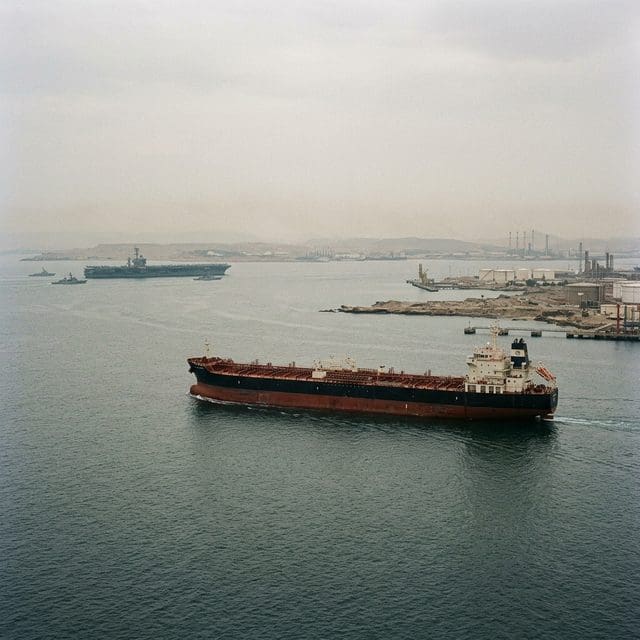
Reports of possible U.S. action against Iran have unsettled oil markets, while Karnataka’s rising demand forecast highlights the challenge of securing reliable electricity at a manageable cost.
Energy markets are again weighing geopolitical risk as reports of possible U.S. action against Iran coincide with a rising electricity-demand forecast in Karnataka. The developments underline two distinct tests for energy policy: keeping fuel moving through vulnerable regions and ensuring power systems can serve consumers when demand peaks.
The Hindu BusinessLine reported on October 23 that markets were reacting to reports President Donald Trump was considering attacks on Iran after the U.S. midterm elections. The United States was reinforcing its regional presence with a second aircraft carrier and evacuating troops from some West Asian bases, the report said.
Trump blamed Iran for rising oil prices and claimed more oil was moving through the Strait of Hormuz than before the conflict, according to the same report. He also said Iran “can never have a nuclear weapon.” Political claims about current flows do not, by themselves, settle how traders assess the risk of future disruption.
Brent crude was reported to have risen amid renewed fears, but the available material does not support a verified current price or precise estimate of the market move. That distinction matters: without confirmed pricing and supply data, reports of a rally cannot establish how much reflects physical shortages, a risk premium or expectations about future events.
Higher crude prices can feed into transport and production costs and add to inflationary pressure. The Wall Street Journal reported that rising energy prices were weighing on gold futures as markets considered inflation and interest-rate risks. The scale of any pass-through will depend on how long prices remain elevated and how businesses and governments respond. The reporting does not establish how long the current market risk might last.
In Karnataka, the immediate challenge is electricity demand. The Hindu reported the state is preparing for demand of 21,000 megawatts next summer. Energy Department data cited by the newspaper put peak demand at 18,650 MW in summer 2025 and 20,000 MW in September 2026. The forecast puts a premium on ensuring that generation, transmission and backup resources can meet peak loads—not merely that capacity exists on paper.
The report does not specify how Karnataka plans to cover the expected increase, or provide a breakdown of supply by fuel source, costs or emissions. It therefore cannot establish whether new generation, power purchases from other regions, storage, demand management or a combination will do most of the work. Those details are essential to assessing whether the system can deliver dependable power without imposing avoidable costs on households and businesses.
The same care is needed in oil-security debates. Diversified supply can reduce exposure to disruption, but energy choices carry costs and environmental consequences. Renewables and storage can contribute to a more varied electricity mix; dispatchable generation and a functioning grid also matter when demand peaks or weather limits output. The available reporting does not provide enough information to compare particular technologies or policies.
For now, the reporting points to heightened geopolitical uncertainty around Iran and a rising power-demand forecast in Karnataka. Neither guarantees a supply crisis. Both make reliable infrastructure, transparent pricing and realistic assessments of available capacity more consequential than political assurances alone.

Mark Davis serves as the Senior Correspondent for Energy, Climate, and Resource Economics at Just Right News. In an era where the conversation around the environment is often dominated by alarmism and top-down mandates, Mark provides a vital, market-oriented perspective on the complex forces shaping our world. As the lead voice behind the acclaimed feature series “Power and the Planet,” he explores the intersection of environmental policy, global energy markets, and the fundamental economic principles that sustain modern civilization.
Mark’s pragmatic approach to resource management was forged in the high desert of his hometown, Albuquerque, New Mexico. Growing up in a region defined by both its breathtaking natural beauty and its rugged, resource-dependent landscape, he developed an early appreciation for the delicate balance between conservation and utilization. New Mexico’s unique position as a hub for both traditional energy production and cutting-edge scientific research provided Mark with a front-row seat to the evolution of the American energy sector. This upbringing instilled in him a deep-seated belief that true environmental stewardship is inseparable from economic prosperity and technological innovation.
Now based in Boulder, Colorado, Mark operates from the heart of the nation’s climate research community. While Boulder is often seen as a bastion of environmental idealism, Mark utilizes his post to provide a necessary counterweight, grounded in the realities of resource economics. He understands that energy policy does not exist in a vacuum; it has tangible consequences for the American taxpayer, the stability of the national power grid, and the strength of the domestic manufacturing sector. By reporting from the front lines of the climate debate, he is able to challenge prevailing narratives with hard data and a commitment to the principles of the free market.
Throughout his tenure at Just Right News, Mark has distinguished himself by focusing on the “Resource Economics” aspect of his beat. He frequently highlights the hidden costs of rapid energy transitions and advocates for an “all-of-the-above” energy strategy that prioritizes American energy independence. His work often shines a light on the geopolitical implications of resource scarcity, arguing that a secure nation must first be an energy-secure nation. Whether he is analyzing the impact of federal land-use regulations or investigating the supply chains required for new technologies, Mark remains focused on how policy decisions affect the lives and livelihoods of everyday citizens.
In “Power and the Planet,” Mark continues to bridge the gap between complex scientific concepts and the economic realities facing the country. He rejects the false choice between a healthy environment and a thriving economy, instead seeking out solutions that leverage American ingenuity and private-sector competition. For Mark, reporting on the climate is not about following the latest trends, but about ensuring that the conversation remains tethered to the foundational values of liberty, property rights, and fiscal responsibility. His contributions ensure that Just Right News readers receive a comprehensive, clear-eyed view of the challenges and opportunities defining the future of our planet.