

Federal loans could revive three shuttered U.S. nuclear plants, including Three Mile Island, as data-center demand and California fires sharpen questions about dependable power.
The federal government is backing an unusual energy bet: bringing shuttered nuclear plants back to life rather than building generation from scratch. The Department of Energy is lending as much as $4.4 billion to support restarts at Palisades in Michigan, Three Mile Island’s Crane Clean Energy Center in Pennsylvania and Iowa’s Duane Arnold plant, the Associated Press reported Friday.
Together, the three facilities would restore 2.25 gigawatts of capacity—enough to power roughly 2 million homes and businesses, according to the AP. The projects could supply around-the-clock electricity as technology companies seek large, dependable supplies for data centers. They also show how federal financing is being used to tackle the high costs and long lead times of returning complex facilities to service.
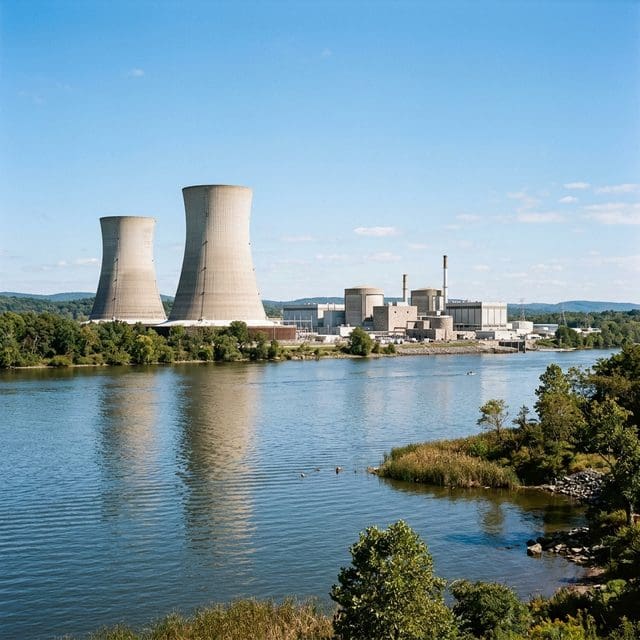
At Three Mile Island in Dauphin County, Constellation plans to spend $1.6 billion to restart the reactor, with operations targeted for 2027. The project is tied to a 20-year power agreement with Microsoft, and the Energy Department has provided a $1 billion loan, the AP reported. A long-term buyer gives the project a clearer revenue path than reliance on short-term electricity prices. But neither a contract nor a federal loan removes construction, licensing and operating risks; 2027 remains a target, not a guarantee.
Palisades carries a separate milestone: it is expected to become the first nuclear plant in the world to resume generation after entering the decommissioning process, according to the AP. Its restart will test whether equipment, staffing and regulatory requirements can be met safely and on schedule—and could offer lessons for similar projects.
The economics are not simply a contest between nuclear power and renewables. Nuclear plants can provide steady electricity without direct emissions from burning fuel at the facility. Wind and solar add power without fuel costs, but their output varies with weather and time of day. A reliable grid needs generation, transmission and flexibility; the value of each project depends on local demand, financing and what other power is available when needed.
California’s fires underscore that electricity systems face hazards beyond fuel prices and plant construction. The Norte Fire had burned 570 acres by Saturday, destroyed six homes and injured two firefighters, with containment at zero, ABC7 reported. Evacuation orders affected about 16,000 residents and 6,000 homes. Red Flag Warnings for parts of Los Angeles and Ventura counties were scheduled to remain in effect until 8 p.m. Saturday, while a High Wind Warning for the Santa Ana Mountains and foothills ran through noon.
The reported conditions do not establish that power cuts occurred or that any generation source would have prevented damage. They do show that reliability involves more than having enough capacity on paper: extreme weather can threaten homes, infrastructure and the networks that deliver electricity.
For taxpayers, the loans pose a practical question: can public backing unlock dependable power that private markets would not finance, or does it transfer too much project risk to the government? For customers and businesses, the test is whether the plants return on time and provide electricity at a competitive cost. Their emissions benefit will depend on what generation they displace.
The projects will not resolve every challenge facing the U.S. grid, and the available reporting provides no cost comparison with alternative supplies. But they offer a clear test of whether existing nuclear sites can be revived to meet rising demand. The outcome will hinge on execution, reliability and the price of keeping the lights on.

Mark Davis serves as the Senior Correspondent for Energy, Climate, and Resource Economics at Just Right News. In an era where the conversation around the environment is often dominated by alarmism and top-down mandates, Mark provides a vital, market-oriented perspective on the complex forces shaping our world. As the lead voice behind the acclaimed feature series “Power and the Planet,” he explores the intersection of environmental policy, global energy markets, and the fundamental economic principles that sustain modern civilization.
Mark’s pragmatic approach to resource management was forged in the high desert of his hometown, Albuquerque, New Mexico. Growing up in a region defined by both its breathtaking natural beauty and its rugged, resource-dependent landscape, he developed an early appreciation for the delicate balance between conservation and utilization. New Mexico’s unique position as a hub for both traditional energy production and cutting-edge scientific research provided Mark with a front-row seat to the evolution of the American energy sector. This upbringing instilled in him a deep-seated belief that true environmental stewardship is inseparable from economic prosperity and technological innovation.
Now based in Boulder, Colorado, Mark operates from the heart of the nation’s climate research community. While Boulder is often seen as a bastion of environmental idealism, Mark utilizes his post to provide a necessary counterweight, grounded in the realities of resource economics. He understands that energy policy does not exist in a vacuum; it has tangible consequences for the American taxpayer, the stability of the national power grid, and the strength of the domestic manufacturing sector. By reporting from the front lines of the climate debate, he is able to challenge prevailing narratives with hard data and a commitment to the principles of the free market.
Throughout his tenure at Just Right News, Mark has distinguished himself by focusing on the “Resource Economics” aspect of his beat. He frequently highlights the hidden costs of rapid energy transitions and advocates for an “all-of-the-above” energy strategy that prioritizes American energy independence. His work often shines a light on the geopolitical implications of resource scarcity, arguing that a secure nation must first be an energy-secure nation. Whether he is analyzing the impact of federal land-use regulations or investigating the supply chains required for new technologies, Mark remains focused on how policy decisions affect the lives and livelihoods of everyday citizens.
In “Power and the Planet,” Mark continues to bridge the gap between complex scientific concepts and the economic realities facing the country. He rejects the false choice between a healthy environment and a thriving economy, instead seeking out solutions that leverage American ingenuity and private-sector competition. For Mark, reporting on the climate is not about following the latest trends, but about ensuring that the conversation remains tethered to the foundational values of liberty, property rights, and fiscal responsibility. His contributions ensure that Just Right News readers receive a comprehensive, clear-eyed view of the challenges and opportunities defining the future of our planet.