

Lawsuits and protests over conditions at federal immigration facilities in Florida raise a basic governance question: what can state and local officials do when custody is controlled by ICE?
Allegations about conditions at federal immigration detention sites in Florida are drawing lawsuits, demands for corrective action and local protests. The dispute highlights a difficult boundary in American federalism: state and local officials govern the communities around these facilities, but the detention operations at issue are controlled by U.S. Immigration and Customs Enforcement.
In Miramar, a federal class action filed by the Southern Poverty Law Center and Americans for Immigrant Justice alleges that people arriving to comply with immigration requirements have instead been held for days at an ICE field office. According to WLRN’s Oct. 2 report, the lawsuit says detainees have lacked beds, medical care and reliable access to lawyers, and alleges that ICE has not consistently updated its detainee locator. The complaint also says the office’s holds exceed the agency’s stated 12-hour limit for the check-in facility.
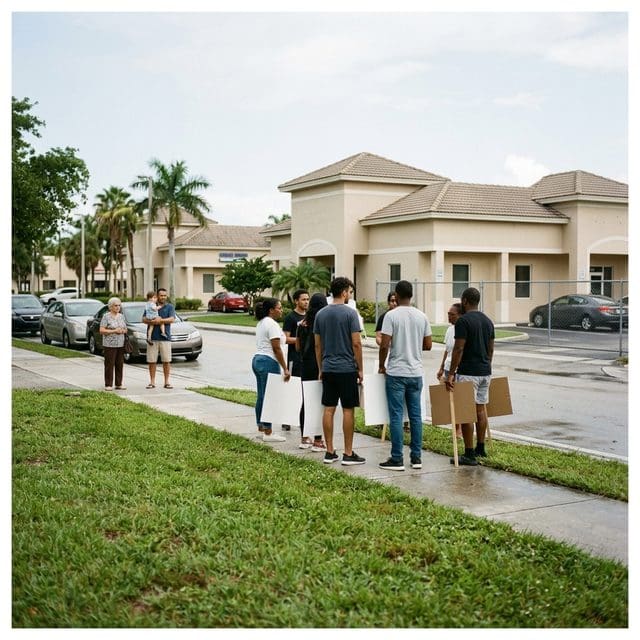
The allegations remain claims in litigation, not findings established in the material available for this report. A separate account by The Bulwark, published Oct. 10, described the site as a detention center in suburban Miami, where families wait outside while relatives are held inside.
The concerns extend beyond Miramar. On Oct. 8, the ACLU of Florida, the Southern Poverty Law Center and Americans for Immigrant Justice demanded corrective action at Baker Correctional Institution in Sanderson. Interviews cited in the ACLU’s account allege that medical sick-call delays range from a few days to two weeks, outdoor recreation occurs only once or twice a week, and waits for legal meetings typically last four days or more. The groups requested a response by Oct. 22.
Florida residents also continued protesting conditions at the Baker facility, which The Independent Florida Alligator reported on Oct. 10 is known as the “Deportation Depot.” The outlet reported allegations of contaminated water, solitary confinement and periods of up to a week without sunlight. Those descriptions, too, are allegations reported by the outlet, not independently established findings in the material provided.
The reporting offers little evidence of a statehouse policy experiment in response. It does not identify a new Florida law, gubernatorial action or local ordinance addressing the specific detention practices alleged. Instead, the immediate avenues described are federal litigation, advocacy-group demands and public protest. That distinction matters: federalism is not simply a contest between governments, but also a question of which government has authority over a particular function.
ICE is a federal agency, and the complaints described in the reports challenge conditions in federal immigration custody. The source material does not establish what legal powers Florida or local governments could use to regulate these sites, nor does it show that state officials have adopted a remedy. It would be premature to treat the allegations as proof that a state policy has failed—or that state lawmakers have a ready mechanism to change federal detention practices.
For state and local leaders, the case nevertheless presents a practical test of accountability. They can face pressure from residents concerned about conditions in their communities while the agency operating the facilities answers to Washington. Whether Florida officials intervene, seek information or defer to federal jurisdiction is not answered by the reporting to date.
That makes the lawsuits and protests an early measure of how local oversight and federal authority meet on the ground. The next developments to watch are the response to the groups’ Baker demand, the progress of the Miramar litigation and whether Florida’s elected officials take a documented role. For now, the available record shows serious, attributed allegations and a federal operator—not a confirmed state-level policy change.

Dylan Brooks serves as the Senior Correspondent for Statehouses and Local Governance at Just Right News, where he brings a principled, constitutionalist lens to the often-overlooked machinery of state-level politics. As the lead voice behind the acclaimed feature series “Fifty Laboratories of Power,” Dylan has dedicated his career to the idea that the most impactful governance happens closest to home. His reporting consistently champions the Tenth Amendment, exploring how individual states can serve as testing grounds for innovative, conservative policy solutions that prioritize personal liberty and fiscal responsibility.
A native of Des Moines, Iowa, Dylan’s journalistic philosophy was forged in the heart of the American Midwest. Growing up in a community where local school board meetings and town halls were the bedrock of civic life, he developed a deep appreciation for the “retail politics” of the heartland. This upbringing instilled in him a fundamental belief that the American experiment is best preserved when power is decentralized. He carries the values of his Iowa roots into every assignment, maintaining a healthy skepticism of federal overreach and a steadfast commitment to the concerns of everyday citizens over the interests of the administrative state.
Now based in Madison, Wisconsin, Dylan operates from one of the nation’s most pivotal political battlegrounds. His location in a state capital known for its rigorous policy debates allows him to provide Just Right News readers with a front-row seat to the legislative process. From Madison, he tracks the ripple effects of statehouse decisions on local municipalities, ensuring that the connection between high-level policy and community impact is never lost. His work often highlights the success of conservative governors and legislatures in fostering economic growth, protecting parental rights, and securing the integrity of local institutions.
As an African American man in the conservative media landscape, Dylan offers a vital perspective on how limited government and free-market principles empower individuals and families. He frequently reports on how deregulation and school choice initiatives provide new avenues for success in underserved communities, challenging the monolithic narratives often presented by legacy media outlets. Dylan’s work is characterized by a commitment to the facts and a refusal to shy away from the complex realities of modern governance.
Throughout his tenure at Just Right News, Dylan has become a trusted authority for readers who value a rigorous, principled approach to the news. Whether he is dissecting a complex state budget or profiling a local grassroots movement, his goal remains the same: to provide the American public with the information they need to hold their local leaders accountable. By focusing on the “Fifty Laboratories of Power,” Dylan Brooks ensures that the vital work being done in statehouses across the country receives the national attention it deserves, always through a lens that respects the traditions and sovereignty of the American people.