

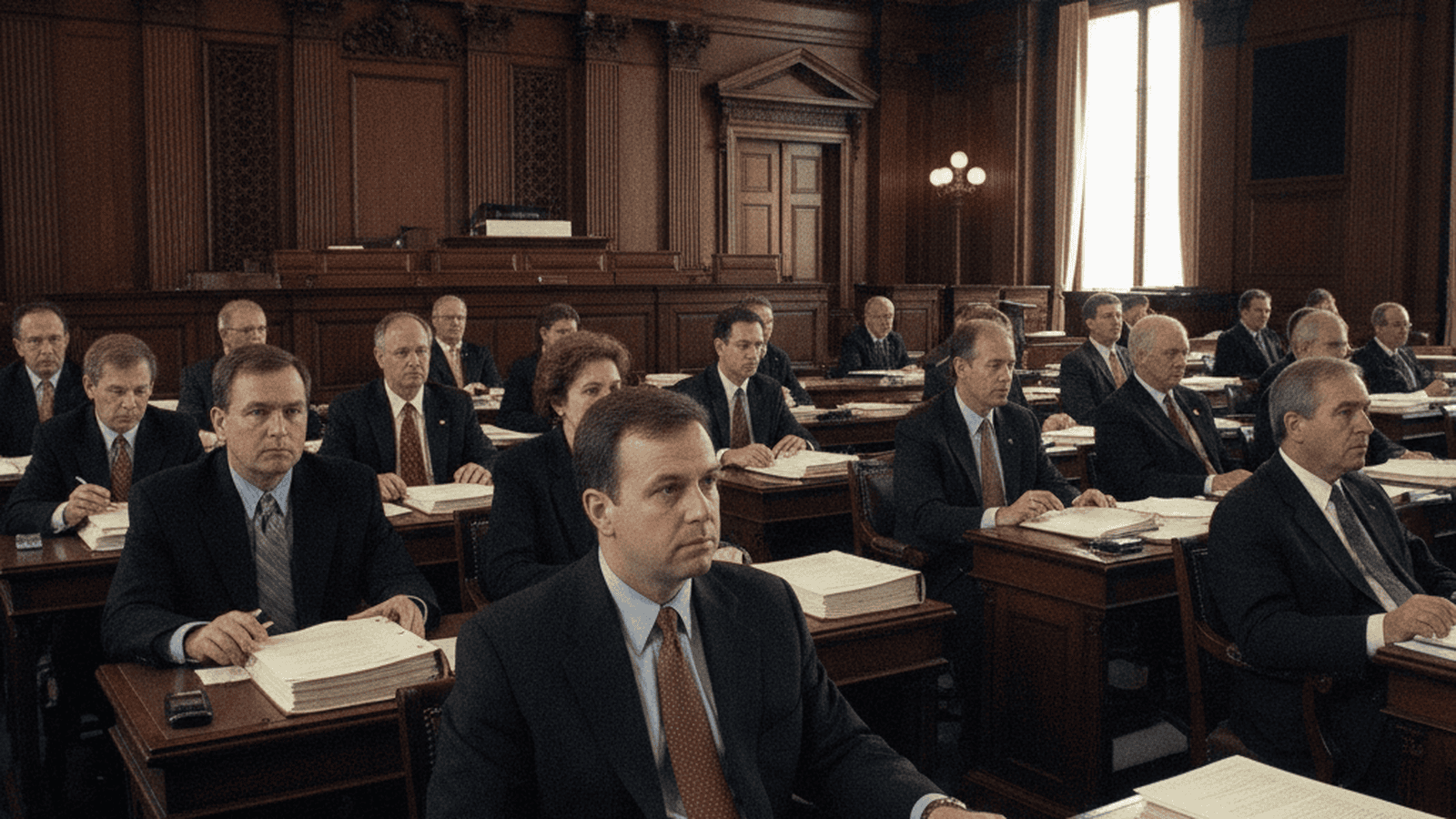
In 2004, the Massachusetts General Court passed legislation to strip the governor of the power to appoint interim U.S. Senators, requiring a special election instead. This move, aimed at preventing Republican Governor Mitt Romney from filling a potential vacancy left by John Kerry, sparked a significant debate over constitutional authority and political maneuvering in the United States.
TLDR: In 2004, Massachusetts lawmakers stripped Governor Mitt Romney of his power to appoint interim U.S. Senators. The move was designed to prevent a Republican appointment if John Kerry won the presidency. This legislative maneuver highlighted the tension between executive prerogative and partisan control over federal representation.
In the summer of 2004, the Massachusetts General Court became the epicenter of a high-stakes constitutional and political confrontation that would reshape the state’s approach to federal representation. The catalyst for this conflict was the presidential campaign of Senator John Kerry, the Democratic nominee challenging incumbent George W. Bush. Under the Massachusetts statutes of the time, if Kerry were to win the presidency, he would vacate his Senate seat, leaving the power of appointment to the sitting governor. This posed a significant strategic dilemma for the state’s Democratic supermajority: the governor’s office was occupied by Republican Mitt Romney.
The prospect of Governor Romney appointing a Republican to a seat long held by Democrats—potentially shifting the balance of power in a closely divided U.S. Senate—prompted immediate legislative action. Democratic leaders, including Senate President Robert Travaglini and House Speaker Salvatore DiMasi, introduced a bill to strip the governor of his appointment power. The proposed legislation mandated that any vacancy in the U.S. Senate be filled exclusively through a special election, to be held within a window of 145 to 160 days after the vacancy occurred.
The debate that followed was one of the most contentious in the history of the Massachusetts State House. Proponents of the bill framed the issue as a matter of democratic integrity. They argued that the right to choose a United States Senator belonged to the voters, not to a single executive official. By requiring a special election, they claimed, the state would ensure that its federal representation remained directly accountable to the will of the people. This “voter empowerment” narrative was designed to provide a principled veneer to a move that many observers saw as purely tactical.
Governor Romney and his Republican allies in the legislature launched a vigorous defense of the status quo. They characterized the bill as a blatant, partisan power grab that ignored decades of legal precedent. Romney argued that leaving a Senate seat vacant for five months would effectively disenfranchise the citizens of Massachusetts during a critical period of national importance. With the nation engaged in wars in Iraq and Afghanistan and facing significant economic challenges, critics argued that the state could not afford to have only one voice in the Senate. Furthermore, they pointed out the inherent hypocrisy of the move, noting that the Democratic legislature had never questioned the appointment power when the governor’s office was held by members of their own party.
Despite the outcry and a flurry of national media attention, the Democratic leadership utilized their supermajority to fast-track the legislation. The bill passed both chambers with significant margins. In July 2004, Governor Romney issued a veto, calling the measure a “partisan maneuver” that undermined the stability of the state’s governance. However, the legislature moved quickly to override the veto, officially changing the law just months before the November election.
The 2004 legislative shift had long-lasting repercussions. While John Kerry ultimately lost the presidential election and retained his Senate seat, the law remained on the books. Its legacy was tested again in 2009 following the death of Senator Edward M. Kennedy. Faced with the need for a reliable Democratic vote during the debate over the Affordable Care Act, the same legislature that had stripped Romney of his power in 2004 reversed course. They amended the law to allow Democratic Governor Deval Patrick to appoint an interim successor, Paul G. Kirk Jr., while awaiting a special election. This secondary shift sparked renewed accusations of political opportunism and highlighted the fluid nature of state election laws when viewed through the lens of national partisan interests.

Lila Hayes serves as a Staff Writer for Just Right News, where she anchors the “Courts, Law, and Constitutional Order” beat. Her work is defined by a steadfast commitment to the foundational principles of the American republic and a rigorous defense of the legal frameworks that ensure national stability. As a primary voice for the outlet, she provides readers with a clear-eyed analysis of the judiciary, focusing on the importance of originalism and the preservation of the separation of powers.
Lila’s perspective was forged in the American heartland. Raised in St. Louis, Missouri, she grew up in a Hispanic household where the values of hard work, faith, and respect for the law were paramount. Her upbringing instilled in her a deep appreciation for the American Dream and the legal protections that make it possible. This Missouri background remains a cornerstone of her reporting, providing a grounded, common-sense counter-narrative to the often-insular legal circles of the coastal elite. She understands that the decisions made in high-court chambers have real-world consequences for families and small business owners across the country.
At Just Right News, Lila has become widely recognized for her signature feature series, “The Rulebook of Power.” In this ongoing project, she delves into the mechanics of the federal government, examining how administrative overreach and judicial activism can threaten the delicate balance of the Constitution. She approaches her beat with the tenacity of a veteran journalist and the precision of a legal scholar, consistently advocating for a judiciary that interprets the law as written rather than legislating from the bench. For Lila, the Constitution is not a “living” document subject to the whims of modern social trends; it is a fixed standard that ensures the government remains the servant of the people, not their master.
Now based in Philadelphia, Pennsylvania, Lila finds herself at the very epicenter of American constitutional history. Living and working in the city where the Founders drafted the documents she defends daily provides a constant source of inspiration. The historic halls and landmarks of Philadelphia serve as a daily reminder of the high stakes involved in her reporting. Her presence in the city allows her to bridge the gap between the historical intent of the law and its contemporary application, ensuring that the legacy of the Founding Fathers remains central to the national conversation.
Throughout her career, Lila has remained dedicated to the idea that a free society requires an informed citizenry and a transparent legal system. Her reporting is more than just a collection of headlines; it is a defense of the constitutional order that has sustained the nation for over two centuries. By focusing on the “Rulebook of Power,” she ensures that her readers understand not just what is happening in the courtrooms, but why those decisions matter for the future of American liberty. Lila Hayes continues to be a vital voice for those who believe that the law should be a shield for the citizen and a constraint on the state.