

In 1907, President Theodore Roosevelt used executive proclamations to protect 16 million acres of timberland in the Pacific Northwest just days before Congress stripped him of the power to do so. This event, known as the “Midnight Forests,” highlighted the tension between federal conservation and local economic interests in the United States.
TLDR: President Theodore Roosevelt’s 1907 “Midnight Forests” proclamations protected 16 million acres of Western land before a congressional ban took effect. This bold use of executive power secured vast tracts of the Pacific Northwest for conservation, sparking a lasting debate over federal land management and presidential authority in the United States.
In early 1907, a fierce legislative battle over the control of public lands reached a climax in the United States. Western politicians, led by Senator Charles W. Fulton of Oregon, grew increasingly frustrated with President Theodore Roosevelt’s aggressive use of the Forest Reserve Act of 1891. This law allowed the executive branch to set aside timberlands as public reserves, a power Roosevelt and his Chief Forester, Gifford Pinchot, utilized to protect millions of acres from private exploitation. The tension between federal conservation efforts and local economic interests in the Pacific Northwest created a significant political rift that threatened to stall national policy.
Congress responded by attaching a rider to the 1907 Agricultural Appropriations Bill. This amendment stripped the president of the authority to create new forest reserves in six Western states: Washington, Oregon, Idaho, Montana, Wyoming, and Colorado. The bill mandated that only an act of Congress could establish such reserves in these regions moving forward. Because the appropriations bill was essential for funding the government, Roosevelt could not easily veto it without causing a fiscal crisis. The legislative maneuver was designed to permanently curtail the expansion of the federal forest system and return control to state-level interests.
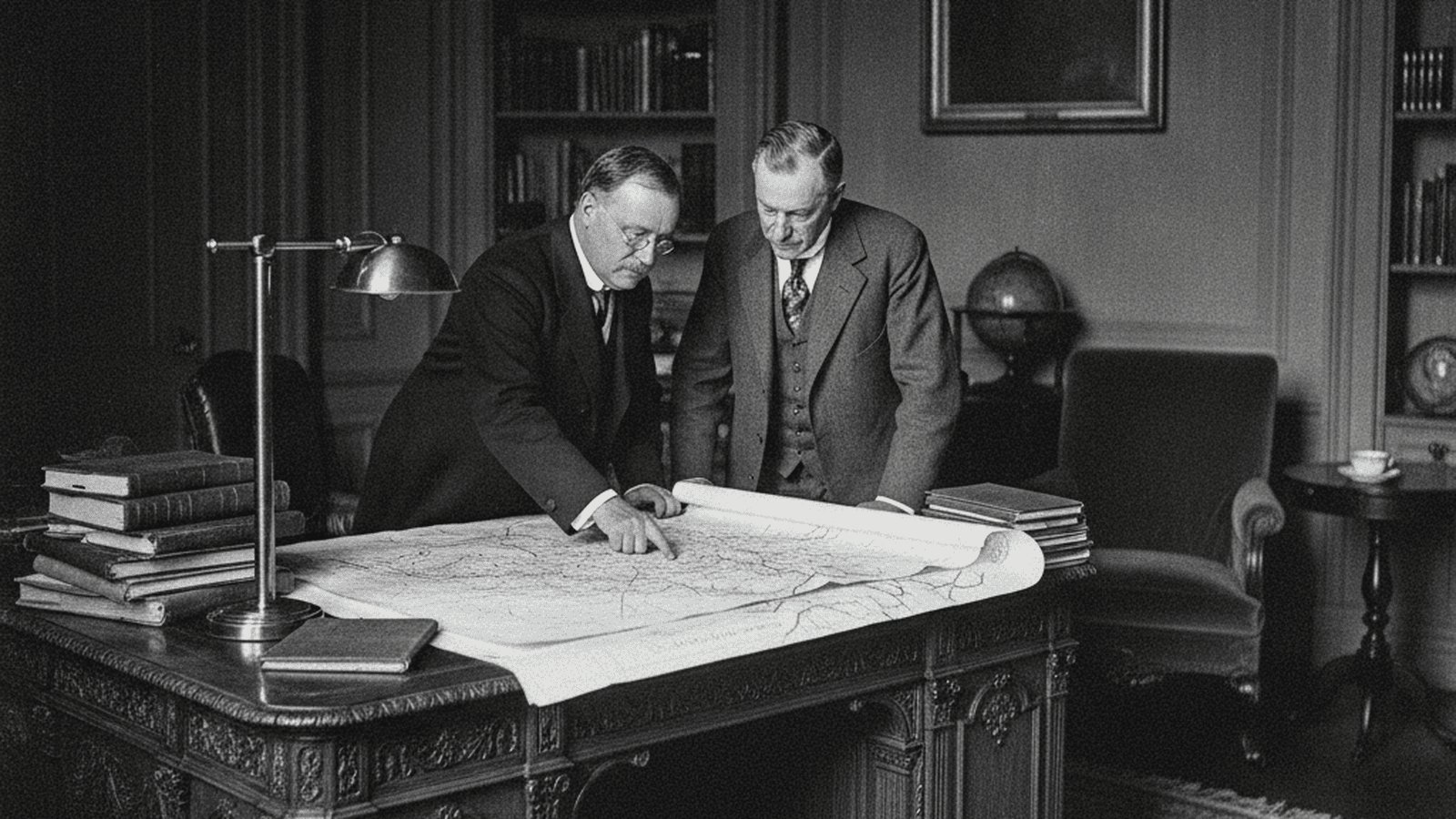
Faced with the imminent loss of his executive prerogative, Roosevelt devised a plan with Pinchot. For several days and nights leading up to the signing deadline, the two men worked in the White House, pouring over maps of the Pacific Coast and the Rocky Mountains. They identified millions of acres of prime timberland that had not yet been protected. Roosevelt signed a series of executive proclamations creating or expanding 21 national forests, totaling approximately 16 million acres. These new reserves spanned across the very states targeted by the congressional rider, effectively securing the land before the law could take effect.
These actions became known as the “Midnight Forests” because they were finalized just before Roosevelt signed the very bill that would have prohibited them. By the time the Agricultural Appropriations Bill became law on March 4, 1907, the land was already under federal protection. The move stunned Western legislators who had expected to open these lands to mining, logging, and grazing interests. Roosevelt’s maneuver demonstrated a bold, some argued overreaching, interpretation of executive authority to achieve conservation goals. He famously remarked that he would rather be criticized for acting than for failing to act in the face of a national need.
The political fallout was immediate and intense. Critics in the Pacific Northwest denounced the proclamations as an abuse of power and a violation of the spirit of the law. However, Roosevelt remained defiant, arguing that the public interest in preserving natural resources outweighed the immediate economic desires of local industries. He viewed the executive branch as a steward of the nation’s future, capable of acting when Congress was paralyzed by special interests. This stance redefined the presidency’s role in environmental management and federal land oversight.
This event solidified the role of the U.S. Forest Service as a powerful federal agency and established a precedent for the use of executive orders in environmental protection. While the 1907 law successfully limited future unilateral land withdrawals in those specific states, the Midnight Forests remained protected. This episode influenced later debates over the Antiquities Act and the balance of power between the federal government and Western states regarding land management. It remains a landmark case in the history of American executive power and the conservation movement, illustrating the potential for executive action to shape the nation’s physical and political landscape.

Miles Harrington serves as the Senior Correspondent for Federal Systems & Executive Power at Just Right News, where he brings a disciplined, constitutionalist lens to the inner workings of the American government. With a focus on the mechanics of the federal bureaucracy and the limits of executive authority, Harrington has established himself as a vital voice for readers who value transparency, accountability, and the preservation of the separation of powers.
A native of Richmond, Virginia, Harrington’s perspective is deeply rooted in the traditions of the Old Dominion. Growing up in a city defined by its historical significance and its role as a center of American jurisprudence, he developed an early appreciation for the foundational principles of the Republic. His upbringing in Richmond—a place where the legacy of the Founding Fathers is woven into the landscape—instilled in him a belief that the federal government should remain within its constitutional bounds. This background informs his skepticism of centralized overreach and his commitment to reporting on the ways in which the administrative state impacts the lives of everyday citizens.
In his current role, Harrington specializes in the complexities of federal systems. He doesn’t just report on the headlines of the day; he digs into the structural shifts within the executive branch that often go unnoticed by the mainstream press. Whether he is analyzing the implications of a new federal regulation or investigating the expansion of agency jurisdiction, his work is characterized by a rigorous adherence to the facts and a dedication to the rule of law.
Harrington is perhaps best known for his signature feature series, “How Washington Works.” Through this ongoing project, he demystifies the often-opaque processes of the nation’s capital, pulling back the curtain on the “Deep State” and the unelected officials who wield significant influence over national policy. By breaking down complex legislative maneuvers and executive orders, he empowers Just Right News readers to understand the true levers of power in Washington. His reporting serves as a necessary check on the federal government, ensuring that the actions of those in power are held up to the light of public scrutiny.
Now based in Washington, D.C., Harrington operates at the epicenter of the political world, yet he remains intentionally distanced from the “Beltway bubble.” His proximity to the halls of power allows him to maintain a robust network of sources across the federal landscape, but his heart remains in the principled conservatism of his Virginia roots. He views his role not merely as a reporter, but as a steward of the public trust, dedicated to providing the clarity and context that conservative voters need to navigate an increasingly complex political environment.
Through his sharp analysis and unwavering commitment to the truth, Miles Harrington continues to be a cornerstone of the Just Right News team. His work ensures that the principles of limited government and executive restraint remain at the forefront of the national conversation, providing a crucial service to those who believe in a government that is truly of, by, and for the people.