

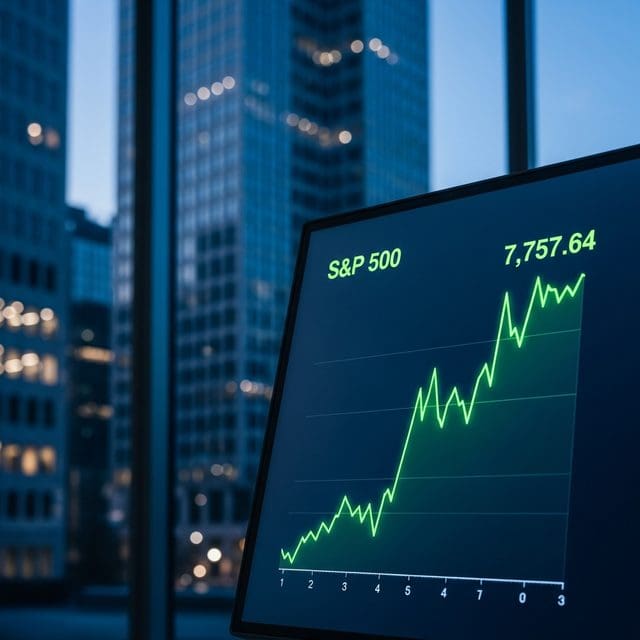
The S&P 500 reached a new all-time high as unexpected job losses in July prompted investors to bet against further Federal Reserve interest rate hikes.
The American economic landscape presented a stark contrast this week between the soaring valuations on Wall Street and the cooling realities of the labor market. The benchmark SPY exchange-traded fund climbed 0.59% on the session, tracking a broader rally that saw the S&P 500 reach a new all-time closing high of 7,757.64. This surge was not driven by a sudden burst of industrial productivity, but rather by a defensive reaction to a July employment report that fundamentally altered the trajectory of Federal Reserve policy expectations.
According to the latest data, the U.S. economy unexpectedly shed 23,000 jobs in July, missing the anticipated gain of 80,000 by a wide margin. Furthermore, June payroll figures were revised downward to just 20,000, and the unemployment rate slipped to 4.1% primarily due to workers exiting the labor force. For the American taxpayer, this signals a fragile labor environment, yet for the financial markets, it provided the ‘soft’ data necessary to dampen expectations of a September interest rate hike. Futures markets now price the probability of a rate increase at approximately 40%, down from over 50% just days ago.
The reaction across the ‘Invisible Economy’ was immediate and synchronized. As stock indices climbed, the U.S. Treasury market saw its most significant weekly rally since May. The 10-year Treasury yield retreated to approximately 4.65%, while the 2-year yield settled near 4.19%. This decline in yields served as a catalyst for a weaker U.S. dollar, with the Dollar Index falling 0.4% to roughly 99.50. While a weaker currency can be a double-edged sword for national sovereignty, it provided a significant tailwind for commodities, sending gold surging 2.44% to a record $4,343.43 per troy ounce.
Technological leadership continues to underpin the market’s upward momentum, despite warnings from institutional strategists. The Nasdaq Composite gained 1.30%, fueled by an insatiable demand for computer memory and the infrastructure required for artificial intelligence development. JPMorgan strategists have cautioned that tech stocks may underperform in the second half of 2026, yet for now, the AI-driven growth narrative remains the primary engine of the S&P 500. Notably, energy companies have also contributed to the index’s strength, posting a 42.5% revenue gain in the second quarter.
However, a closer look at market internals reveals a growing disconnect between price action and investor conviction. Despite the record highs in the S&P 500, U.S. equity funds experienced net outflows in the week ending August 5. This suggests that while retail sentiment remains buoyed by the headline numbers, institutional players are quietly taking profits and rotating capital. Interestingly, the average stock has begun to outperform the S&P 500 for the first time in four years, indicating that the rally may finally be broadening beyond a handful of tech giants.
For working households, the current market environment is a study in volatility and central bank dependence. While the rise in SPY and the S&P 500 suggests prosperity, the underlying contraction in payrolls and the reliance on a ‘no-hike’ narrative from the Federal Reserve point to an economy at a crossroads. As Zaria Systems files to charter new national trust banks and firms like Koppers Holdings maintain steady dividends, the structural components of the economy remain active, but the overarching theme is one of cautious navigation through a cooling labor market and a shifting monetary regime.

Jordan Lee serves as the Senior Correspondent for Wall Street, Finance, and Monetary Systems at Just Right News. Based in the heart of the world’s financial capital, New York City, Lee brings a sharp, principled eye to the complex mechanisms that drive the global economy. His reporting is defined by a commitment to fiscal responsibility, the defense of the free market, and a deep-seated belief that a transparent monetary system is the bedrock of a free society.
Raised in Portland, Oregon, Lee’s perspective was forged in a city that has undergone significant cultural and economic shifts. His upbringing in the Pacific Northwest instilled in him a profound appreciation for the industriousness of small business owners and the importance of local economic stability. Watching the evolution of his hometown’s landscape sparked an early interest in how federal fiscal policy and large-scale financial trends eventually trickle down to the average citizen. This background provides him with a unique vantage point; he understands the growing disconnect between the policy-making elite and the reality of Main Street, a theme that frequently resonates throughout his work.
Now operating from his base in New York City, Lee bridges the gap between the high-stakes trading floors of Manhattan and the households of everyday Americans. He views the financial sector not merely as a collection of numbers and tickers, but as a vital engine of American prosperity that requires constant vigilance and accountability. His reporting often highlights the dangers of centralized financial control and the necessity of maintaining a system that rewards merit, risk-taking, and innovation.
As the creator and lead of the featured series, “The Invisible Economy,” Lee pulls back the curtain on the often-opaque world of monetary systems. He specializes in translating the dense jargon of central banking and international finance into actionable insights for the Just Right News audience. His work explores the “invisible” forces—such as inflationary pressures, regulatory creep, and the expansion of the administrative state—that erode the purchasing power of American families. By focusing on these systemic issues, Lee empowers readers to understand the hidden forces shaping their financial independence.
Lee’s journalistic philosophy is rooted in a steadfast commitment to traditional American values. As an Asian American professional who has navigated the competitive corridors of the financial world, he is a vocal advocate for meritocracy and the preservation of the American Dream. He believes that a stable currency and a predictable regulatory environment are essential for national sovereignty and individual liberty. His reporting frequently warns against the risks of government overreach in the private sector, arguing that the most effective solutions to economic challenges arise from competition and individual enterprise rather than bureaucratic mandates.
At Just Right News, Jordan Lee remains dedicated to providing a clear-eyed defense of the taxpayer. Whether he is analyzing market volatility or investigating the long-term implications of national debt, his mission is to provide the truth about where the money is going and what it means for the future of the country. Through his rigorous analysis and principled stance, Lee has become a trusted voice for those who value a strong, sovereign, and fiscally sound America.