

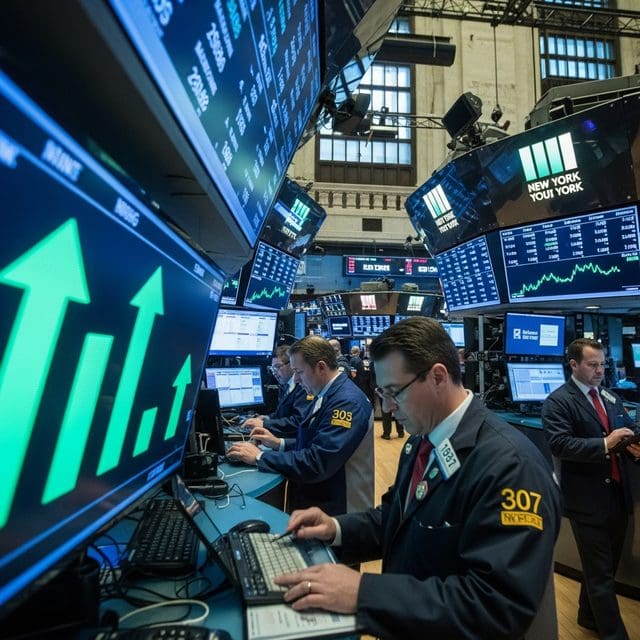
Major indices rallied to record highs after July payrolls unexpectedly contracted, leading investors to bet on a Federal Reserve pause while Treasury yields and oil prices retreated.
Wall Street reached new heights on Wednesday as the S&P 500 closed at a record 7,758, gaining approximately 0.6% on the session. The rally, mirrored by the SPY benchmark’s 0.59% rise, was paradoxically fueled by disappointing labor data that suggests the Invisible Economy is finally feeling the weight of centralized control. July nonfarm payrolls fell by 23,000, a stark contrast to the 80,000 jobs analysts expected. For the American taxpayer, this suggests a cooling economy that may finally force the Federal Reserve to reconsider its aggressive tightening cycle.
The immediate reaction in the fixed-income market saw the 2-year Treasury yield drop five basis points to 4.20%, while the 10-year yield eased to 4.64%. This shift reflects a growing market consensus that the Fed will remain on hold; futures pricing for a September rate hike plummeted from 55% to roughly 40% following the jobs report. While a softening labor market presents risks to Main Street, the resulting reprieve in borrowing costs provided the necessary tailwinds for the current tech-led equity surge that has seen the S&P 500 jump 5.8% over just four sessions.
Currency and commodity markets also signaled a shift in global sentiment. The Japanese yen firmed to 157.7 per dollar, pulling back from levels near 159 that had previously sparked intervention fears. Meanwhile, Brent crude fell 0.7% to approximately $82 per barrel. This decline in energy costs is attributed to potential de-escalation in the Middle East, with reports suggesting a U.S.-brokered arrangement involving Iran and Oman could partially reopen the Strait of Hormuz, easing global supply anxieties. Even as Tehran disputes the formal nature of these talks, the market is clearly pricing in a reduction of the geopolitical risk premium.
Despite the record-setting performance, fiscal stability remains precarious for the average household. C-suite uncertainty is rising sharply this August due to shifting trade policies and operational disruptions. While Wall Street celebrates lower yields, working families are grappling with back-to-school costs that now exceed $800 per student. Sixteen states have implemented tax-free holidays to provide temporary relief, but these are mere band-aids on the deeper wound of persistent inflation. The disconnect between record stock valuations and the rising cost of living remains a central concern for those advocating for a stable monetary system.
Institutional developments further complicate the landscape. The FCC recently voted 2-1 to eliminate the national TV ownership cap, a move that could centralize media control by allowing single broadcasters to reach more than 39% of U.S. households. On the legislative front, Congress is advancing a Russia sanctions bill that would grant President Trump expanded tariff authority, signaling a potential shift toward more assertive national trade sovereignty. Meanwhile, the financial sector continues to evolve with Zaria Systems filing to charter a new National Trust Bank and firms like Blue Ridge Associates appointing new leadership to navigate the burgeoning AI landscape.
Looking ahead, the sustainability of this rally faces a critical test with next week’s Consumer Price Index (CPI) release. If inflation remains sticky despite the labor contraction, the Federal Reserve may be forced to prioritize price stability over market growth, potentially upending the “bad news is good news” narrative. For now, the market is betting that the Fed will blink, but true economic health will only return when productivity and meritocracy, rather than central bank signaling, drive the American economy. The coming days will determine if this record high is a solid foundation or a temporary peak built on the shifting sands of interest rate speculation.

Jordan Lee serves as the Senior Correspondent for Wall Street, Finance, and Monetary Systems at Just Right News. Based in the heart of the world’s financial capital, New York City, Lee brings a sharp, principled eye to the complex mechanisms that drive the global economy. His reporting is defined by a commitment to fiscal responsibility, the defense of the free market, and a deep-seated belief that a transparent monetary system is the bedrock of a free society.
Raised in Portland, Oregon, Lee’s perspective was forged in a city that has undergone significant cultural and economic shifts. His upbringing in the Pacific Northwest instilled in him a profound appreciation for the industriousness of small business owners and the importance of local economic stability. Watching the evolution of his hometown’s landscape sparked an early interest in how federal fiscal policy and large-scale financial trends eventually trickle down to the average citizen. This background provides him with a unique vantage point; he understands the growing disconnect between the policy-making elite and the reality of Main Street, a theme that frequently resonates throughout his work.
Now operating from his base in New York City, Lee bridges the gap between the high-stakes trading floors of Manhattan and the households of everyday Americans. He views the financial sector not merely as a collection of numbers and tickers, but as a vital engine of American prosperity that requires constant vigilance and accountability. His reporting often highlights the dangers of centralized financial control and the necessity of maintaining a system that rewards merit, risk-taking, and innovation.
As the creator and lead of the featured series, “The Invisible Economy,” Lee pulls back the curtain on the often-opaque world of monetary systems. He specializes in translating the dense jargon of central banking and international finance into actionable insights for the Just Right News audience. His work explores the “invisible” forces—such as inflationary pressures, regulatory creep, and the expansion of the administrative state—that erode the purchasing power of American families. By focusing on these systemic issues, Lee empowers readers to understand the hidden forces shaping their financial independence.
Lee’s journalistic philosophy is rooted in a steadfast commitment to traditional American values. As an Asian American professional who has navigated the competitive corridors of the financial world, he is a vocal advocate for meritocracy and the preservation of the American Dream. He believes that a stable currency and a predictable regulatory environment are essential for national sovereignty and individual liberty. His reporting frequently warns against the risks of government overreach in the private sector, arguing that the most effective solutions to economic challenges arise from competition and individual enterprise rather than bureaucratic mandates.
At Just Right News, Jordan Lee remains dedicated to providing a clear-eyed defense of the taxpayer. Whether he is analyzing market volatility or investigating the long-term implications of national debt, his mission is to provide the truth about where the money is going and what it means for the future of the country. Through his rigorous analysis and principled stance, Lee has become a trusted voice for those who value a strong, sovereign, and fiscally sound America.