

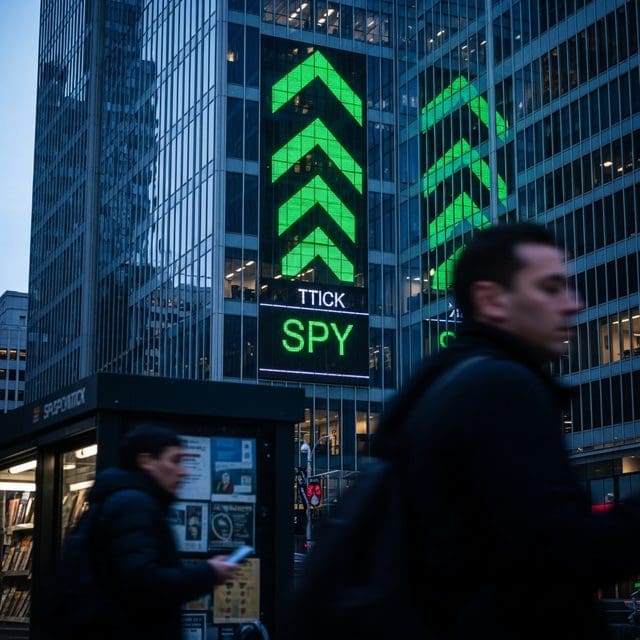
The S&P 500 climbed 1.77% as robust artificial intelligence demand and cooling energy costs provided a significant boost to global equity markets and manufacturing growth.
The American equity market demonstrated remarkable resilience today, with the SPY benchmark climbing 1.77% in a session defined by a clear ‘risk-on’ sentiment. This rally, which pushed the S&P 500 to a close of 7,736.52, was anchored by a confluence of technological innovation and a significant easing of geopolitical risk premiums in the energy sector. For the American household, this market movement reflects a complex interplay between the high-flying tech sector and the tangible economic realities of manufacturing and energy costs.
While the Nasdaq Composite outpaced the broader market with a 2.59% surge, the gains were not limited to Silicon Valley. Manufacturing data from July 2026 indicates that U.S. factories are growing at their fastest pace in more than four years. This industrial resurgence is being driven almost entirely by the insatiable demand for computer memory and the physical infrastructure required for artificial intelligence development. However, this growth comes with a caveat for the American taxpayer; manufacturers report they are still grappling with supply shortages and the lingering sting of higher inflation, even as output accelerates.
Energy costs, a critical component of every domestic budget, provided a significant tailwind for the markets today. Brent crude eased to $79.02 per barrel, a sharp decline from the $102 levels seen earlier in July. This move is largely attributed to renewed hopes for a U.S.-Iran deal that could secure the Strait of Hormuz, reducing the supply-risk premia that often punishes the consumer at the pump. This drop in oil prices, combined with cooling inflation expectations, has led to a welcome decline in U.S. Treasury yields. The 10-year yield fell to approximately 4.61%, down from last week’s high of 4.74%, offering a brief reprieve from the high-interest-rate environment that has constrained consumer borrowing and small business expansion.
Institutional activity further stabilized the landscape as the summer volatility begins to fade. Citadel Securities officially declared the stock market’s technical reset complete as of August 4, recommending a resumption of equity purchases. This institutional confidence was mirrored in the currency markets, where the U.S. Treasury Department and the Federal Reserve took the rare step of jointly intervening with Japanese counterparts to boost the yen. Such coordinated efforts highlight a commitment to maintaining national sovereignty and orderly global financial systems amidst shifting valuations.
Beyond the major indices, the day saw significant activity in the private and mid-cap sectors. Reformation completed its NYSE debut, while PureHealth reported a robust net profit of $337 million for the first half of 2026, with revenue climbing to $4.0 billion. In the real estate sector, Prudent Growth Partners finalized the $5.5 million sale of the Carolina Commerce Center in North Carolina, signaling that multi-tenant flex properties remain a viable asset class even as the broader economy shifts toward digital infrastructure. Additionally, Platinum Equity announced a major investment in LMPG, a North American lighting specialist, further proving that capital is still flowing into the domestic physical economy.
Despite the overarching optimism, the ‘Invisible Economy’ remains under scrutiny by those advocating for market integrity. Legal investigations by firms like Pomerantz LLP into Metropolitan Bank Holding Corp. and Rollins, Inc. serve as a reminder that meritocracy requires constant vigilance against corporate mismanagement. Furthermore, while the AI narrative drives top-line growth, the reality of decade-high unemployment figures in partner economies like New Zealand suggests that the global recovery remains uneven. For the American worker, the focus remains on whether these market gains will translate into long-term price stability and a return to sound fiscal footings, or if they are merely a byproduct of centralized financial maneuvers.

Jordan Lee serves as the Senior Correspondent for Wall Street, Finance, and Monetary Systems at Just Right News. Based in the heart of the world’s financial capital, New York City, Lee brings a sharp, principled eye to the complex mechanisms that drive the global economy. His reporting is defined by a commitment to fiscal responsibility, the defense of the free market, and a deep-seated belief that a transparent monetary system is the bedrock of a free society.
Raised in Portland, Oregon, Lee’s perspective was forged in a city that has undergone significant cultural and economic shifts. His upbringing in the Pacific Northwest instilled in him a profound appreciation for the industriousness of small business owners and the importance of local economic stability. Watching the evolution of his hometown’s landscape sparked an early interest in how federal fiscal policy and large-scale financial trends eventually trickle down to the average citizen. This background provides him with a unique vantage point; he understands the growing disconnect between the policy-making elite and the reality of Main Street, a theme that frequently resonates throughout his work.
Now operating from his base in New York City, Lee bridges the gap between the high-stakes trading floors of Manhattan and the households of everyday Americans. He views the financial sector not merely as a collection of numbers and tickers, but as a vital engine of American prosperity that requires constant vigilance and accountability. His reporting often highlights the dangers of centralized financial control and the necessity of maintaining a system that rewards merit, risk-taking, and innovation.
As the creator and lead of the featured series, “The Invisible Economy,” Lee pulls back the curtain on the often-opaque world of monetary systems. He specializes in translating the dense jargon of central banking and international finance into actionable insights for the Just Right News audience. His work explores the “invisible” forces—such as inflationary pressures, regulatory creep, and the expansion of the administrative state—that erode the purchasing power of American families. By focusing on these systemic issues, Lee empowers readers to understand the hidden forces shaping their financial independence.
Lee’s journalistic philosophy is rooted in a steadfast commitment to traditional American values. As an Asian American professional who has navigated the competitive corridors of the financial world, he is a vocal advocate for meritocracy and the preservation of the American Dream. He believes that a stable currency and a predictable regulatory environment are essential for national sovereignty and individual liberty. His reporting frequently warns against the risks of government overreach in the private sector, arguing that the most effective solutions to economic challenges arise from competition and individual enterprise rather than bureaucratic mandates.
At Just Right News, Jordan Lee remains dedicated to providing a clear-eyed defense of the taxpayer. Whether he is analyzing market volatility or investigating the long-term implications of national debt, his mission is to provide the truth about where the money is going and what it means for the future of the country. Through his rigorous analysis and principled stance, Lee has become a trusted voice for those who value a strong, sovereign, and fiscally sound America.