

While national indicators point toward historic economic acceleration, the individuals powering American healthcare and retail face rising physical strain and mounting trade-related costs.
The gleaming glass of financial centers and the rapid-fire expansion of the artificial intelligence sector suggest an American economy in full bloom. In the second quarter of 2026, U.S. manufacturing grew at its fastest pace in four years, fueled by an insatiable demand for computer memory. The S&P 500 reached new highs as of August 5, 2026, reflecting investor confidence in a high-tech future. Yet, beneath these aggregate triumphs, the human machinery of the country is showing signs of significant wear.
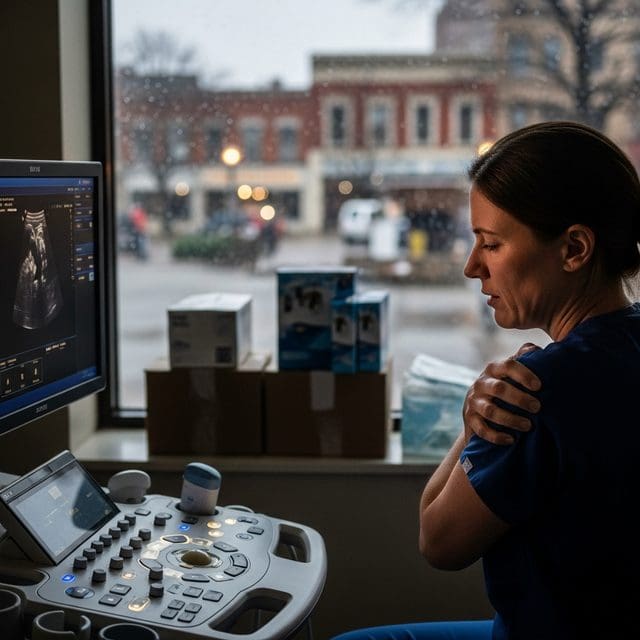
In the quiet, darkened rooms of cardiology labs, the cost of progress is measured in physical pain. The American Society of Echocardiography (ASE) recently issued new guidelines to address work-related musculoskeletal disorders. These are not sudden injuries from a construction site, but the slow, repetitive strain of cardiac sonographers whose bodies are failing under the pressure of a national staffing shortage. A new $75,000 research award announced in late July aims to study how this shortage restricts patient access, revealing a healthcare system where technology advances faster than the humans required to operate it.
This tension between corporate success and individual burden extends into the American household. Mattel reported a 10% jump in net sales this week, reaching $1.125 billion, driven by toy-based films and adult collectors. However, the company’s adjusted earnings per share fell to a mere penny. The culprit is a familiar one for those watching the borders: tariff-related cost pressures. While families continue to buy, the friction of global trade policy is tightening margins for the companies providing their entertainment, forcing a delicate balance between consumer demand and operational reality.
Even the digital world offers a complex picture of growth and loss. FuboTV reported a surge in revenue to $1.482 billion, narrowing its net loss as it nears a goal of positive cash flow by 2027. With 5.75 million North American subscribers, the platform represents the shifting way Americans consume media. Yet, as millions tune in, the platforms they use navigate a landscape of rising business uncertainty. C-suite leaders report that shifting trade policies and geopolitical instability are creating a climate of hesitation that data points often obscure. This uncertainty is compounded by legal challenges, such as OpenAI’s $3.2 million settlement with the DOJ over allegations of discrimination against U.S. workers.
In the Niagara Region, the struggle is more visceral. Premier Doug Ford recently visited municipalities under states of emergency following devastating floods, meeting with workers who form the backbone of the local economy. In this region, the economy is dominated by small employers who already face difficulty in finding skilled workers. For these communities, the macro-economic boom of the AI sector feels distant when the immediate task is reclaiming a storefront from rising waters. Even established institutions like the Simon Property Group are not immune to internal friction, as the founding family remains embroiled in lawsuits over private real estate holdings, proving that even successful enterprises face instability when the human element is strained.
The American spirit remains one of self-reliance, but the current economic climate asks more of the individual than ever before. Whether it is a sonographer pushing through shoulder pain to complete a scan or a small business owner navigating the ripple effects of international tariffs, the true story of 2026 is found in the endurance of the people. They are the ones bridging the gap between the record-breaking highs of the S&P 500 and the grounded reality of maintaining a community in a rapidly changing world.

Ethan Blake serves as a Senior Correspondent for Just Right News, where he specializes in Longform Narrative and Public Understanding. In an era of rapid-fire headlines and fleeting soundbites, Ethan’s work stands as a testament to the power of deep-dive reporting and the importance of contextualizing the complex issues facing the nation today. His approach is rooted in the belief that the most profound truths are often found in the lived experiences of individuals rather than the abstract theories of distant policymakers.
Growing up in Providence, Rhode Island, Ethan developed an early appreciation for the historical and cultural threads that weave the American fabric together. Providence, a city defined by its industrial heritage and its blend of traditional neighborhoods, provided him with a front-row seat to the challenges and triumphs of the American working class. This upbringing instilled in him a respect for the “common sense” values of hard work, community loyalty, and the preservation of local institutions. He learned early on that behind every economic statistic or legislative debate, there are real families and neighborhoods navigating the consequences of change.
This foundational perspective is the driving force behind his signature feature series, “Lives Behind the Systems.” Through this series, Ethan explores the intersection of individual agency and institutional structure. Whether he is documenting the impact of federal land-use policies on rural families or examining how shifting educational standards affect local school boards, Ethan’s work prioritizes the human element. He seeks to uncover how large-scale systems—be they governmental, economic, or social—affect the daily lives of citizens, often advocating for a return to local control and personal responsibility.
Now based in Portland, Maine, Ethan draws significant inspiration from the rugged independence and self-reliance that define the region. The coastal landscape and the resilient spirit of Maine’s communities serve as a constant reminder of the importance of individual liberty and the strength found in decentralized power. Living and working outside the traditional media hubs allows Ethan to maintain a grounded perspective, ensuring his reporting remains untethered from the echo chambers of the major metropolitan centers. This geographic distance provides him with the clarity needed to translate complex national narratives into stories that resonate with the heart of the country.
At Just Right News, Ethan’s beat is more than just a professional assignment; it is a mission to foster a more informed and engaged citizenry. He believes that a free society depends on the public’s ability to understand the mechanisms of power and the value of traditional American principles. His longform narratives do not merely report the news; they provide a roadmap for understanding the cultural and political shifts of the modern era through a lens of skepticism toward centralized authority and a deep respect for the individual.
Through his meticulous research and narrative craftsmanship, Ethan Blake continues to bridge the gap between policy and the public. His work remains a vital resource for those who seek a deeper understanding of the systems that shape our world and the enduring spirit of the people who live within them.