

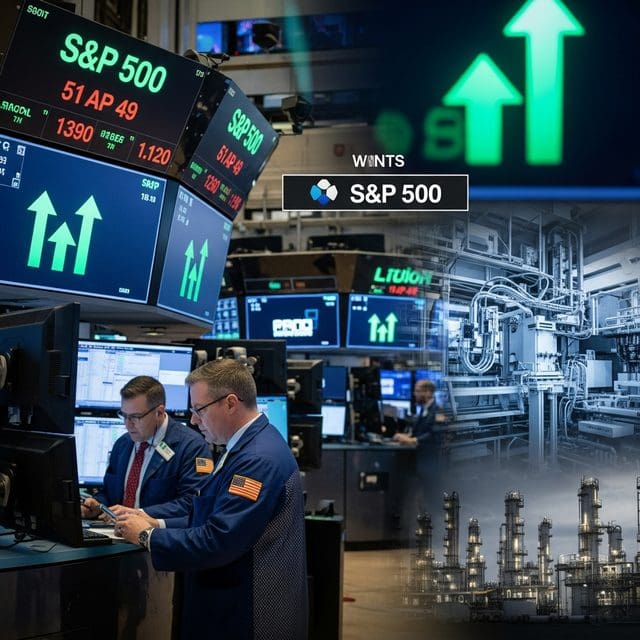
U.S. indices reached historic peaks as explosive AI-driven earnings and cooling energy prices offset manufacturing supply constraints and lingering inflationary pressures for American households.
The American financial landscape reached unprecedented heights on August 5, 2026, as the S&P 500 climbed to a record 7,736.52. While the benchmark SPY maintained a modest gain of 0.09% during the session, the underlying data reveals a massive rotation into the technology and industrial sectors. For the American taxpayer, this movement signals a market increasingly decoupled from traditional inflationary fears, driven instead by an insatiable demand for artificial intelligence and a tentative de-escalation in global energy markets that has provided a much-needed reprieve for Treasury yields.
Palantir Technologies emerged as the day’s standout performer, with shares surging nearly 30% following a report of 93% revenue growth and an upward revision of its full-year outlook. This explosive move, coupled with a 6.5% gain in the PHLX Semiconductor Index, underscores the market’s current obsession with the ‘Invisible Economy’ of data and processing power. Even industrial stalwarts like Caterpillar participated in the risk-on sentiment, rising 5.6% on record quarterly revenue, proving that the AI boom is beginning to provide a significant tailwind for traditional American manufacturing and infrastructure.
However, this growth is not without its domestic complications. While U.S. manufacturers grew at their fastest pace in more than four years this July, they continue to battle supply shortages and rising input costs. The broader economy showed accelerating growth in the second quarter of 2026, yet the fiscal reality for many households remains tied to the volatile energy sector. Oil prices saw significant swings throughout the session; Brent crude initially fell below $80 on hopes of a U.S.-Iran diplomatic breakthrough before a renewed Houthi attack on a Saudi tanker pushed prices back toward the $80.17 mark by midday. Washington, alongside mediators in Qatar and Oman, continues to pursue a deal regarding the Strait of Hormuz, which remains a primary macro catalyst for the week.
From a monetary perspective, the dip in oil prices earlier in the day helped reduce September Federal Reserve rate-hike expectations. This shift pushed Treasury yields lower, reinforcing the equity bid across the board. The institutional sector is also showing signs of expansion despite centralized regulatory hurdles; Zaria Systems has filed an application with the OCC to charter the Zaria National Trust Bank, and Beedie Capital recently anchored a new $500 million growth fund. These moves suggest that capital is still seeking out meritocratic opportunities in a high-growth environment, even as the Department of Justice pursues regulatory actions, such as the $3.2 million settlement with OpenAI over hiring discrimination allegations.
For the frontline worker, the news is a mix of corporate efficiency and new financial tools. Traxxion launched a new wallet powered by Payactiv, offering embedded earned wage access to help households manage the gap between rising costs and payday. Meanwhile, major players like Disney and Booking Holdings saw gains of 3.2% and 5.5% respectively, reflecting a consumer discretionary sector that remains resilient. Even as JPMorgan strategists warn that tech stocks may eventually underperform in the latter half of the year, the current momentum—fueled by a 9% revenue increase at global entities like PureHealth and a 3.9% rise in Nvidia following new chip deals—suggests that for now, the market is betting on productivity gains to outrun the costs of a complex global landscape.
Ultimately, the stability of this record-setting rally depends on whether these AI-driven productivity gains can translate into long-term fiscal stability for Main Street. As the S&P 500 continues to scale new heights, the focus for principled observers remains on whether this centralized financial growth can coexist with a stable monetary system and national sovereignty in the face of ongoing geopolitical friction.

Jordan Lee serves as the Senior Correspondent for Wall Street, Finance, and Monetary Systems at Just Right News. Based in the heart of the world’s financial capital, New York City, Lee brings a sharp, principled eye to the complex mechanisms that drive the global economy. His reporting is defined by a commitment to fiscal responsibility, the defense of the free market, and a deep-seated belief that a transparent monetary system is the bedrock of a free society.
Raised in Portland, Oregon, Lee’s perspective was forged in a city that has undergone significant cultural and economic shifts. His upbringing in the Pacific Northwest instilled in him a profound appreciation for the industriousness of small business owners and the importance of local economic stability. Watching the evolution of his hometown’s landscape sparked an early interest in how federal fiscal policy and large-scale financial trends eventually trickle down to the average citizen. This background provides him with a unique vantage point; he understands the growing disconnect between the policy-making elite and the reality of Main Street, a theme that frequently resonates throughout his work.
Now operating from his base in New York City, Lee bridges the gap between the high-stakes trading floors of Manhattan and the households of everyday Americans. He views the financial sector not merely as a collection of numbers and tickers, but as a vital engine of American prosperity that requires constant vigilance and accountability. His reporting often highlights the dangers of centralized financial control and the necessity of maintaining a system that rewards merit, risk-taking, and innovation.
As the creator and lead of the featured series, “The Invisible Economy,” Lee pulls back the curtain on the often-opaque world of monetary systems. He specializes in translating the dense jargon of central banking and international finance into actionable insights for the Just Right News audience. His work explores the “invisible” forces—such as inflationary pressures, regulatory creep, and the expansion of the administrative state—that erode the purchasing power of American families. By focusing on these systemic issues, Lee empowers readers to understand the hidden forces shaping their financial independence.
Lee’s journalistic philosophy is rooted in a steadfast commitment to traditional American values. As an Asian American professional who has navigated the competitive corridors of the financial world, he is a vocal advocate for meritocracy and the preservation of the American Dream. He believes that a stable currency and a predictable regulatory environment are essential for national sovereignty and individual liberty. His reporting frequently warns against the risks of government overreach in the private sector, arguing that the most effective solutions to economic challenges arise from competition and individual enterprise rather than bureaucratic mandates.
At Just Right News, Jordan Lee remains dedicated to providing a clear-eyed defense of the taxpayer. Whether he is analyzing market volatility or investigating the long-term implications of national debt, his mission is to provide the truth about where the money is going and what it means for the future of the country. Through his rigorous analysis and principled stance, Lee has become a trusted voice for those who value a strong, sovereign, and fiscally sound America.