

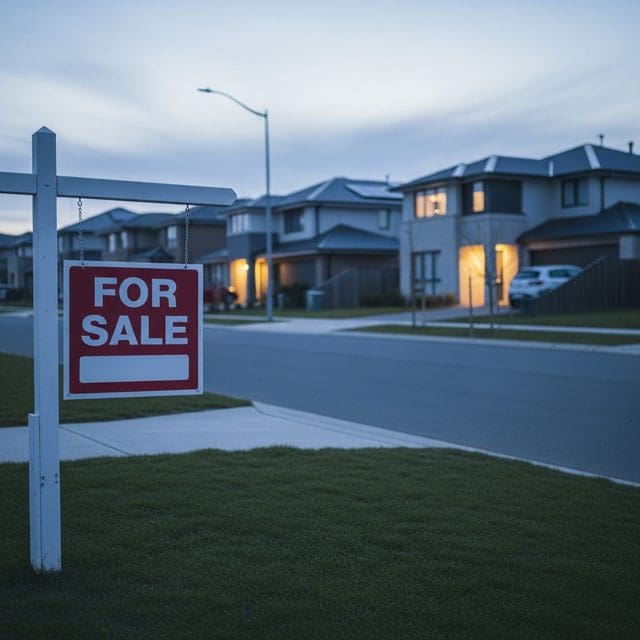
Rising interest rates and tax policy reversals are cooling housing markets in Australia and India, while vulnerable populations in Victoria face mounting mental health and homelessness crises.
The global housing market is entering a period of significant correction as the era of cheap credit vanishes, replaced by a volatile mix of high interest rates and shifting tax policies. In Australia, national dwelling prices fell 0.7% in July, marking the sharpest monthly decline since late 2022. This downturn, led by 5% year-to-date drops in Sydney and Melbourne, reflects a broader cooling as the Reserve Bank of Australia (RBA) maintains a restrictive monetary stance despite the emerging price slide. While the RBA reports that fewer than 1% of borrowers are currently in negative equity, the psychological and financial floor of the market is being tested. The national median home price has retreated to approximately A$928,000, roughly A$19,000 below the peak seen in March.
Market analysts attribute this cooling not only to the 4.35% cash rate but also to recent reversals in negative gearing and capital gains tax concessions. These policy shifts, intended to address long-term affordability, have dampened investor confidence and lowered auction clearance rates. In Sydney, median house values remain above A$1.5 million despite these recent declines, but the momentum has clearly shifted. The RBA is expected to hold rates steady through the remainder of 2026, even as market risks remain skewed to the downside and the ongoing conflict in the Middle East adds a layer of global inflationary pressure that complicates the domestic recovery.
In Victoria, the human cost of housing instability is becoming increasingly visible. A new report highlights a disturbing trend where young homeless individuals are being forced into hospital settings during mental health crises due to a lack of stable, supportive housing infrastructure. While Victoria’s housing prices grew a modest 4.1% in the year leading to March 2026—trailing the growth seen in New South Wales—the current market chill is hitting a region already struggling with social service capacity. Advocates are now calling on political leaders to prioritize housing-first solutions to prevent the medicalization of homelessness, noting that the lack of affordable rentals is driving the most vulnerable into emergency departments rather than stable homes.
Across the globe, the residential development landscape is shifting in response to these pressures. Lodha Developers is aggressively expanding into India’s National Capital Region (NCR), targeting a pilot housing project in Gurugram for late 2027. This move, part of a broader strategy to monetise assets and diversify into high-growth corridors, comes as developers seek to navigate a global environment defined by higher borrowing costs. Lodha has secured two joint-development projects in the NCR with a gross development value of approximately INR 29.5 billion, signaling that even as the secondary market cools, institutional capital is still betting on long-term infrastructure and residential demand in emerging hubs.
For the American observer, these international trends serve as a cautionary tale regarding the intersection of central bank policy and local sovereignty. As the Federal Reserve left U.S. interest rates unchanged in late July, the persistent cost-of-living crisis remains tethered to the availability and affordability of shelter. The U.S. domestic situation is further complicated by geopolitical volatility; despite a temporary ceasefire in Lebanon and a brief drop in oil prices following the reopening of the Strait of Hormuz, the expansion of regional conflict has kept markets on edge. Whether in Melbourne or the American Midwest, the fundamental challenge remains: balancing market-driven growth with the fiscal responsibility required to keep the dream of homeownership within reach of the working class while protecting the most vulnerable from the fallout of bureaucratic overreach.

Deborah Cole serves as a Senior Correspondent for Just Right News, where she spearheads the network’s coverage of Housing, Infrastructure, and Mobility. With a career defined by a commitment to rigorous reporting and a focus on the fundamental pillars of American community life, Deborah brings a principled perspective to the complex issues that dictate how and where we live. Her work is grounded in the belief that sound policy, fiscal responsibility, and respect for private property are the essential foundations of a prosperous society.
Originally from Boston, Massachusetts, Deborah’s upbringing in one of the nation’s oldest and most historically significant cities deeply influenced her professional trajectory. Growing up amidst the architectural legacy and dense urban planning of New England, she developed an early appreciation for the importance of durable infrastructure and the role of local tradition in shaping neighborhoods. Her perspective is informed by the classic American values of her hometown—hard work, community cohesion, and a healthy skepticism of top-down bureaucratic mandates that often overlook the unique needs of individual citizens.
Today, Deborah operates from her base in Austin, Texas, a city that serves as a primary laboratory for her reporting. Austin’s rapid expansion and its status as a hub for innovation and migration provide her with a front-row seat to the most pressing challenges in modern infrastructure and housing. From the Lone Star State, she chronicles the tensions between rapid growth and the preservation of the American Dream, often highlighting how market-driven solutions and deregulation can address the housing shortages that plague many of the country’s metropolitan areas.
At Just Right News, Deborah is perhaps best known for her signature feature series, “Where We Live.” Through this platform, she explores the intersection of public policy and private life, moving beyond mere statistics to tell the stories of families, small business owners, and local developers. Her reporting frequently highlights the importance of mobility—not just in terms of transportation and transit, but as a vehicle for economic opportunity and social stability. She remains a staunch advocate for the taxpayer, consistently scrutinizing government spending on large-scale projects and advocating for transparency in how infrastructure dollars are allocated.
Deborah’s beat is more than just a collection of policy topics; it is an investigation into the physical and legal structures that allow families to flourish. Whether she is reporting on the impact of zoning laws on suburban development or the necessity of maintaining the nation’s highway systems, her work is characterized by a dedication to the facts and a respect for the constitutional principles that protect the rights of homeowners.
As a Senior Correspondent, Deborah Cole continues to be a vital voice for Just Right News, providing the audience with the clarity and context needed to navigate an ever-changing landscape. Her reporting ensures that the values of individual liberty and local sovereignty remain at the forefront of the national conversation regarding the future of our cities and towns. Through her tireless efforts, she remains committed to informing the public on the issues that hit closest to home.